It closes veins.
A sclerosant injected into a vein damages its lining.
Sclerotherapy: A solution injected with a fine needle into spider veins on the legs, which irritates the vein lining so the vein closes and is absorbed. It takes several sessions, and a brown line often marks the treated vein for months afterward.
V-Beam: A laser tuned to the color of blood. It fades facial redness, broken vessels, rosacea flushing, port-wine stain birthmarks and some red scars. The thing to plan around is whether your settings will bruise the skin or not.
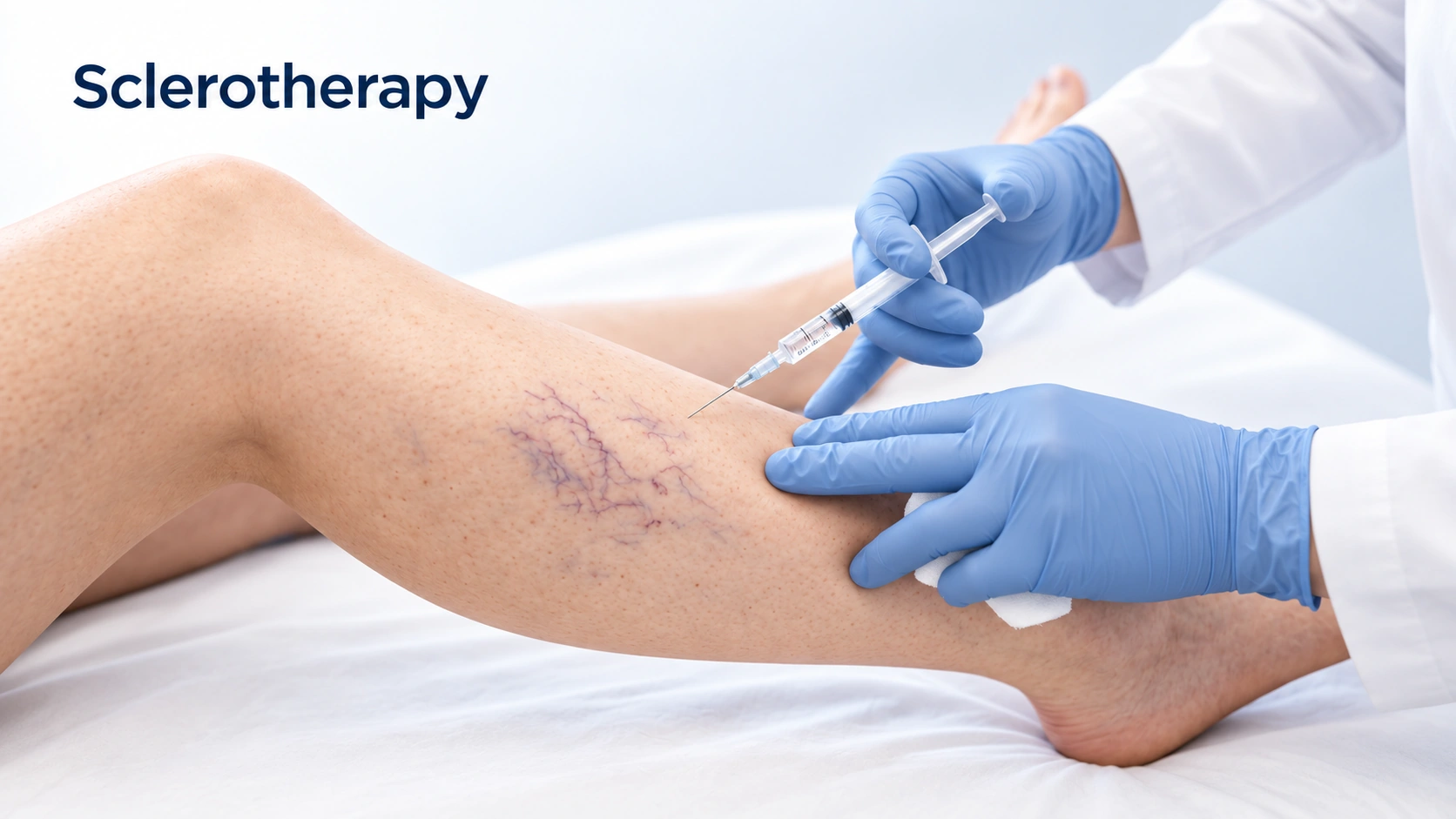
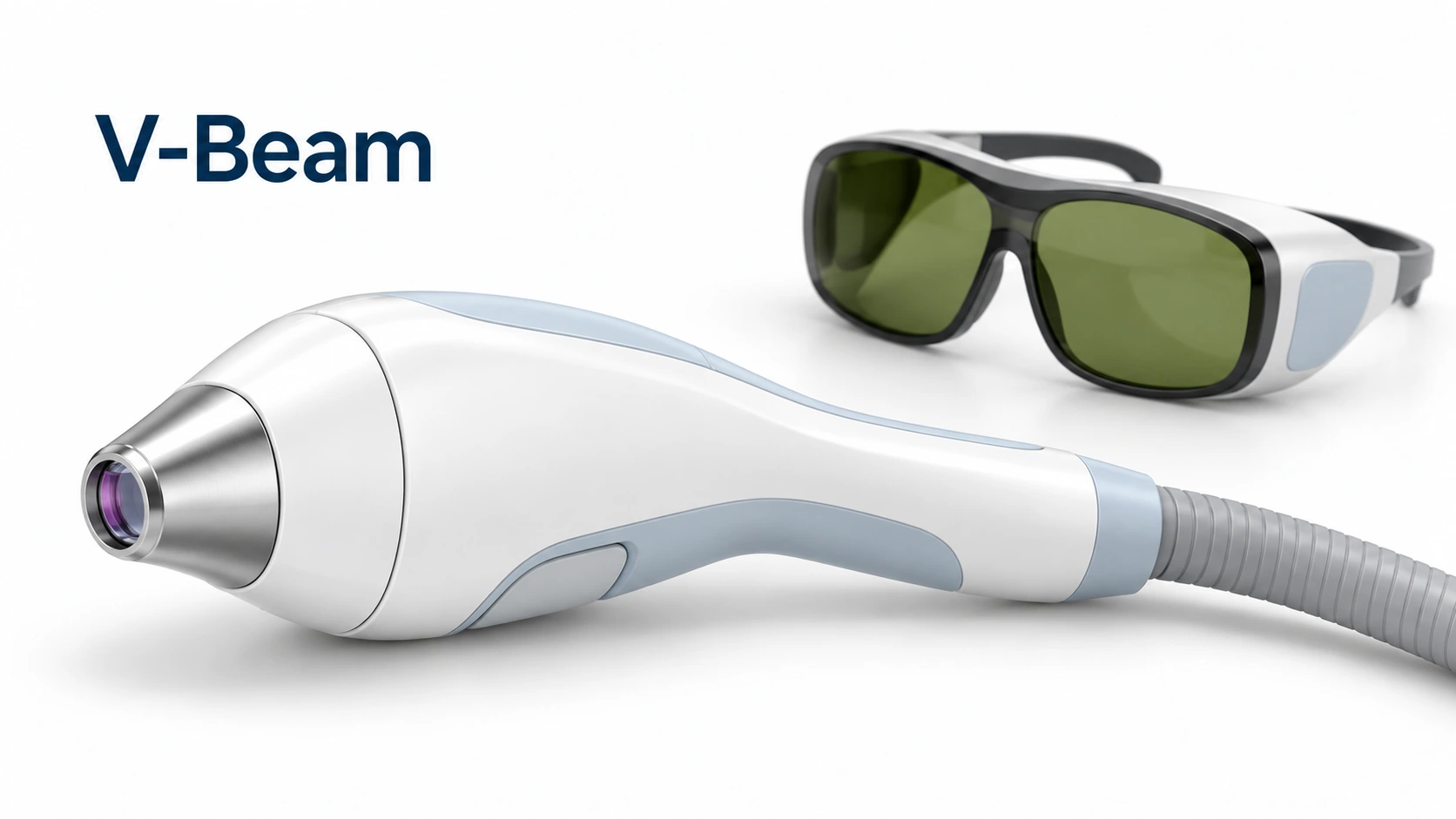
Choose for spider veins on the legs — several sessions, and brown marks along treated veins can last months.
Choose for facial redness, broken vessels, port-wine stains or red scars — plan around whether your settings will bruise.
Can you have both?
They suit different vessels. Sclerotherapy treats leg veins; V-Beam treats facial redness and fine vessels.
A sclerosant injected into a vein damages its lining.
It is gradually replaced by fibrous tissue.
Small visible veins and underlying reflux are treated differently.
Previous clots, circulation problems and pregnancy should be discussed.
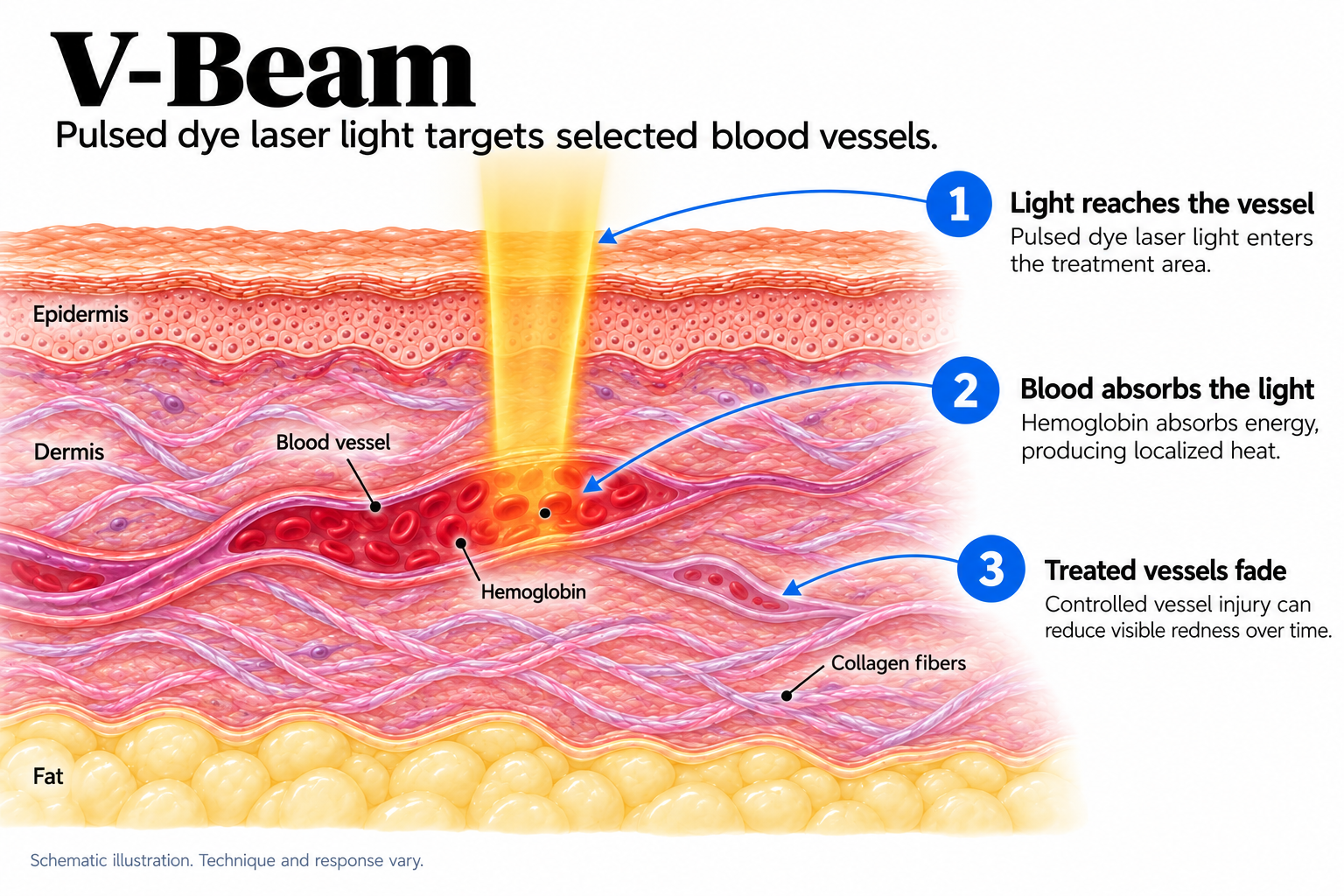
Brief pulses of visible light are absorbed by hemoglobin in blood vessels.
It is used for vascular lesions, persistent redness and some red scars.
The diagnosis should be confirmed first.
Prior pigment changes, scarring and tanning affect safety.
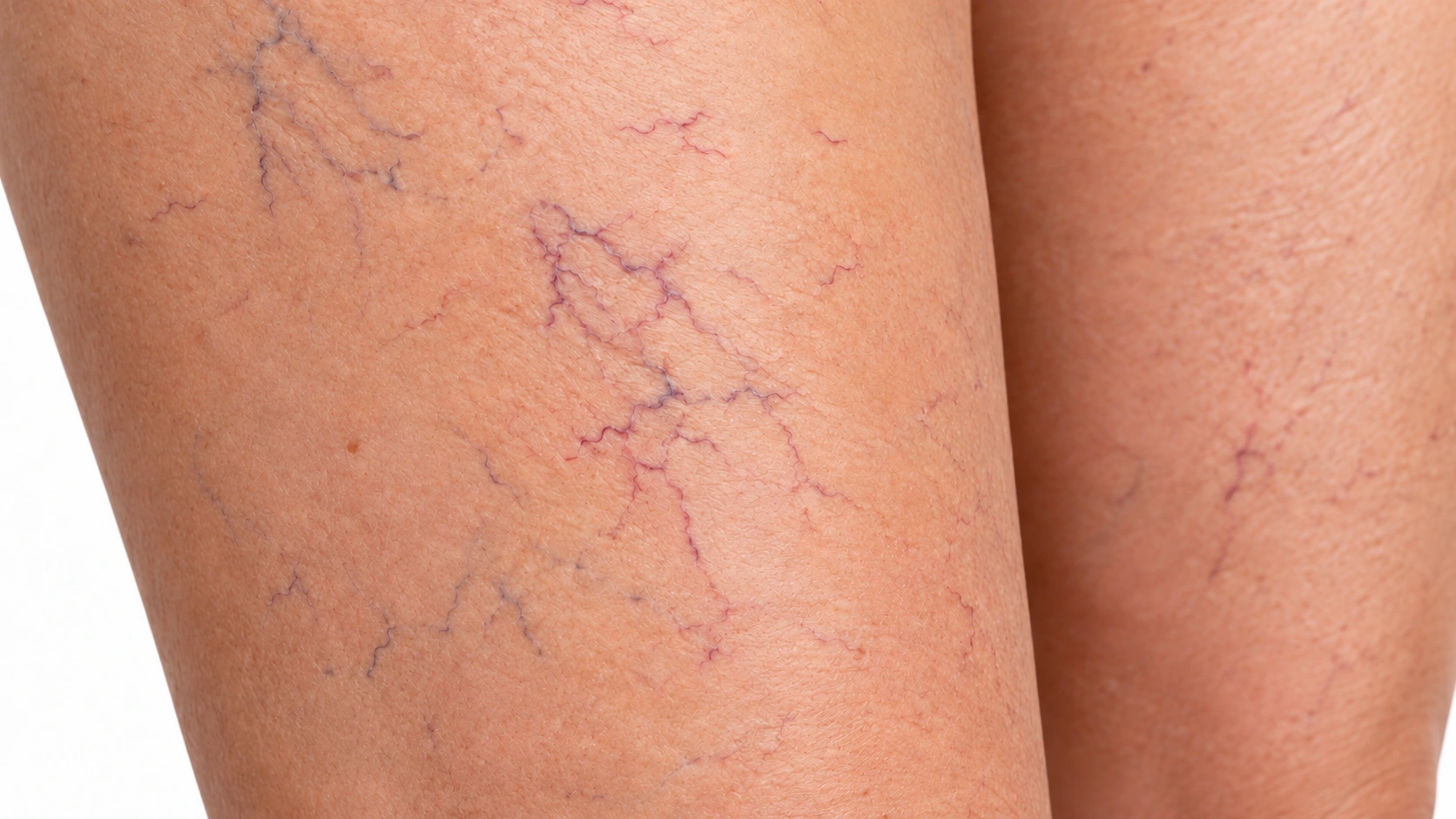
Clears leg veins.

Reduces redness and vessels.
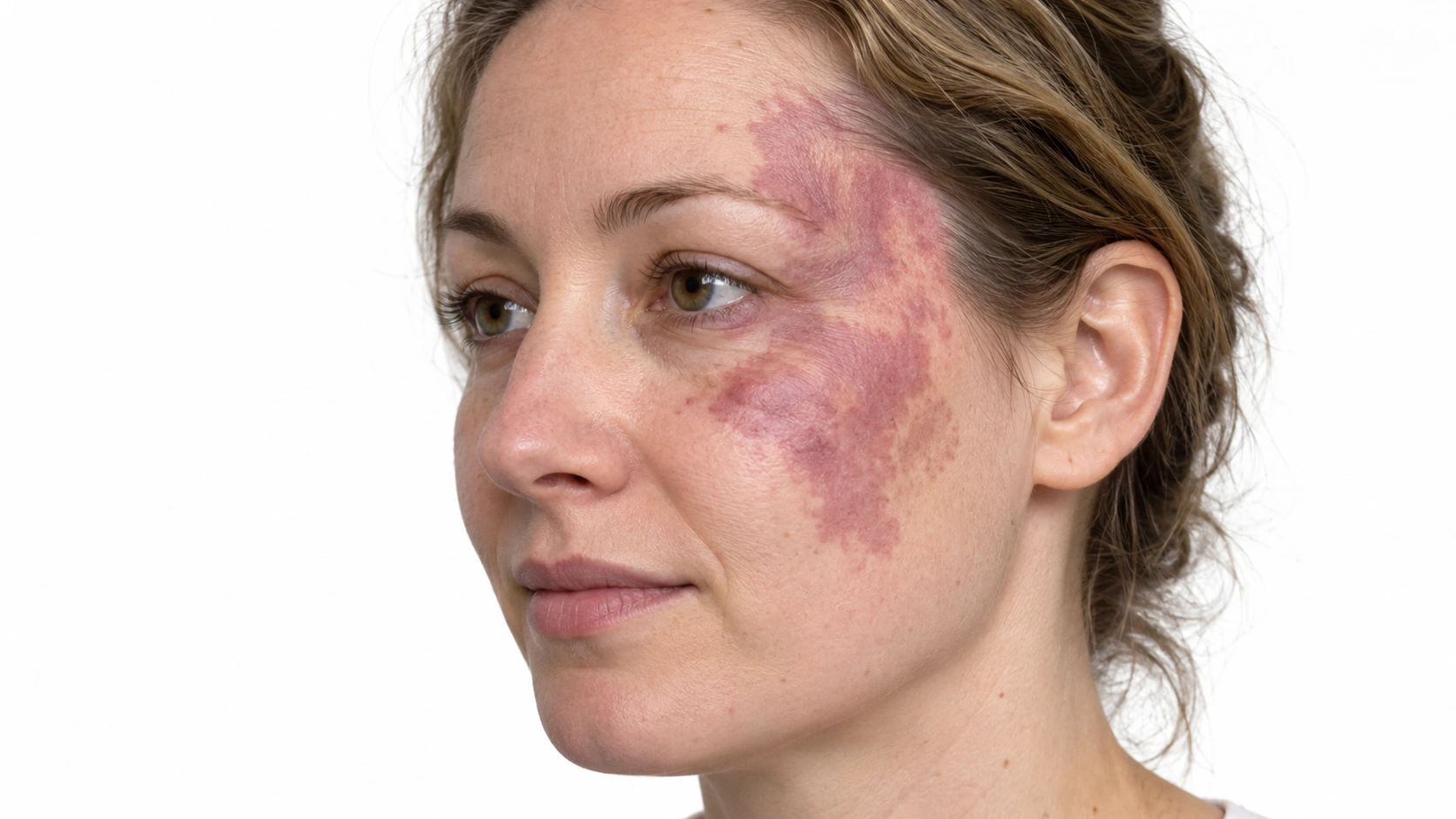
The standard treatment.
Clears facial vessels.
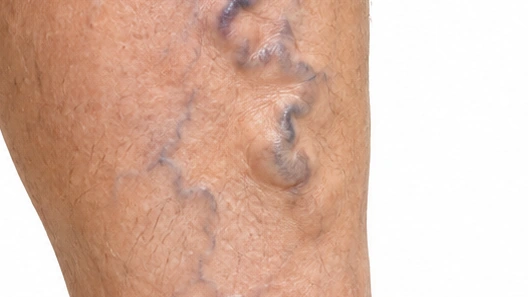
Treats small varicose veins.
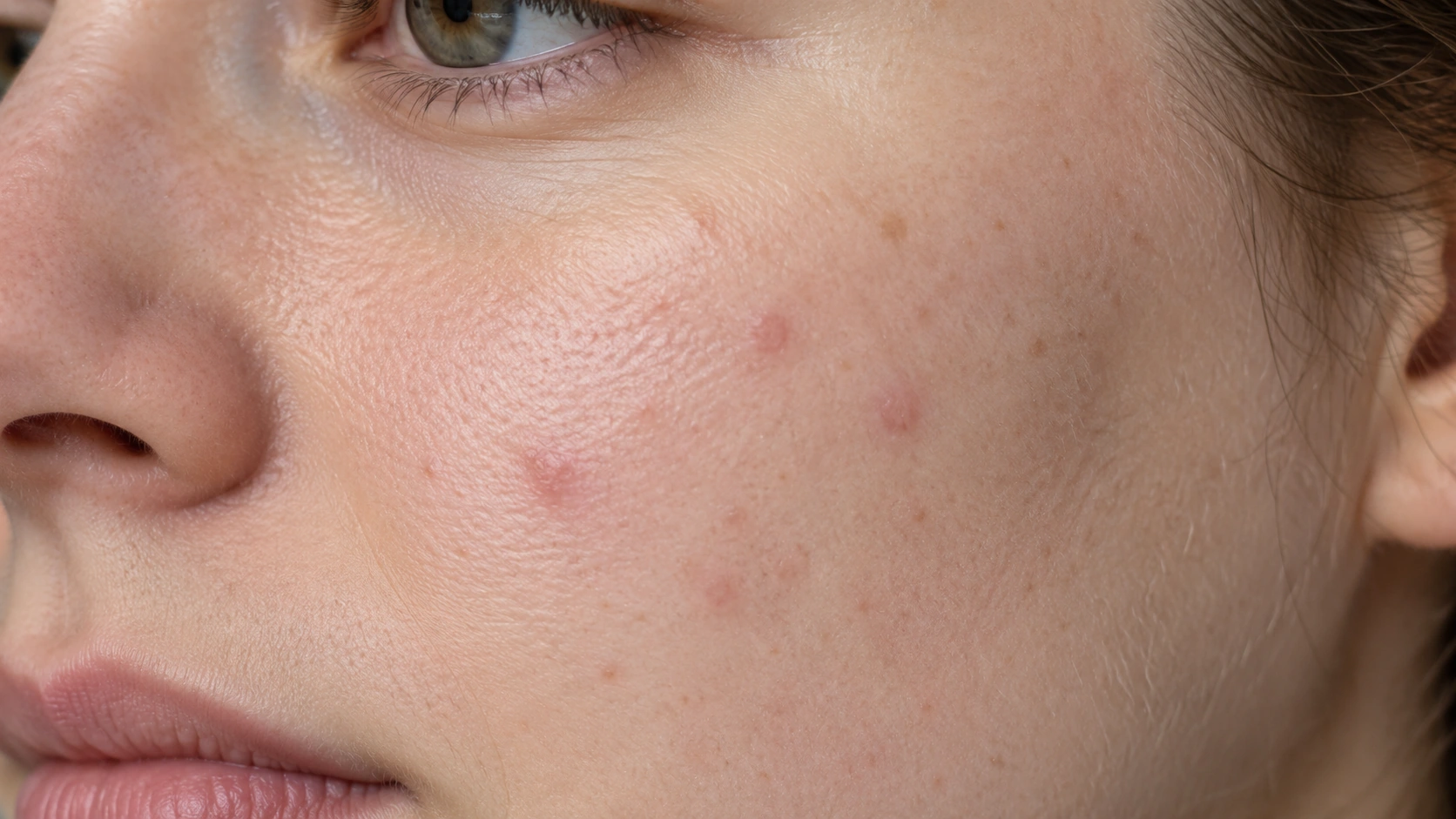
Fades red marks.
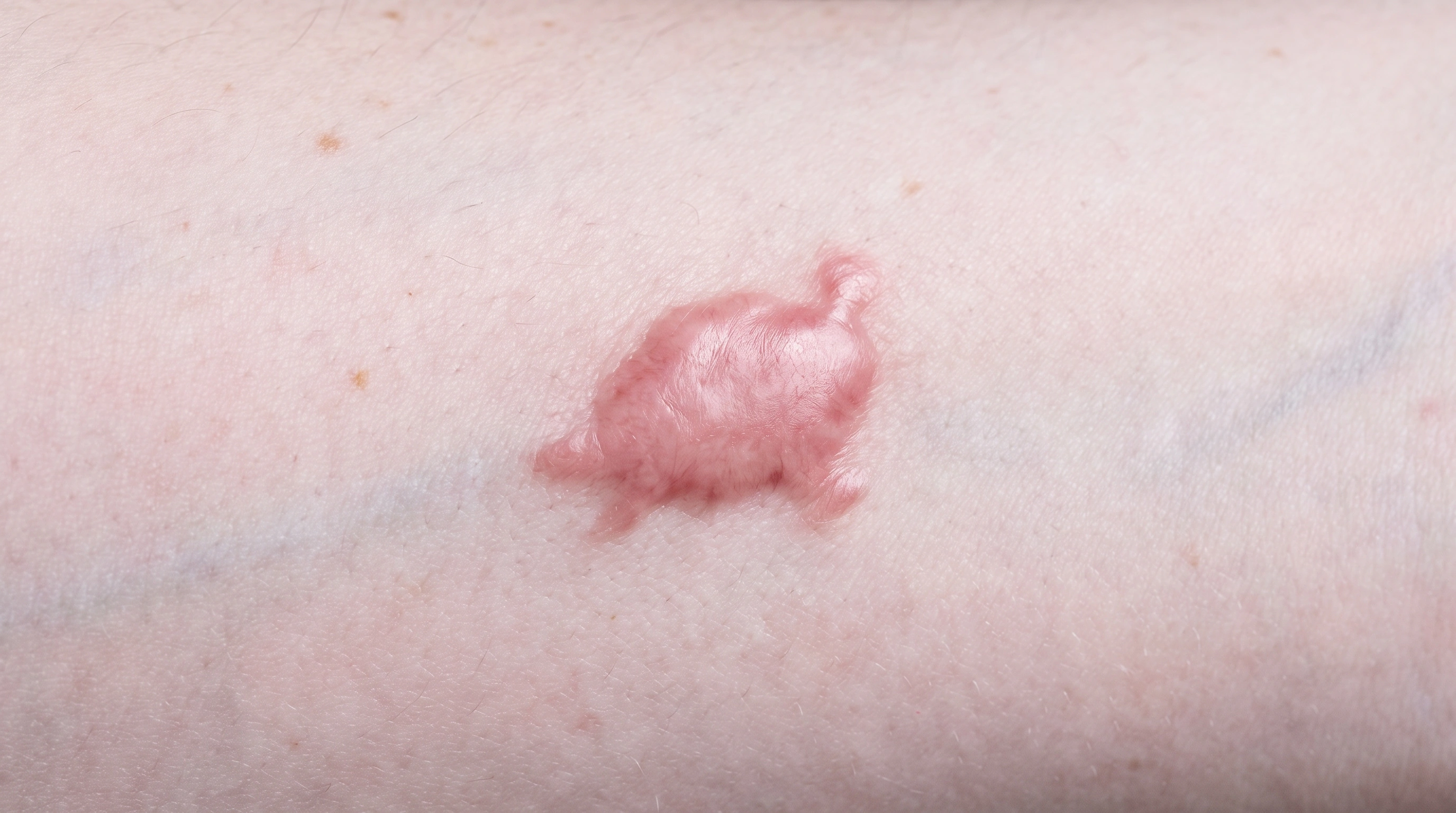
Reduces redness and itch.
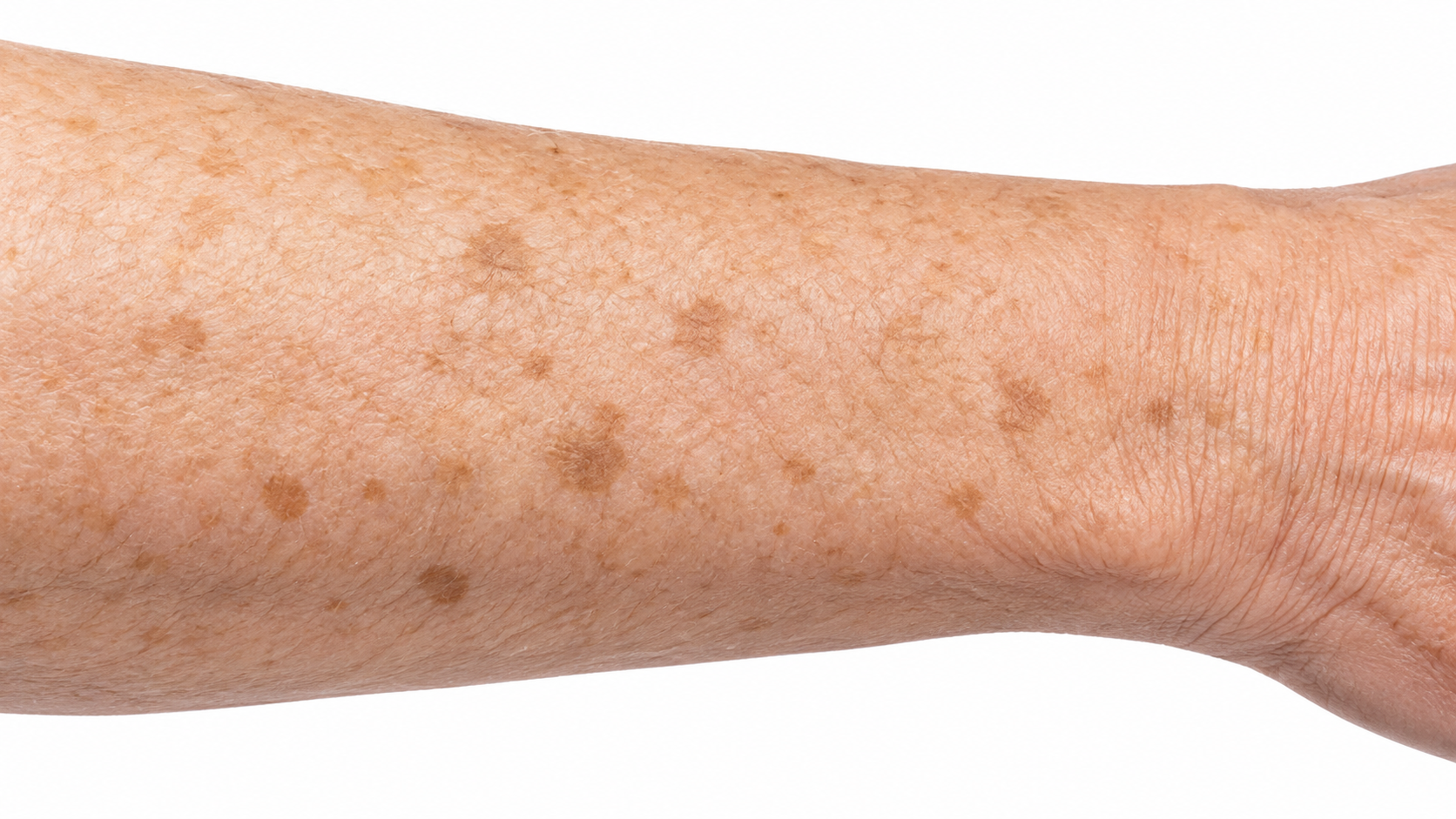
Other lasers work better.
Not used on the face.
Lasers are used instead.

Doesn't target pigment.
Leg veins.
Face, neck and chest; the selected vessels or lesions determine the treatment field.
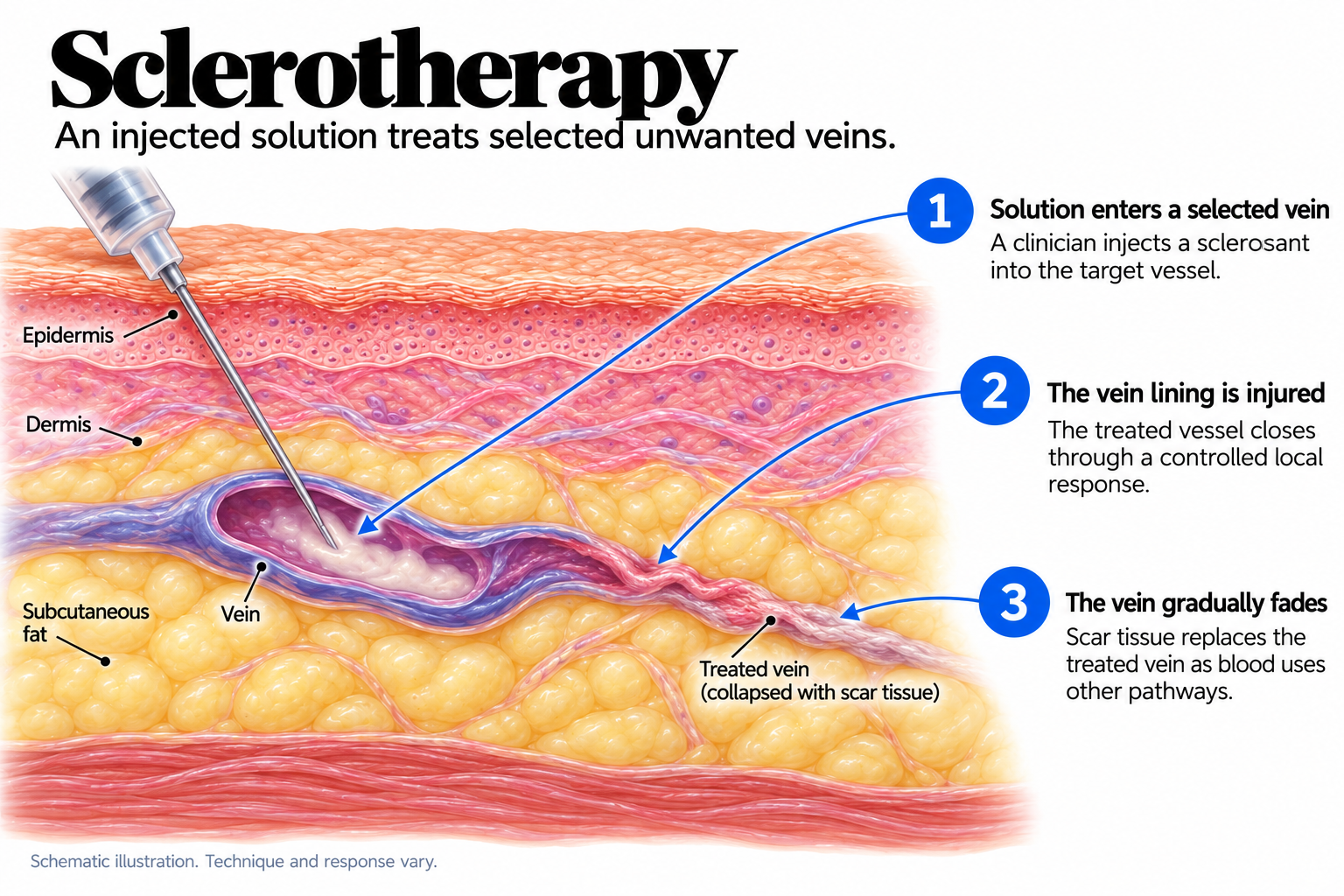
Solution enters a selected vein: A clinician injects a sclerosant into the target vessel. The vein lining is injured: The treated vessel closes through a controlled local response. The vein gradually fades: Scar tissue replaces the treated vein as blood uses other pathways.
Schematic illustration. Technique and response vary. This explains a mechanism and does not specify treatment settings.
Light reaches the vessel: Pulsed dye laser light enters the treatment area. Blood absorbs the light: Hemoglobin absorbs energy, producing localized heat. Treated vessels fade: Controlled vessel injury can reduce visible redness over time.
Schematic illustration. Technique and response vary. This explains a mechanism and does not specify treatment settings.
2 weeks before: Sun: Avoid sun and sunbeds on your legs for a couple of weeks before and after.
4 weeks before: Sun and tanning: Avoid sun, sunbeds and self-tanner on the area.
Before you book: Events: If bruising would be a problem, say so before the first pulse — it changes the settings.
1 to 2 days before: Shaving: Shave your legs a day or two before, if you shave.
Actives and hair removal: Stop retinoids, benzoyl peroxide and exfoliating acids 3 to 5 days before.
Actives and hair removal: Stop waxing, threading and hair removal creams.
Clean, dry skin: Tape and dressings need clean, dry skin.
What to bring: Stockings and clothes: Buy the compression stockings your provider recommends beforehand.
Clean skin: Clean skin, no makeup.
Your legs are examined standing up, when veins fill, and photographs are usually taken.
Skin is cleaned and photos usually taken.
You lie down, the skin is cleaned, and the provider works along the leg injecting small amounts into each vein, often using magnifying glasses or a vein light.
A session runs about 15 to 45 minutes. Each injection stings for a second or two, sometimes with brief cramping along the vein.
You wear opaque eye shields, with metal shields under the eyelid near the eye.
The handpiece fires overlapping pulses, each preceded by cold gas, with a snapping sound and a smell of cold. Nose and cheeks take a few minutes, a full face 10 to 20 minutes. Each pulse is like a hot rubber band snapped on the skin: sharp, brief, worst on the nose and upper lip.
Stockings or wraps go on before you stand, and you walk for fifteen or twenty minutes.
Warm, red and slightly swollen, like mild sunburn.
Days 1 to 14: Small red welts, itching and mild aching along the treated veins.
Days 1 to 3: Swelling is worst the morning after and settles over two to three days, with cheeks and under-eyes puffing most.
Days 3 to 14: Purple turns brown, then green, then yellow, then goes.
Weeks 3 to 8: The veins fade and most bruising resolves.
Weeks 2 to 8: Once the bruise clears, the change from the session becomes visible.
Months 2 to 12: Brown staining fades slowly, and most clears within six to twelve months.
1–3 months
1–4 weeks per session
Treated veins are gone; new ones can appear
Months to years; new vessels can form
In the US a session usually runs about $300 to $600, priced per leg or per block of time rather than per vein.
In the US, a pulsed dye laser session for the face usually runs $300 to $700, and small single-area treatments such as one cherry angioma or a few nose vessels can be less.
Ask what a session includes, whether the price covers both legs, and whether a follow-up visit to release trapped blood costs extra.
Insurance almost never covers laser treatment of rosacea redness or facial vessels — it is classified as cosmetic.
Usually two to four per leg, four to six weeks apart, and stubborn veins sometimes need injecting more than once. Extensive veins need more. Expect a course, plus touch-ups every year or two as new veins appear.
Blood trapped in the closed vein breaks down and leaves iron in the skin. Most fades over six to twelve months, and sun makes it darker and slower to clear. It is more visible and slower to fade on deeper skin tones. If a firm tender lump forms, having it released in the office speeds the fading.
A patch of very fine new red vessels where a vein was treated, usually within a few months. It happens to a minority, often fades on its own over months, and occasionally needs further injections or laser.
No. Ropey bulging veins need a vein specialist, an ultrasound to find the source, and usually a procedure that closes the larger vein with heat, glue or ultrasound-guided foam. Treating the spider veins on top is why some people see them return quickly.
Each injection stings for a second or two, sometimes with brief cramping along the vein. Dozens in a session make it repetitive rather than severe. Afterward, aching and itching for a few days.
Usually yes, for the first week or two. Bruising, raised red lines and brownish streaks are the normal middle stage. Judge the result months after the course finishes.
Only if the laser is set to give you one. Purpuric settings burst the vessel and leave a purple bruise for 7 to 14 days, and generally clear more per session. Non-purpuric settings leave you pink and slightly swollen for a day or two and need more sessions. Decide before the first pulse.
It treats part of it. Visible vessels and the background flush respond well. The bumps and pus spots do not, and those need creams or tablets. Most people with rosacea use both.
For facial redness, usually 3 to 5, spaced 4 to 8 weeks apart, then a top-up every year or two. A few isolated broken vessels may need only one or two. Port-wine stains take many more, over years.
It is used on deeper skin tones, with lower energy, longer pulses and more cooling, often with a test spot first. The risk of a light or dark patch is higher than on fair skin, so many providers choose a 1064 nm Nd:YAG instead, because that wavelength is absorbed much less by pigment.
Usually, gradually. The laser clears the vessels that are there; it does not stop new ones forming or change the rosacea underneath. Most people return for maintenance every one to two years, and sunscreen and prescription creams stretch that out.
No. This wavelength is aimed at blood, not pigment. Melasma can even be provoked by heat and light, so if pigment is your main concern this is the wrong device.