PRODUCT REVIEW
CeraVe Vitamin C Serum
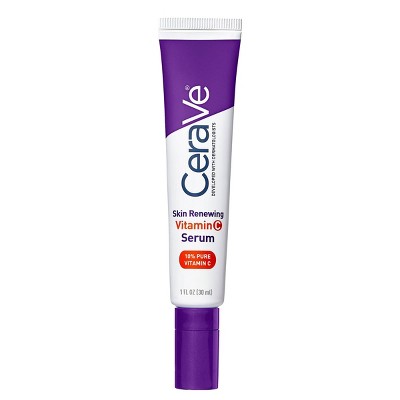
A 10% pure L-ascorbic acid serum with ceramides, in an opaque pump. It gets form, dose and packaging right, for about $24.
Key facts
CeraVe Vitamin C Serum at a glance.
L-ascorbic acid 10%
Key active
Lightweight cream-gel
Texture
Anyone starting vitamin C; sensitive skin
Best for
$20–$25
Approximate price
Fragrance free
Fragrance
1 oz
Size
$28.99
Price
Serum
Type
What is it?
Top things to know about CeraVe Vitamin C Serum
- CeraVe Vitamin C Serum is a fragrance free antioxidant serum for the face, in an opaque tube with a pump, about $20 to $25 at drugstores. It is a daily antioxidant and brightening step, not an exfoliant and not a moisturizer, and CeraVe says plainly it is not for the eye area.
- The active is 10% L-ascorbic acid, pure vitamin C rather than a derivative. It needs a low pH to get into skin, and low pH is mildly irritating, which is why the base carries ceramides, cholesterol and phytosphingosine, the fats that hold the surface layer together.
The vitamin C serum to start with. It uses 10% pure L-ascorbic acid, the form with decades of evidence, in an opaque pump that keeps air out — and air is what turns vitamin C useless. Replace it once it darkens to orange. Keep it away from the eye area.
— Dr. Schwarz
Skin fit
Is it right for your skin?
Sun Damage
Ultraviolet light damages skin partly by creating free radicals, unstable molecules that tear at collagen and cell membranes. An antioxidant donates an electron and stops that chain. Vitamin C is the best-studied one for skin, and this runs it at 10%, inside the range where the evidence holds. It goes under sunscreen, not instead of it.
Hyperpigmentation
Melanin is built by an enzyme called tyrosinase. Vitamin C interferes with it, so less new pigment is made while marked cells at the surface shed on their own schedule. Expect slow, even brightening rather than spot removal, over months.
Post-Inflammatory Hyperpigmentation
The brown mark left by a healed spot is pigment dropped during the inflammation. Vitamin C slows fresh pigment production and soaks up some of the free-radical damage keeping the area inflamed. The ceramides help on skin that is still recovering.
Sensitive Skin
Pure vitamin C stings, and 10% is the gentler end of the effective range. Ceramides and cholesterol support the barrier in the step that stresses it. Try this L-ascorbic acid serum first; if it still burns, the form is wrong for you, not the brand.
Texture
What it feels like on skin.
Serum
Thicker than the word serum suggests. The silicone-heavy base feels like a light cream rather than water. It spreads easily and sinks in within a minute, leaving a slippery finish that can pill if you rub sunscreen on before it dries. It stings for the first minute — that is the low pH, not a bad bottle. The opaque pump keeps air out. If what comes out has turned orange, the vitamin C has oxidized. Replace it.
Troubleshooting
If it didn’t work for you.
If it pills
Try thisWait a full minute before the next layer, and use less. The silicone base is the reason.
Alternatives
If this isn’t the right product for you
Timeless Vitamin C
The same 10% L-ascorbic acid at a similar price, without the ceramides.
L'Oréal Paris Revitalift 10% Pure Vitamin C Face Serum
10% pure L-ascorbic acid in an opaque tube for under $30. Form and packaging both right.
Paula's Choice BOOST C15 Super Booster
15% L-ascorbic acid with vitamin E and ferulic acid in opaque packaging, the closest here to the classic clinical formula. It costs more.
Ingredients · Interactive
What’s in it, and where each ingredient works.
Full ingredient list · 26 ingredients, in label order. Click one.
The base the other ingredients are dissolved in. Most of it evaporates soon after the product goes on.
A small humectant. It moves into the outer layer of skin and holds water there.
A silicone that smooths the surface and adds to the protective film.
One of the main fats between skin cells in the outer layer. It helps refill gaps in the barrier.
A second skin ceramide. It works with the others to rebuild the barrier.
A long-chain ceramide that helps the barrier fats stack into tight, orderly layers.
A thickener that gives the product its texture.
A fatty alcohol that softens skin and thickens the product. Despite the name, it is not drying.
An emulsifier that also helps the product spread and feel smooth.
A form of hyaluronic acid. Its molecule is large, so it stays on the surface and holds water there.
An emulsifier that helps hold the ceramides in the formula.
A barrier fat that works alongside ceramides. The barrier needs both to repair well.
The preservative. It stops bacteria and mold from growing in the product.
Binds minerals in the water so the preservative works better and the formula stays stable.
A thickener that keeps the texture even.
A building block skin uses to make its own ceramides.
Helps the preservative work and softens the feel of the product.
How to use it
How to use it.
How to apply it
- How muchA pea-sized amount for the whole face. Keep it out of the eye area.
- CarefulEase in at three mornings a week if your skin is reactive. Do not layer it with a copper peptide serum — copper and L-ascorbic acid cancel each other out.
What to expect
- What to expectNothing dramatic. Tone evens out over two to three months and dark marks fade slowly. Keep it away from heat, and replace it if it turns orange.
Questions
Common questions.
Is CeraVe Vitamin C Serum real vitamin C?
Yes. 10% pure L-ascorbic acid, the best-studied form.
Why does CeraVe Vitamin C Serum use an opaque pump?
It limits air and light, which keeps L-ascorbic acid from oxidizing.
Can I use CeraVe Vitamin C Serum around my eyes?
No. CeraVe says to avoid the eye area.
Is CeraVe Vitamin C Serum fragrance-free?
Yes.
Will CeraVe Vitamin C Serum sting?
It can, because L-ascorbic acid works at a low pH.
References
Sources.
- 1. Topical Vitamin C and the Skin: Mechanisms of Action and Clinical Applications (https://pmc.ncbi.nlm.nih.gov/articles/PMC5605218) — Peer-reviewed review confirming L-ascorbic acid promotes collagen synthesis, acts as a potent antioxidant, provides photoprotection, and brightens/reduces pigmentation, and that L-ascorbic acid is unstable (requiring low pH and protective formulation). Link
- 2. Topical L-ascorbic acid: percutaneous absorption studies (https://pubmed.ncbi.nlm.nih.gov/11207686/) — Landmark study showing L-ascorbic acid must be formulated at pH below 3.5 to penetrate skin, that percutaneous absorption depends critically on formulation, and that vitamin C derivatives (magnesium ascorbyl phosphate, ascorbyl-6-palmitate) did NOT raise skin ascorbic acid levels — backing the 'pure L-ascorbic acid vs. derivative' distinction. Link
- 3. Topical vitamin C: a useful agent for treating photoaging and other dermatologic conditions (https://pubmed.ncbi.nlm.nih.gov/16029672/) — Dermatologic review documenting the body of evidence that topical vitamin C promotes collagen synthesis, provides UVA/UVB photoprotection, and lightens hyperpigmentation — supporting the claim of decades of evidence for brightening, collagen, and antioxidant protection. Link
- 4. Ex vivo Cutaneous Absorption Assessment of a Stabilized Ascorbic Acid Formulation Using a Microdialysis System (https://karger.com/spp/article-abstract/17/6/298/295475/Ex-vivo-Cutaneous-Absorption-Assessmentof-a) — Demonstrates that an 8% L-ascorbic acid formulation penetrates human skin and builds a dermal reservoir, supporting that concentrations in the ~8-20% range are effective for delivering vitamin C into skin. Link
- 5. CeraVe Skin Renewing Vitamin C Serum (https://www.cerave.com/skincare/serums/skin-renewing-vitamin-c-serum) — Manufacturer page confirming the product is formulated with 10% pure Vitamin C and uses protective packaging designed to prevent oxidation and maintain performance. Link