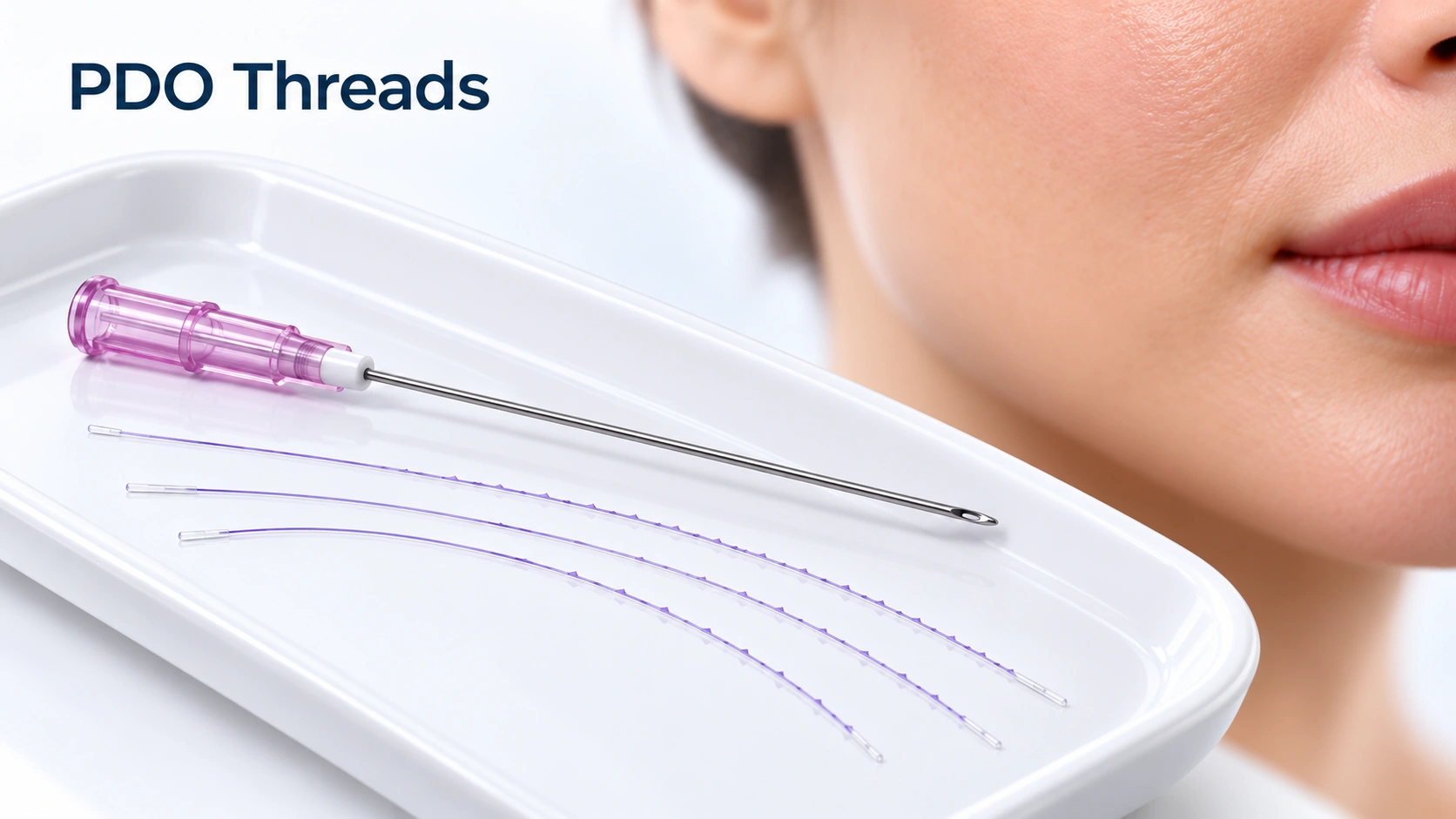
They are dissolvable threads.
Polydioxanone threads are placed beneath the skin.
PDO Threads: Dissolvable stitches placed under the skin to lift it a little and prompt some collagen. The lift is real but small, it lasts months rather than years, and it is not a substitute for a facelift.
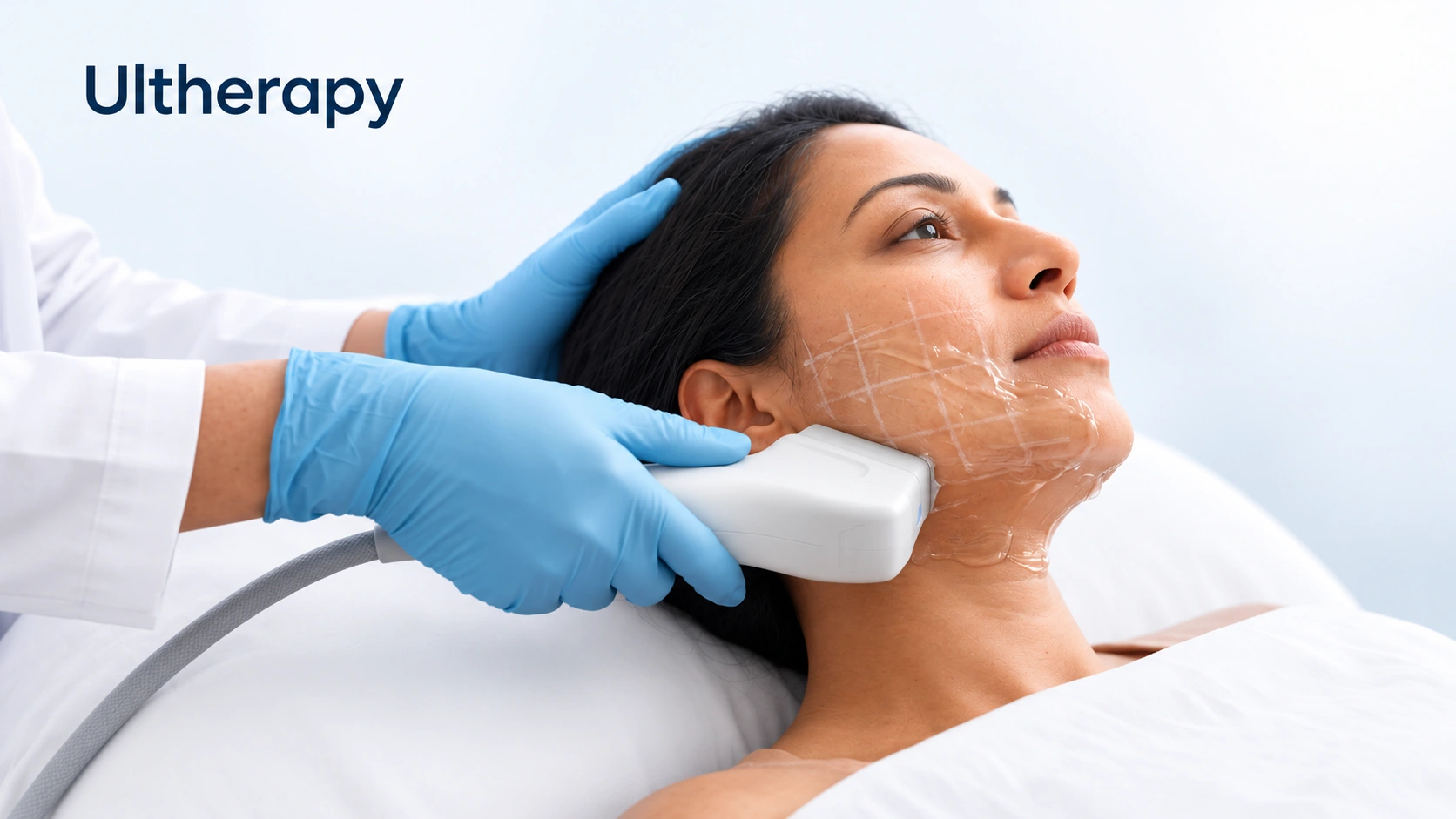
Ultherapy: Focused ultrasound delivered through the skin to heat small points in the deeper layers, so the body lays down new collagen over the following months. It gives a mild tightening of loose skin on the brow, jawline and neck. It is not a facelift, and the treatment itself is painful.
Choose for a small, temporary lift of mild sagging without surgery — not a substitute for a facelift.
Choose for a mild lift of the brow, jaw or neck without surgery or downtime — not a facelift, and the treatment hurts.
Can you have both?
Both are non-surgical lifts. Most people choose one; they are rarely combined in the same area.
Polydioxanone threads are placed beneath the skin.
They provide mechanical lift and a tissue response.
Results are not equivalent to surgery.
Infection risk and prior procedures should be discussed.
Ultherapy heats selected tissue depths under visualization.
It is used for selected concerns about loose skin.
It does not remove excess skin.
Energy placed in the wrong tissue can cause injury.
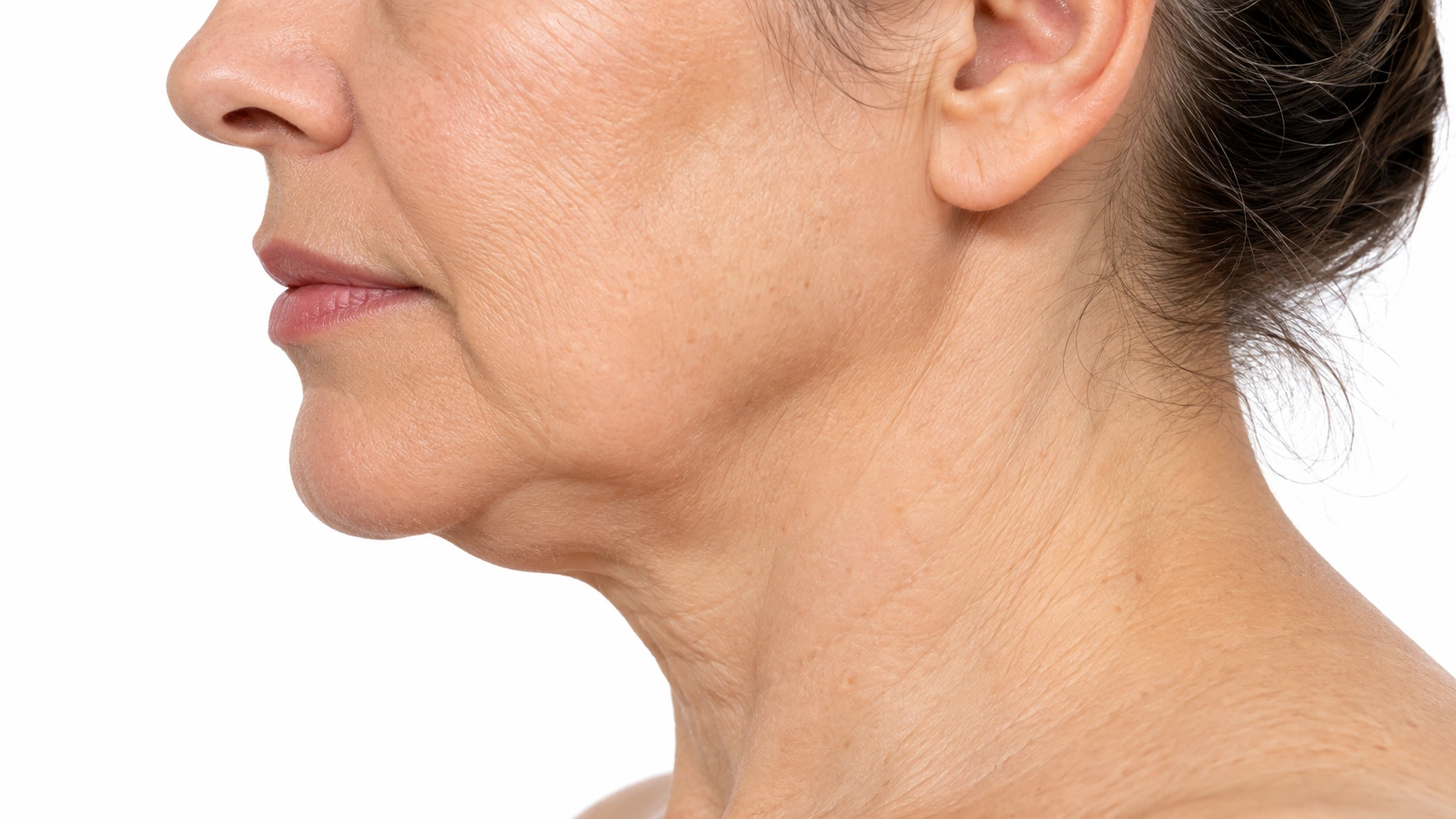
Mild lift of brow and jaw.
Mild, temporary lift.
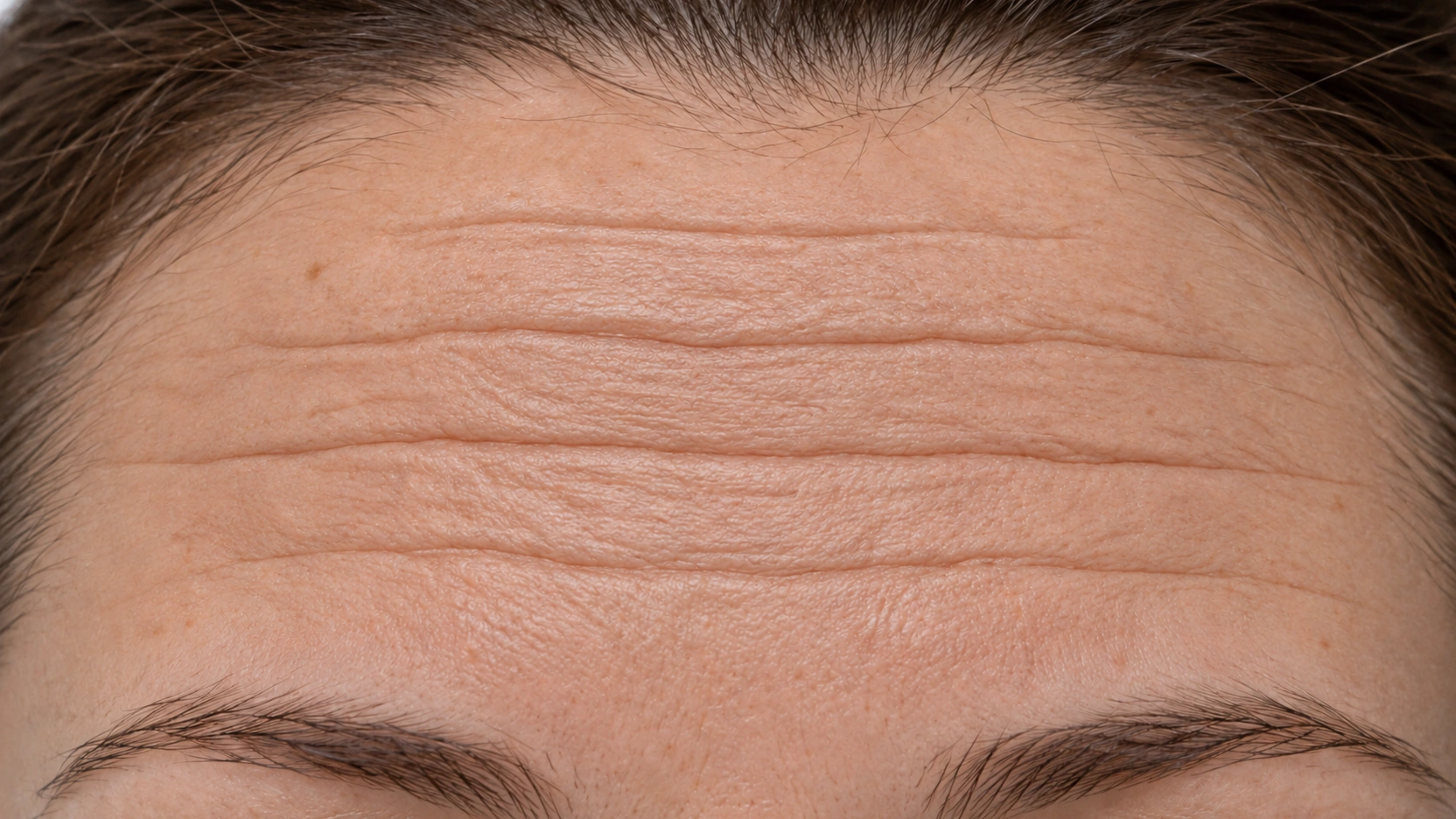
Little change on deep folds.
Limited change on deep folds.
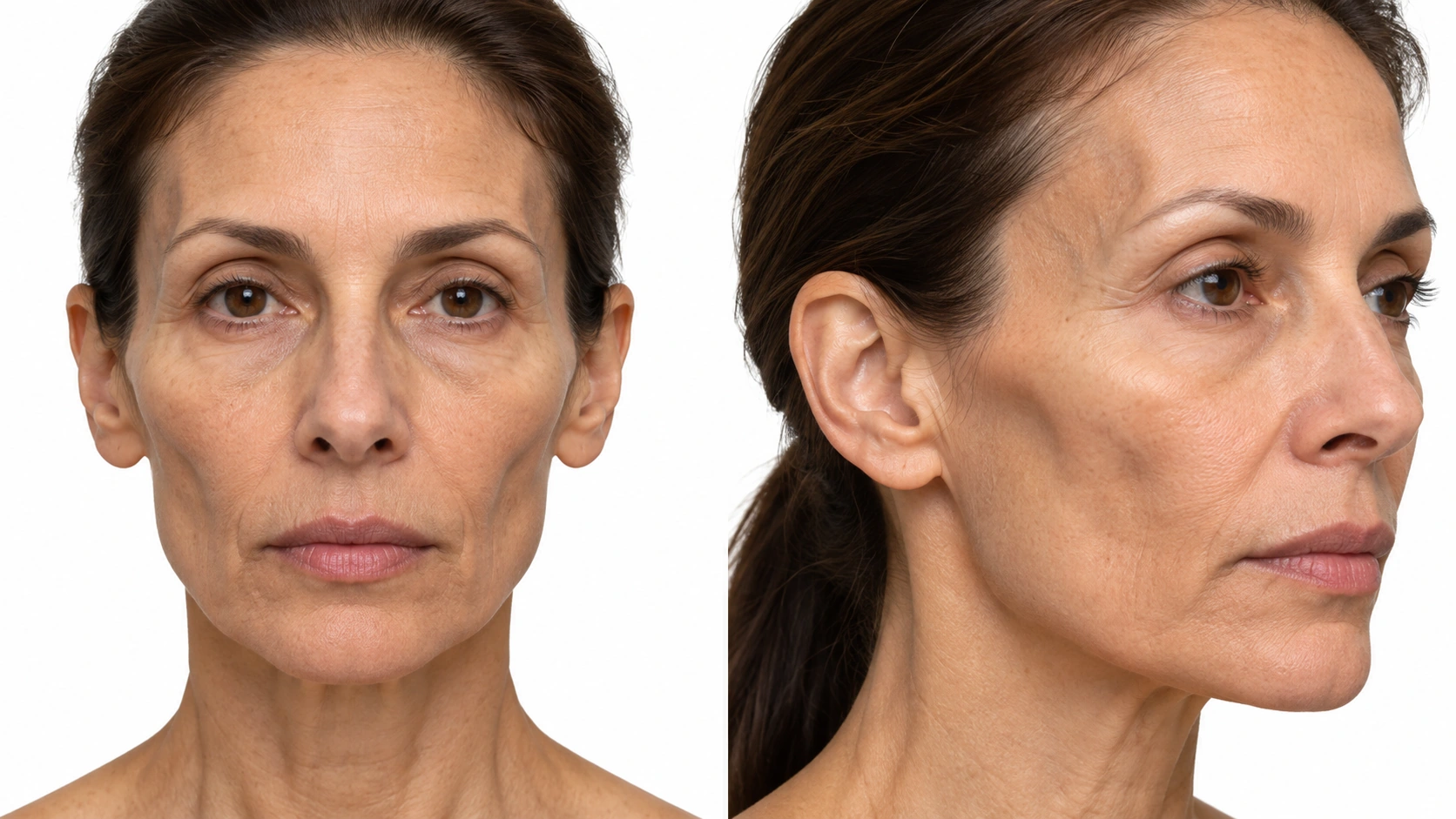
Doesn't add volume.
Doesn't add volume.

Doesn't change scars.
Selected areas of the face; placement follows the assessed lifting plan.
Brow, jawline and neck.
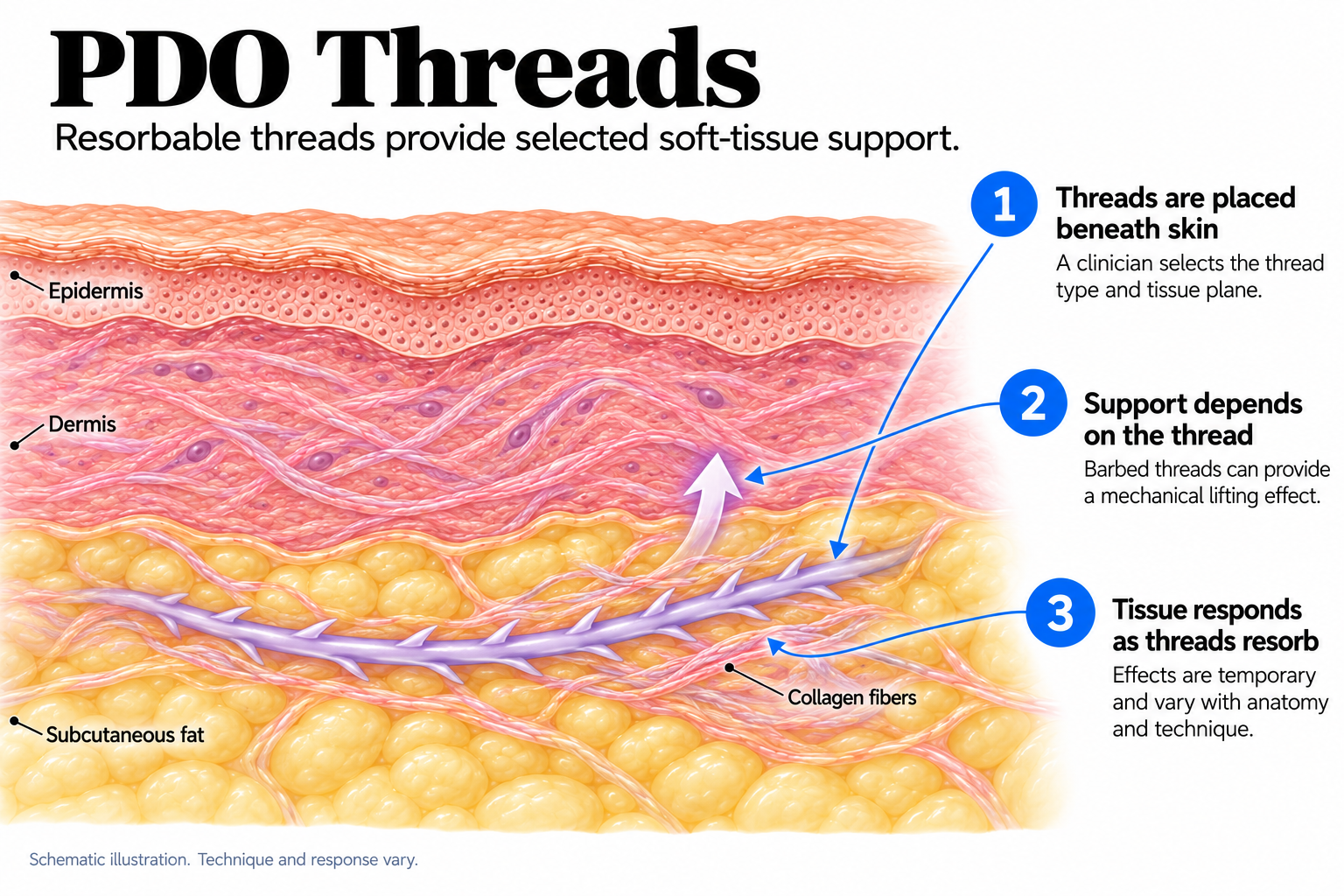

Threads are placed beneath skin: A clinician selects the thread type and tissue plane. Support depends on the thread: Barbed threads can provide a mechanical lifting effect. Tissue responds as threads resorb: Effects are temporary and vary with anatomy and technique.
Schematic illustration. Technique and response vary. This explains a mechanism and does not specify treatment settings.
Ultrasound locates tissue planes: Imaging helps the clinician view the treatment area. Focused energy creates heat points: Ultrasound concentrates energy at selected depths. Repair remodels support tissue: Collagen changes develop gradually; lifting effects vary.
Schematic illustration. Technique and response vary. This explains a mechanism and does not specify treatment settings.
2 weeks before: Events: Do not book this within two weeks of an event.
Before you book: Dental work and flares: Get dental work done first, since wide mouth opening is discouraged for a few weeks.
A few days before: Blood thinners and alcohol: Ask the prescribing doctor before pausing a blood thinner.
Until the visit: Skin care: Nothing to stop, and no pre-treatment cream needed.
Photos: Have photos taken sitting upright, in the light you will be reviewed in.
An hour before: Pain relief: Ask what is on offer.
You are assessed and marked sitting upright, because the face falls differently lying down.
Photos and a ride: Photographs first — the change is gradual and modest, so photos are the only reliable way to judge it.
Photographs are taken, areas marked, and the provider decides which depths and how many lines of energy each area gets.
Small entry points are made near the hairline or temple.
A needle or cannula carries each thread along a planned path, the thread is anchored, and tension is adjusted while both sides are checked. A face takes 30 to 60 minutes. You feel pressure, tugging and an odd crunching rather than sharp pain. Soreness starts once the anesthetic wears off.
Gel goes on and the handpiece is pressed to the skin.
The provider checks the imaging screen and delivers a line of energy: seconds of deep heat and sharp pain, then a pause. Swapping the transducer changes depth. Face and neck take 60 to 90 minutes, smaller areas about 30. It is worst over the jawbone and brow and stops when the treatment does.
Swollen and tight, with small marks at the entry points.
Skin is flushed and slightly swollen, sometimes with small raised lines along the path.
Days 1 to 7: Chewing, yawning and wide smiling are uncomfortable, and bruising at entry points is common.
Days 1 to 7: The area is tender to press and can ache when chewing if the jaw was treated.
Weeks 1 to 2: Small dimples and irregular lines along the threads usually smooth out.
Weeks 2 to 6: The over-lifted look relaxes into the actual result.
Weeks 1 to 4: Swelling gone, sensation returning, skin looking the way it did before.
Weeks 4 to 8: Remaining numbness or tenderness usually resolves.
Immediately
2–3 months, building to 6
6–12 months
About 1 year
In the US a full-face thread lift commonly runs about $1,500 to $4,500, and more in some cities.
In the US a single smaller area such as under the chin, the brow or the chest runs about $1,000 to $2,000, and a full face and neck about $2,000 to $4,500, varying a lot by city and practice.
Insurance does not cover it.
Insurance does not cover it.
A few millimeters, and less once swelling settles. Enough to soften an early jowl or lift a brow slightly in the right face. Not enough to change the outline of a face — anyone promising that is describing surgery.
The material dissolves in about four to six months. The visible effect usually lasts around six to twelve months, then fades gradually. Some firming from the collagen along the tracks remains after the lift has gone.
No, and that comparison is the main reason people are unhappy afterward. A facelift moves the deeper layer of the face and removes skin, under surgery, and lasts years. Threads gather skin along a stitch for months.
Under local anesthetic it feels more strange than painful — pressure and tugging. The days afterward are sore, especially chewing or yawning, and that usually settles within one to two weeks.
Both are recognized and both are fixable, but they need the provider who placed them. Dimples in the first two weeks usually settle on their own. A thread poking through, or a dimple still there at two weeks, should be reported rather than waited out.
It depends what you are comparing them with. For mild early sagging, in someone who cannot or will not have surgery and understands it lasts under a year, they can be. For heavy jowls or a loose neck they are not, and the same money spent on volume or put toward surgery usually gives a result people are happier with.
Yes — one of the more painful non-invasive treatments, worst along the jaw and brow where bone sits underneath. The pain comes in bursts with each line of energy and stops when the treatment ends. Ask about pain control before booking: a painkiller beforehand, a nerve block, or a mild sedative.
A mild one. In somewhat loose skin it shows as a slightly crisper jawline and a small lift at the brow, visible in side-by-side photographs more than in the mirror. Heavy sagging does not respond.
Nothing for the first month, change from around two to three months, peak at about six. It then fades over roughly a year to eighteen months.
Not necessarily. Ultrasound devices differ in energy and design, and most cheaper machines have no imaging screen, so the operator cannot see the tissue layers. Ask what device is being used and who is operating it.
Rare, and reported — usually temporary weakness of a facial muscle or numbness recovering over weeks to months. It is the main reason to care who is holding the handpiece.
Yes, and one of the better energy options for deeper skin tones, because ultrasound is not absorbed by pigment the way laser light is. Settings do not change.