Acne
Clears severe and stubborn acne.
Accutane: A high-dose oral vitamin A drug for severe or scarring acne. It is the only acne treatment that can produce lasting remission after a fixed course. Mirvaso: A gel that narrows facial blood vessels to fade redness for about half a day. It treats color only, it does nothing for bumps, and in some people the redness returns worse as it wears off.
Choose for severe, scarring or stubborn acne that keeps coming back after other treatments. It is the only acne medicine that can give lasting remission after one course.
Choose to fade rosacea redness for a day or an event — it treats color only, not bumps.
Can you take them together?
Mirvaso treats facial redness and does not interact with Accutane. It can be used during a course for rosacea redness if your dermatologist agrees.
Compare uses by strength of evidence. Evidence level describes confidence in a benefit, not its size.




Reduces pore clogging: Helps normalize cell buildup inside follicles. Reduces acne bacteria: Less oil makes follicles less favorable for C. acnes. Makes less oil: Shrinks oil glands and reduces their oil output. Calms inflammation: Dampens immune responses involved in acne.
Oral isotretinoin mechanism overview. Reduced C. acnes is an indirect effect of a changed follicular environment, not antibiotic action. The complete mechanism is not known. Gland outline is conceptual, not a measured size reduction or permanent cure.
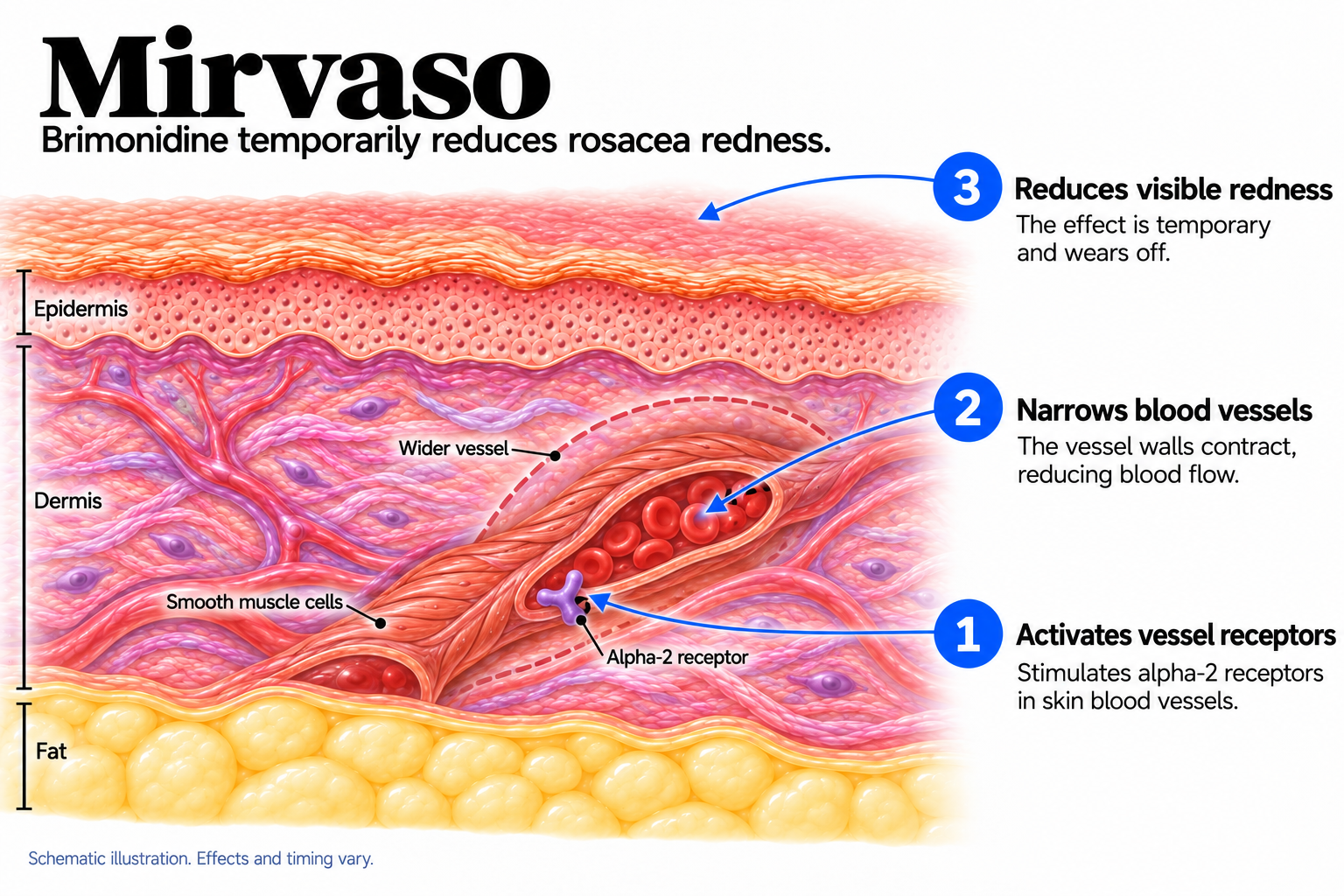
Activates vessel receptors: Stimulates alpha-2 receptors in skin blood vessels. Narrows blood vessels: The vessel walls contract, reducing blood flow. Reduces visible redness: The effect is temporary and wears off.
Brimonidine is a relatively selective alpha-2 agonist. This explains temporary vasoconstriction, not permanent removal of blood vessels or cure of rosacea.
Dose is set by body weight, and the total across the whole course matters more than any single day.
Starting dose: Often about 0.5 mg/kg a day, sometimes lower to ease into the side effects. Not the target.
Going up: Usually raised after the first month or two if blood tests and side effects allow, commonly to about 1 mg/kg a day.
Usual dose: About 0.5 to 1 mg/kg daily for most of the course.
Total course: Judged by cumulative dose, usually about 120 to 150 mg/kg of body weight. Reaching that total is what cuts relapse. Most people need five to eight months.
When to Apply: Once a day on clean dry skin, timed for when you most want the redness down. A pea-sized amount for the whole face, divided between forehead, nose, chin and cheeks and spread thinly. Makeup and sunscreen go on once it has dried.
How to Start: Test one small area, such as one cheek, for several days first. That is the cheapest way to find out whether you get rebound. Use less than a pea-sized amount, and never more than once a day.
If It Irritates: Burning, stinging or itching where you applied it is common early and often settles. If redness worsens, or comes back stronger as the gel wears off, stop and speak to your doctor. Rebound does not settle by pushing through it.
If It's Not Working: There is one strength, and more gel is not the answer. The next steps are oxymetazoline cream, which works on a different receptor, or laser and light treatment, which treats the vessels themselves.
With a fatty meal, unless you have the formulation made to work without food. Absorption of standard capsules roughly doubles with fat, so an empty stomach lowers your dose. Splitting the daily amount into two doses with meals is common.
Take it with your next meal if it is the same day, otherwise skip it. Do not double up. The total over months is what counts, and the missed dose moves to the end of the course.
Liver enzymes and triglycerides are checked before you start and again during the course, usually in the early months and after a dose increase. Cholesterol and triglycerides commonly rise, then settle afterwards.
Anyone who can become pregnant is enrolled in iPLEDGE, a federal safety program requiring two forms of contraception or documented abstinence, a pregnancy test before starting, monthly tests during, and pickup inside set time windows. Miss a window and that month starts again.
Nobody stays on this drug. The course ends, and the effect on the oil gland lasts, so most people need nothing more than a topical retinoid. A smaller group needs a second course.
No blood tests for ordinary use. What is monitored is what you can see: does the redness fade, does it come back worse, does burning settle.
A small amount is absorbed, so the gel carries the theoretical body-wide effects of its class — low blood pressure, a slow heart rate, drowsiness, dizziness. These are rare on intact skin, but they are why heart disease, low blood pressure, circulatory problems or an existing brimonidine eye drop should be raised before you start.
Review a few weeks in — is this worth continuing.
Approximate windows, not promises.
Weeks 1 to 4Dry lips first, almost always. Skin dries. Acne may flare.
Weeks 4 to 12Steady clearing. Dryness peaks and stays.
Months 4 to 6Most people are clear or nearly clear.
After the courseSkin keeps improving for a few months, and dryness clears within weeks to a couple of months.
First 30 minutesStarting: Redness begins to fade. Some tingling or warmth is normal.
3 to 6 hoursPeak: The face is at its least red. The fixed pink of cheeks, nose and forehead visibly lightens.
9 to 12 hoursWearing off: Color returns, in most people to where it started.
Days 1 to 14Watching for rebound: In a minority, redness comes back worse than it started, sometimes with burning. It can appear on day one or after a week or two.
OngoingNo build-up: It does not accumulate. Day ninety works like day one.
Sorted by what to do about them.
Generic isotretinoin is moderately priced; the formulations that absorb without food cost much more. The real obstacle is not cost but iPLEDGE, with monthly appointments and pickup windows to plan travel and work around.
Brand priced for most of its life, and often not covered, because insurers treat facial redness as cosmetic. Generic brimonidine gel has appeared in some markets, bringing the price down unevenly.
A tube lasts a long time if you stick to the pea-sized rule.
If cost is the barrier, the honest question is whether a treatment lasting twelve hours that does not change the disease is where the budget should go, or whether laser or light treatment is the better buy.
The label warns about mood changes and some people report them. Large studies have not shown that isotretinoin causes depression, and severe acne itself is strongly linked to low mood. Mood is asked about at every visit, and any change should be reported.
The concern came from case reports, and larger studies have not shown a clear causal link. Severe abdominal pain or bloody diarrhea still needs assessment.
iPLEDGE applies the same rules to everyone who can become pregnant. A program rule, not a judgement about you.
For most people, yes. About one in five needs a second, and stopping short of the cumulative target is the most avoidable reason.
Occasional drinking is usually fine. Heavy drinking adds to the liver and triglyceride effects already being monitored.
An early flare is common in the first few weeks, especially with more severe acne. It is managed, not a reason to stop.
Redness that comes back worse than it started, as the gel wears off or after several days of use, sometimes with burning. A minority of users, but the main reason people stop. It settles within a couple of weeks of stopping.
Use less than you think — a pea-sized amount for the whole face, once a day at most — and test one small area for several days first. Over-application is the pattern most linked to trouble.
No. It is a blood vessel treatment. Bumps and pustules need a separate medicine, and the two are often prescribed together.
It begins around thirty minutes, peaks at three to six hours, and is gone by twelve. It does not accumulate, so daily use is not needed if you want it for occasions.
Yes, once it has dried.
Not really. Those are visible individual vessels; they need laser or light. Brimonidine pales the background around them, which can make them look less obvious.