Psoriasis
Clears moderate to severe plaques.
Eucrisa: A non-steroid ointment for mild to moderate eczema. It can be used on the face and in skin folds, and there is no limit on how long it can be used. Methotrexate: An old, inexpensive tablet or injection for severe psoriasis and psoriatic arthritis. It is taken once a week, not daily, and it needs regular blood tests.
Choose for mild to moderate eczema when you want a non-steroid you can use anywhere, for as long as needed.
Choose for severe psoriasis, especially with joint pain, as an inexpensive weekly treatment with regular blood tests.
Can you take them together?
Eucrisa can be used on remaining patches while taking methotrexate. They do not interact.
Compare uses by strength of evidence. Evidence level describes confidence in a benefit, not its size.



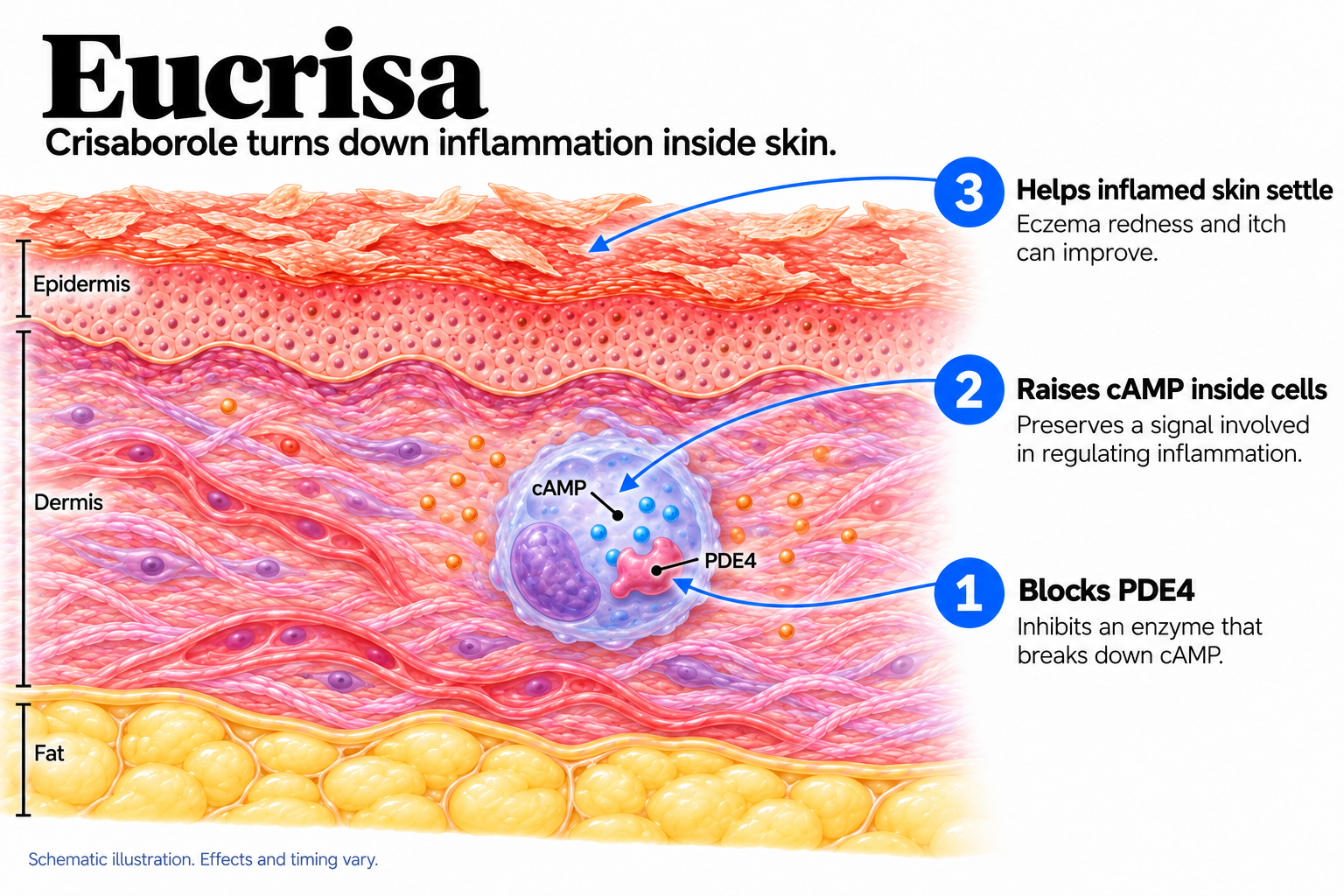
Blocks PDE4: Inhibits an enzyme that breaks down cAMP. Raises cAMP inside cells: Preserves a signal involved in regulating inflammation. Helps inflamed skin settle: Eczema redness and itch can improve.
PDE4 inhibition and increased intracellular cAMP are established. The exact link to clinical improvement is not fully defined; this is a simplified overview, not every downstream pathway.
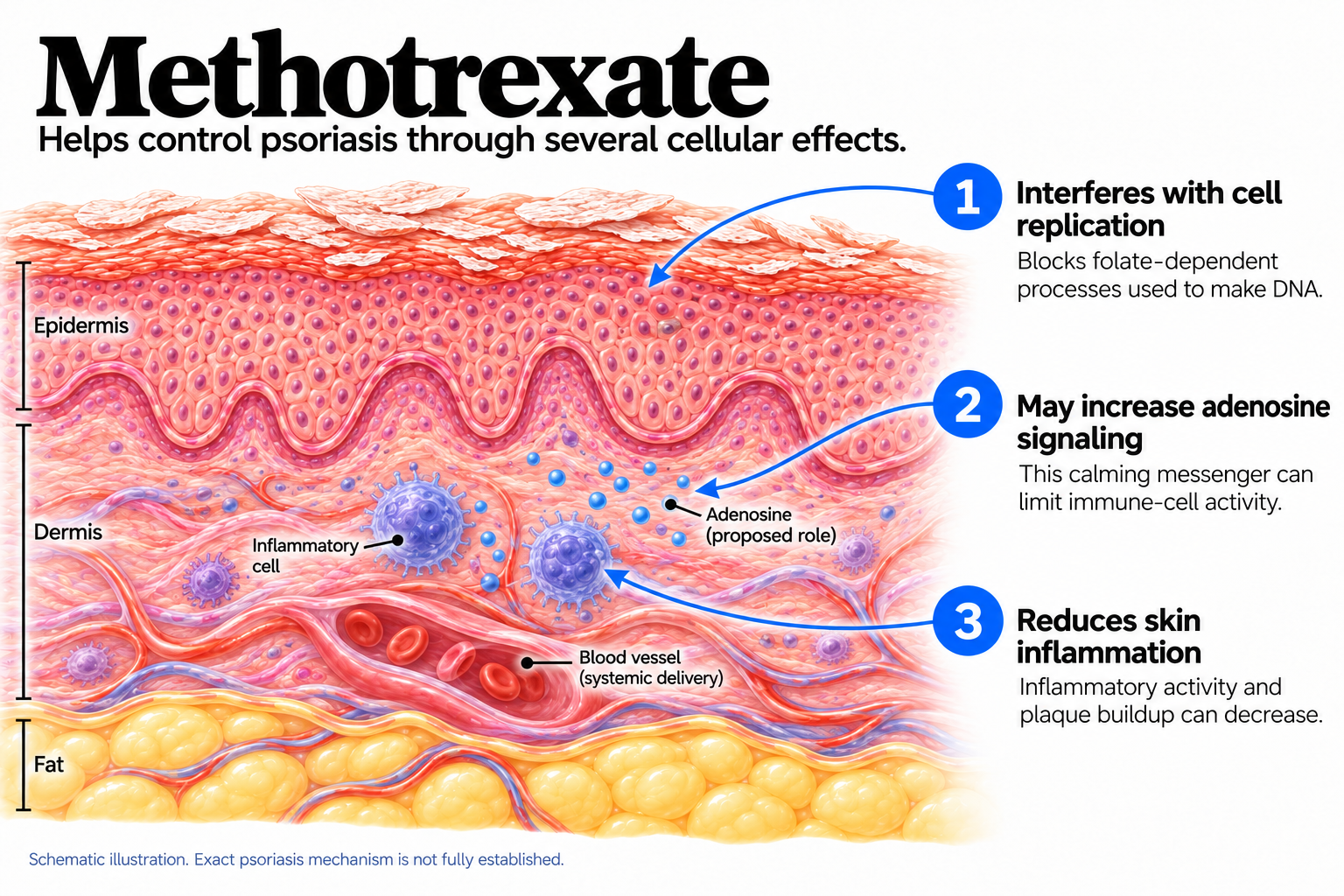
Interferes with cell replication: Blocks folate-dependent processes used to make DNA. May increase adenosine signaling: This calming messenger can limit immune-cell activity. Reduces skin inflammation: Inflammatory activity and plaque buildup can decrease.
The psoriasis mechanism is not fully established. Folate antagonism affects replication, while low-dose anti-inflammatory actions include proposed adenosine pathways supported by experimental work; their precise clinical contributions are unresolved.
When to Apply: A thin layer twice a day on the inflamed areas, on clean dry skin. Moisturizer goes everywhere, including over the top once it has settled.
How to Start: Twice daily from day one, on the flaring areas only, not over the whole body as a preventive. If the stinging is hard to tolerate, moisturize first and use the ointment straight from the fridge. The stinging usually fades within the first week.
If It Irritates: Burning or stinging for a few minutes after applying is the commonest effect, and usually not an allergy. It settles as the skin heals. Redness spreading beyond where you applied it, or stinging that gets worse rather than better after two weeks, should be reviewed.
If It's Not Working: There is one strength, so there is nothing to increase. Four weeks of proper twice-daily use is a fair trial. After that: a different non-steroid, a short steroid course to break the flare, or a look at what else is driving the rash.
This drug is taken once a week. Taking it every day can cause fatal bone marrow failure. Pick one day of the week, write it down, and keep to it.
Test dose: A single small dose, often 2.5 mg to 5 mg, with blood counts checked about a week later before going further. A safety check, not the treatment dose.
Starting dose: Commonly 7.5 mg to 15 mg once weekly, adjusted for age, weight, kidney function and other illnesses. Lower in older people and in reduced kidney function.
Going up: Small steps, usually 2.5 mg to 5 mg every few weeks with blood tests in between, until the psoriasis responds or side effects set the ceiling.
Usual dose: Most people settle between 15 mg and 25 mg once weekly. Above about 15 mg tablet absorption gets unreliable, a common point to switch to the injection.
Folic acid alongside it: It reduces nausea, mouth ulcers and blood count problems. Usually a daily dose on the days you are not taking methotrexate, or one larger weekly dose on a different day. It does not stop the drug working.
Total course: No fixed course. It continues as long as it works and blood tests stay normal, which for some people is years.
No blood tests and no routine monitoring. Very little reaches the bloodstream, and what does is broken down quickly, so nothing accumulates.
Monitoring is a review at about four weeks to decide whether it is working. Long term, this is a drug people can stay on: no maximum duration, no limit on the area treated, no rest period. That is the practical difference between it and a topical steroid.
The one thing worth watching is whether it is quietly standing in for treatment that would actually control the disease. Eczema that keeps escaping it needs a different plan, not more months of the same ointment.
Methotrexate is watched by blood test, and the schedule is not optional. The problems it causes are silent until they are advanced.
Before starting: Full blood count, liver tests, kidney function, and a pregnancy test where relevant. Hepatitis B, hepatitis C, HIV and tuberculosis screening is standard, because the drug damps the immune system. A chest x-ray if there is any history of lung disease.
Early on: Blood counts and liver tests within a week or two of starting, and again after each dose increase. This is when a sudden drop in blood counts would show.
Once stable: Full blood count, liver tests and kidney function every one to three months, depending on the dose and what else you take, for as long as you are on the drug.
The liver over the long term: Years of methotrexate can scar the liver, and the risk rises with total lifetime dose, heavy alcohol use, obesity, diabetes and fatty liver disease. Biopsy used to be the check; most clinics now use a blood marker of scarring and a scan of liver stiffness.
The lungs: A rare but serious lung inflammation can occur. A new dry cough, breathlessness or fever means being seen, not waiting for the next appointment.
What to report between tests: Mouth ulcers, unexplained bruising or bleeding, sore throat or fever, dark urine, yellowing of the eyes or skin, severe nausea, any new cough or breathlessness.
Once a week, on the same day every week. Choose a day you will remember and write it somewhere visible. Some people take the whole dose at once; some split it into two portions about twelve hours apart on the same day to reduce nausea. Do not spread it across different days unless you were told to.
Take tablets with water, and with food if they upset your stomach. An evening dose means the tiredness and mild nausea happen while you are asleep.
Folic acid goes on the other days, as prescribed. It is not a substitute for a missed methotrexate dose.
With the weekly injection, keep to the same day and rotate the site.
Take it as soon as you remember if it is within about two days of your usual day. If longer, skip it and take the next on your usual day. Never take two weekly doses close together to catch up, and never take a daily dose to make up for a missed week.
If you have taken more than one weekly dose, or taken it several days in a row, contact a doctor or a poison center straight away. Do not wait to see how you feel. This overdose is treatable caught early and dangerous when it is not.
Approximate windows, not promises.
First few minutesApplying it: A thin layer twice a day. Stinging or warmth for a few minutes is common, worst in week one.
Days 1 to 7Adjusting: Stinging is at its worst now. Itch eases before the rash looks different.
Week 2Settling: Redness and scaling fade. Most of the stinging has gone.
Week 4Judge it here: The point the trials measured. A meaningful share of people reach clear or almost clear skin; a meaningful share do not. No change by four weeks means more time will not help.
OngoingFace, eyelids and folds: Its strongest case. Use it on and off as needed: no cumulative limit, no rest period, none of the thinning that limits steroids on thin skin.
First doseTaking it: Once a week, not daily, with folic acid on the other days. Nausea, tiredness or mouth soreness in the day or two after each dose is common early on; folic acid usually blunts it.
Weeks 1 to 2Settling in: Nothing visible in the skin yet.
Weeks 4 to 8Working: Plaques thin and spread less, thickness and scale first. Joint pain from psoriatic arthritis often improves in the same window, one reason it is chosen over a skin-only treatment.
About 3 monthsJudge it here: Substantial improvement is the realistic target.
Beyond 3 monthsLong term: Where it suits, the result holds while the dose continues, with regular blood tests. Some stay on it for years.
Many monthsNails: Nail psoriasis can improve, but slowly. Nails always lag behind the skin.
Sorted by what to do about them.
Cost is the obstacle here, not safety. It has been brand-name with no stocked generic for most of its life, and the cash price for a large tube is high. Generic availability changes, so ask the pharmacy.
Prior authorization is common. Plans usually want a topical steroid first, sometimes a calcineurin inhibitor too, which is cheaper as a generic. A savings card exists for people with commercial insurance, with terms that change often.
Tube size matters more than with most creams, because it goes on twice a day over an area. A small tube covering a child's whole body lasts days. Ask for the size that matches the area treated.
Generic methotrexate tablets are among the least expensive systemic treatments in dermatology. Folic acid is cheap too.
The weekly auto-injector pens cost considerably more, and coverage usually requires showing that tablets caused nausea or did not work well enough. Plain injectable vials are cheaper than the pens.
The real cost is the monitoring, repeated blood tests and periodically a liver scan or blood marker. Usually covered, but they are appointments and not optional.
Insurers frequently require a trial of methotrexate before approving a biologic, one reason it is still so often the first systemic drug tried.
Probably the drug itself acting on inflamed skin, not the base. It is the commonest complaint, worst in the first days, and fades within a week.
Thin skin is where it makes the most sense and it is used there, but not in the eye itself. Keep it off the lid margin.
No, it is milder. Its advantage is delicate skin and long stretches without the thinning that limits steroids.
There is no set limit. On during flares, off in between, for as long as it helps.
It is licensed from three months of age.
Licensed for atopic dermatitis. Doctors sometimes use it off-label for other inflammatory rashes, where the evidence is thinner.
Once a week, on the same day. Never daily. Daily dosing by mistake is the most dangerous error with this drug and it has been fatal. Get medical help the same day if it happens.
Methotrexate blocks folate, and the mouth ulcers, nausea and low blood counts come from that. Folic acid on the other days restores enough folate to reduce them without stopping the treatment working.
Yes. Liver damage and falling blood counts cause no symptoms until they are advanced. The tests are the only early warning.
The concern is regular drinking, not a single glass, because alcohol and methotrexate both stress the liver. Agree an actual limit with your doctor.
No. It must be stopped well before trying to conceive, and the advice covers both partners. It causes miscarriage and serious birth defects. Ask your own doctor how far in advance.
Give it about three months. First changes often show at four to eight weeks, but three months on a tolerated dose is the fair point to judge.
It is chemotherapy at much higher doses. At psoriasis doses it acts as an immune-calming drug, and the experience is not comparable.