Eczema
Reduces itch and clears skin.
Dupixent: An injected biologic for moderate to severe eczema. It blocks two of the immune signals that drive the itch, and it is taken long term rather than as a course. Eucrisa: A non-steroid ointment for mild to moderate eczema. It can be used on the face and in skin folds, and there is no limit on how long it can be used.
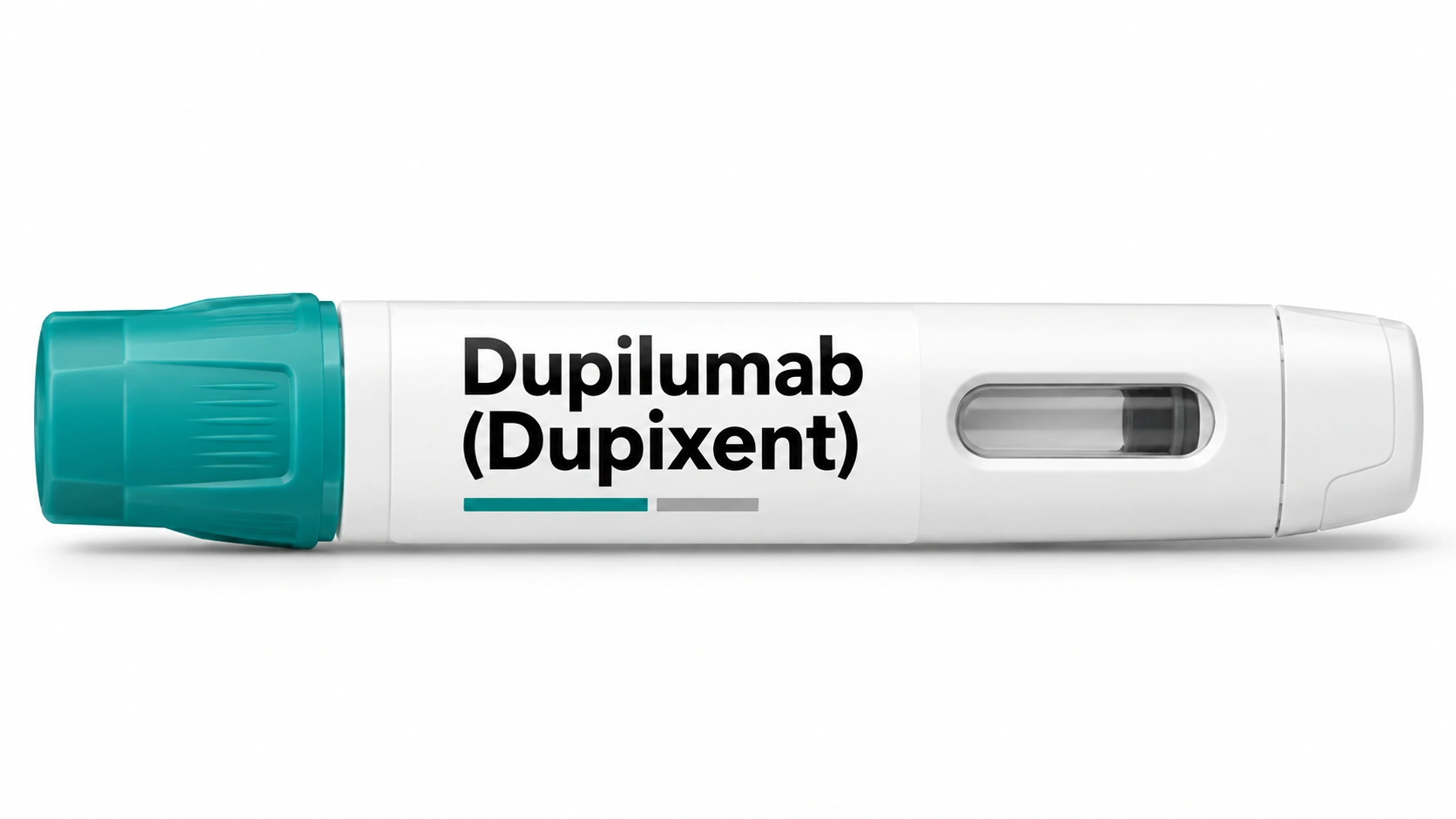
Choose for moderate to severe eczema that creams can't control, as a long-term treatment without blood tests.
Choose for mild to moderate eczema when you want a non-steroid you can use anywhere, for as long as needed.
Can you take them together?
Eucrisa can be used on remaining patches while on Dupixent. They do not interact.
Compare uses by strength of evidence. Evidence level describes confidence in a benefit, not its size.





Blocks IL-4 and IL-13 signals: Binds their shared receptor to interrupt these messages. Calms type 2 inflammation: Reduces immune signaling that drives eczema. Eases eczema and itch: Inflamed skin and itch improve as signaling falls.
Dupilumab binds IL-4 receptor alpha, inhibiting IL-4 and IL-13 signaling. Diagram focuses on atopic dermatitis; it does not show every approved indication or all downstream effects.
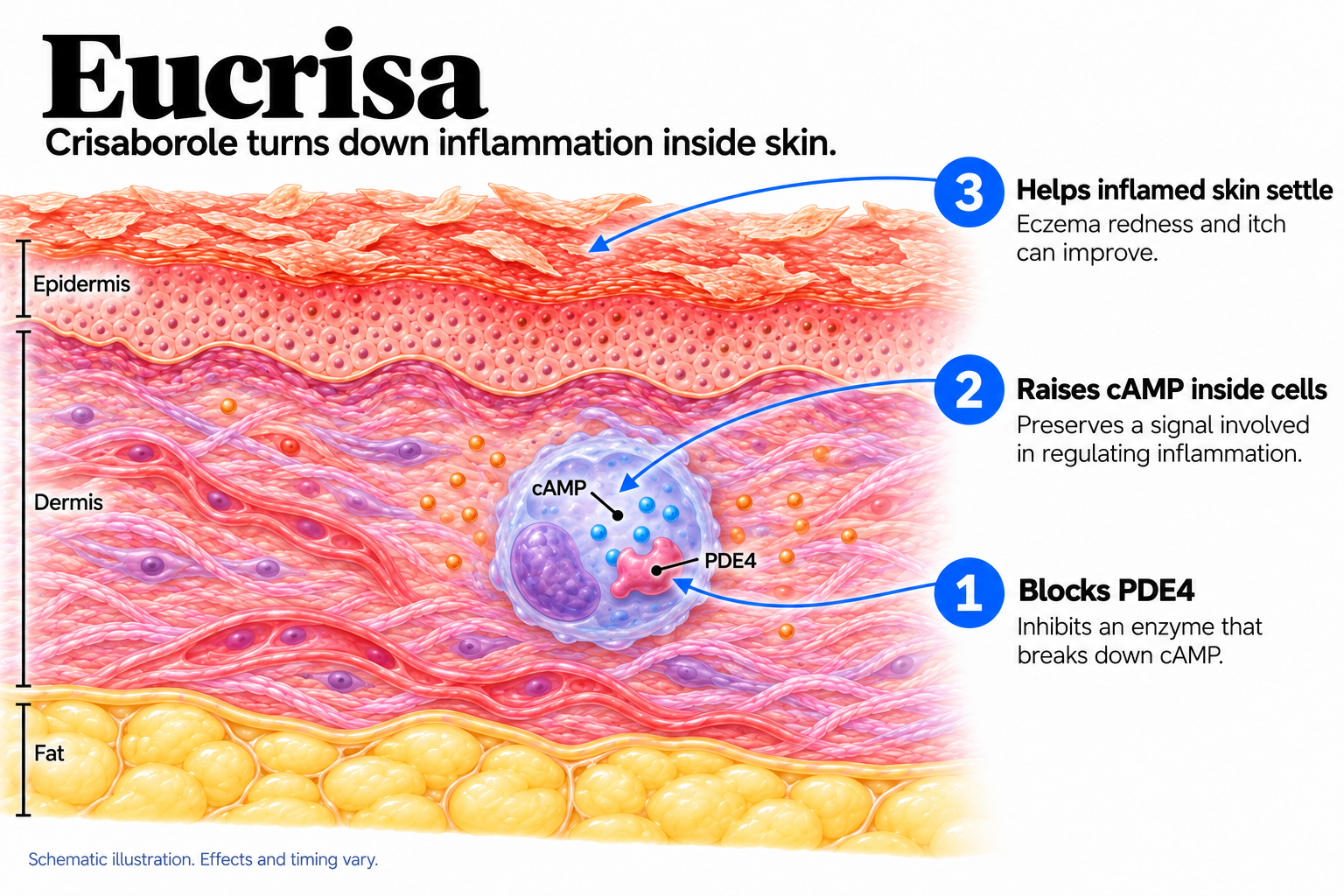
Blocks PDE4: Inhibits an enzyme that breaks down cAMP. Raises cAMP inside cells: Preserves a signal involved in regulating inflammation. Helps inflamed skin settle: Eczema redness and itch can improve.
PDE4 inhibition and increased intracellular cAMP are established. The exact link to clinical improvement is not fully defined; this is a simplified overview, not every downstream pathway.
There is no titration. The number is fixed by age and weight; the only variable is how often you inject.
Loading dose: Adults start with two 300 mg injections the same day at two different spots — 600 mg total. That front-loading reaches a working level quickly.
Usual dose: 300 mg every two weeks for adults. Adolescents 12 and over who weigh about 60 kg or more use the same schedule.
Children and smaller adolescents: Dose is set by weight, and the youngest children inject every four weeks rather than every two. Go by the prescription.
Going up: There is nothing higher. If it is not working at sixteen weeks, the conversation is about a different treatment, not a bigger dose.
Total course: Open-ended. This is maintenance, not a course — people stay on it for years when it works.
When to Apply: A thin layer twice a day on the inflamed areas, on clean dry skin. Moisturizer goes everywhere, including over the top once it has settled.
How to Start: Twice daily from day one, on the flaring areas only, not over the whole body as a preventive. If the stinging is hard to tolerate, moisturize first and use the ointment straight from the fridge. The stinging usually fades within the first week.
If It Irritates: Burning or stinging for a few minutes after applying is the commonest effect, and usually not an allergy. It settles as the skin heals. Redness spreading beyond where you applied it, or stinging that gets worse rather than better after two weeks, should be reviewed.
If It's Not Working: There is one strength, so there is nothing to increase. Four weeks of proper twice-daily use is a fair trial. After that: a different non-steroid, a short steroid course to break the flare, or a look at what else is driving the rash.
Pick a day of the week and keep it. Take the pen or syringe out of the fridge 30 to 45 minutes ahead and let it warm to room temperature on its own — never in hot water, on a radiator, or in a microwave. A cold injection stings much more, and that one step explains most of the difference between people.
Inject into the front of the thigh or the abdomen, at least two inches from the navel. The upper arm works if someone else is injecting. Change the spot each time and avoid skin that is bruised, tender, scarred, or flaring. If the dose is two injections, give them one after the other in two different spots.
Give it as soon as you remember, as long as that is within about a week of the due day, then go back to your schedule. If longer than that, skip it and take the next on the usual day. Never double up to catch up. One missed injection does not undo months of treatment.
No routine blood tests are required — no liver, kidney, or blood count checks, which is a real advantage over the older systemic eczema drugs. Monitoring is a conversation about the skin, the itch, and the eyes.
Ask about the eyes at every visit. Conjunctivitis affects roughly one in ten people treated for eczema, more often with severe skin or eyelid involvement, and usually responds to lubricating drops or a short prescription course. Eye pain or changed vision goes to an eye doctor rather than being watched. Eosinophil counts rise in some people without causing anything, so a count taken for another reason should be read with that in mind.
Nothing builds up over the years, and there is no ceiling on how long you can stay on it. The recurring problem is insurance renewal, not safety.
No blood tests and no routine monitoring. Very little reaches the bloodstream, and what does is broken down quickly, so nothing accumulates.
Monitoring is a review at about four weeks to decide whether it is working. Long term, this is a drug people can stay on: no maximum duration, no limit on the area treated, no rest period. That is the practical difference between it and a topical steroid.
The one thing worth watching is whether it is quietly standing in for treatment that would actually control the disease. Eczema that keeps escaping it needs a different plan, not more months of the same ointment.
Approximate windows, not promises.
First few minutesThe injection: A sting for a few seconds, then redness or aching. Common early, and it settles with later doses.
First few minutesApplying it: A thin layer twice a day. Stinging or warmth for a few minutes is common, worst in week one.
Weeks 1 to 2Itch lifts: Often within days, before anything shows in the mirror. The earliest and most reliable change.
Weeks 2 to 8Working: Sleep improves, scratching drops, and the skin looks calmer. Red or gritty eyes, if they happen, start here.
Weeks 12 to 16Judge it here: Trials measured their main result at sixteen weeks. Most responders reach their best skin here and a good number get close to clear; people only partly better at twelve often kept improving.
Weeks 12 to 24Sleep and daily life: These follow the itch, on a similar timeline, and trials measured them separately from the rash.
After 6 monthsThe face and neck: A stubborn pink patch appears here in a minority, usually after the rest of the skin has cleared. It is treatable and not a sign the drug has stopped working.
Days 1 to 7Adjusting: Stinging is at its worst now. Itch eases before the rash looks different.
Week 2Settling: Redness and scaling fade. Most of the stinging has gone.
Week 4Judge it here: The point the trials measured. A meaningful share of people reach clear or almost clear skin; a meaningful share do not. No change by four weeks means more time will not help.
OngoingFace, eyelids and folds: Its strongest case. Use it on and off as needed: no cumulative limit, no rest period, none of the thinning that limits steroids on thin skin.
Sorted by what to do about them.
Cost decides access here more often than anything medical. Dupilumab is a biologic with no generic and no biosimilar in the United States, and the list price runs to tens of thousands of dollars a year. Almost nobody pays that, and almost everybody has to do the paperwork that brings it down.
Prior authorization is close to universal. Plans want a diagnosis, a record of how much of the body is affected, and evidence that prescription topicals were tried and could not hold the disease — usually a mid- or high-strength steroid, often a calcineurin inhibitor too. Some add phototherapy or an older systemic drug first. First-pass denials are common and appeals often succeed, so a denial is a step, not the end. Ask the prescribing office who handles appeals.
The manufacturer's copay program cuts the monthly cost sharply for people with commercial insurance, and a separate program covers people with no insurance. Copay cards cannot be used with Medicare, Medicaid, or other government plans, which is where the largest out-of-pocket gaps sit. Terms change every year, so a plan that refused last year is worth asking again.
Cost is the obstacle here, not safety. It has been brand-name with no stocked generic for most of its life, and the cash price for a large tube is high. Generic availability changes, so ask the pharmacy.
Prior authorization is common. Plans usually want a topical steroid first, sometimes a calcineurin inhibitor too, which is cheaper as a generic. A savings card exists for people with commercial insurance, with terms that change often.
Tube size matters more than with most creams, because it goes on twice a day over an area. A small tube covering a child's whole body lasts days. Ask for the size that matches the area treated.
Itch often improves within two weeks. The skin takes longer — sixteen weeks is the fair point to judge.
It stings for a few seconds. Letting it reach room temperature first makes the biggest difference.
Roughly one in ten get red or gritty eyes, more often with severe eczema or eyelid involvement. Most settle with drops.
No routine tests, which is unusual for a drug of this kind.
Some people do, and some keep a good stretch. Eczema usually returns eventually, and restarting normally works.
Yes. Most people need far less, but flares still get topical treatment, and moisturizer continues indefinitely.
Probably the drug itself acting on inflamed skin, not the base. It is the commonest complaint, worst in the first days, and fades within a week.
Thin skin is where it makes the most sense and it is used there, but not in the eye itself. Keep it off the lid margin.
No, it is milder. Its advantage is delicate skin and long stretches without the thinning that limits steroids.
There is no set limit. On during flares, off in between, for as long as it helps.
It is licensed from three months of age.
Licensed for atopic dermatitis. Doctors sometimes use it off-label for other inflammatory rashes, where the evidence is thinner.