Cica vs Polyhydroxy Acids

Cica: Used in soothing moisturizers; ingredient-specific clinical evidence is limited. Polyhydroxy Acids: Offers exfoliation through ingredients such as gluconolactone and lactobionic acid.
Research updated 2026-10-25
Five centella creams on white, a green-tinted jar plus tubes labeled Madagascar Centella, Madeca Cream and Cica Cream PlusFive PHA toner and serum bottles lined up on white with clear liquid swatches beside them

Which one is right for you?

Choose Cica if…

Consider for a gentle moisturizer; check the complete formula and your tolerance.

  • Sensitive, easily irritated skin
  • You want a soothing moisturizer
  • No known plant allergies

Choose Polyhydroxy Acids if…

Choose for mild exfoliation when stronger acids are uncomfortable; tolerance still varies.

  • Sensitive skin that stings with AHAs
  • Mild dullness or texture
  • Gentle exfoliation
Fine together

Can you use both?

A gentle pairing for sensitive skin: PHAs exfoliate lightly, cica calms.

At a glance

● Cica
● Polyhydroxy Acids
Type
Centella asiatica extract family
Polyhydroxy acid (PHA) family
What it does
Used in soothing moisturizers; ingredient-specific clinical evidence is limited.
Offers exfoliation through ingredients such as gluconolactone and lactobionic acid.
Best for
Sensitive Skin; Wrinkles and Fine Lines
Acne; Dull Skin; Sensitive Skin
Studied concentrations
0.1% madecassoside with 5% vitamin C in a small photoaging trial.
14% gluconolactone in an acne trial; newer studies test mixed-acid formulas.
When to use
Morning or night, as directed by the finished product.
Start on a few evenings weekly; increase only if comfortable.
Time to results
Comfort may improve quickly; reassess persistent dryness
Often 8–12 weeks in small cosmetic studies; results may be subtle
Irritation
Can cause a contact rash; avoid assuming botanical products are allergy-free.
Can still sting or cause a rash; sensitive skin does not guarantee tolerance.
Sensitive skin
Choose a simple formula and test a small area first. Individual tolerance matters more than an ingredient’s reputation for being gentle.
Choose a simple formula and test a small area first. Avoid actively inflamed or broken skin unless the product is specifically directed for it.
Available
Cosmetic or OTC products; some high-strength procedures are separate treatments.

What it helps

Compare uses by strength of evidence. Evidence level describes confidence in a benefit, not its size.


Evidence level
Cica
Polyhydroxy Acids
Limited evidenceEarly or small studies
Sensitive Skin on light skin.

Sensitive Skin

Some formulas may feel comfortable, but an extract alone is not a proven treatment.
A relaxed forehead with faint shallow horizontal fine lines.

Wrinkles and Fine Lines

A small madecassoside/vitamin C trial reported improvement; the ingredients cannot be separated.
Sensitive Skin on light skin.

Sensitive Skin

Some tested formulas were well tolerated; this is not proof that all PHAs suit reactive skin.
Inflamed acne on light skin. The spots sit in a patch of pink, and the ring of redness around each one is easy to see. A few have a yellow-white head, and the skin between them is dry and flaking.

Acne

One controlled trial found fewer lesions with 14% gluconolactone.
Dull Skin on light skin.

Dull Skin

Small studies of PHA formulas suggest smoother surface texture.
Insufficient evidence
Scars on light skin.

Scars

The cited combination photoaging study did not test scar treatment.
Inflamed acne on light skin. The spots sit in a patch of pink, and the ring of redness around each one is easy to see. A few have a yellow-white head, and the skin between them is dry and flaking.

Acne

The reviewed sources do not establish this ingredient as a treatment for this concern.
Flat tan patches with soft irregular edges across the forehead and upper cheek of an adult with light skin, the surface completely smooth.

Melasma

The reviewed sources do not establish this ingredient as a treatment for this concern.
Flat tan patches with soft irregular edges across the forehead and upper cheek of an adult with light skin, the surface completely smooth.

Melasma

The reviewed sources do not establish this ingredient as a treatment for this concern.
The front of one shin on pale skin. The surface is pink with fine white flaking and a few shallow cracks, and the skin around it is even in tone.

Dry Skin

The reviewed sources do not establish this ingredient as a treatment for this concern.
Acne scarring on light skin. Small sharply cut pits and broad shallow dips across a cheek, several sitting inside faint flat pink marks, with no active spots.

Acne Scarring

The reviewed sources do not establish this ingredient as a treatment for this concern.
How it works

Cica

Cica mechanism diagram. Contains plant compounds: Extracts may include madecassoside and related molecules. Repair signaling is being studied: Laboratory findings do not guarantee clinical repair.
Open full-size diagram
Diagram explanation and sources

Contains plant compounds: Extracts may include madecassoside and related molecules. Repair signaling is being studied: Laboratory findings do not guarantee clinical repair.

Schematic illustration; not a measurement of skin penetration. Effects vary with ingredient identity and formulation. Some illustrated pathways are experimental; laboratory findings do not establish a clinical treatment benefit.
Source 1

Polyhydroxy Acids

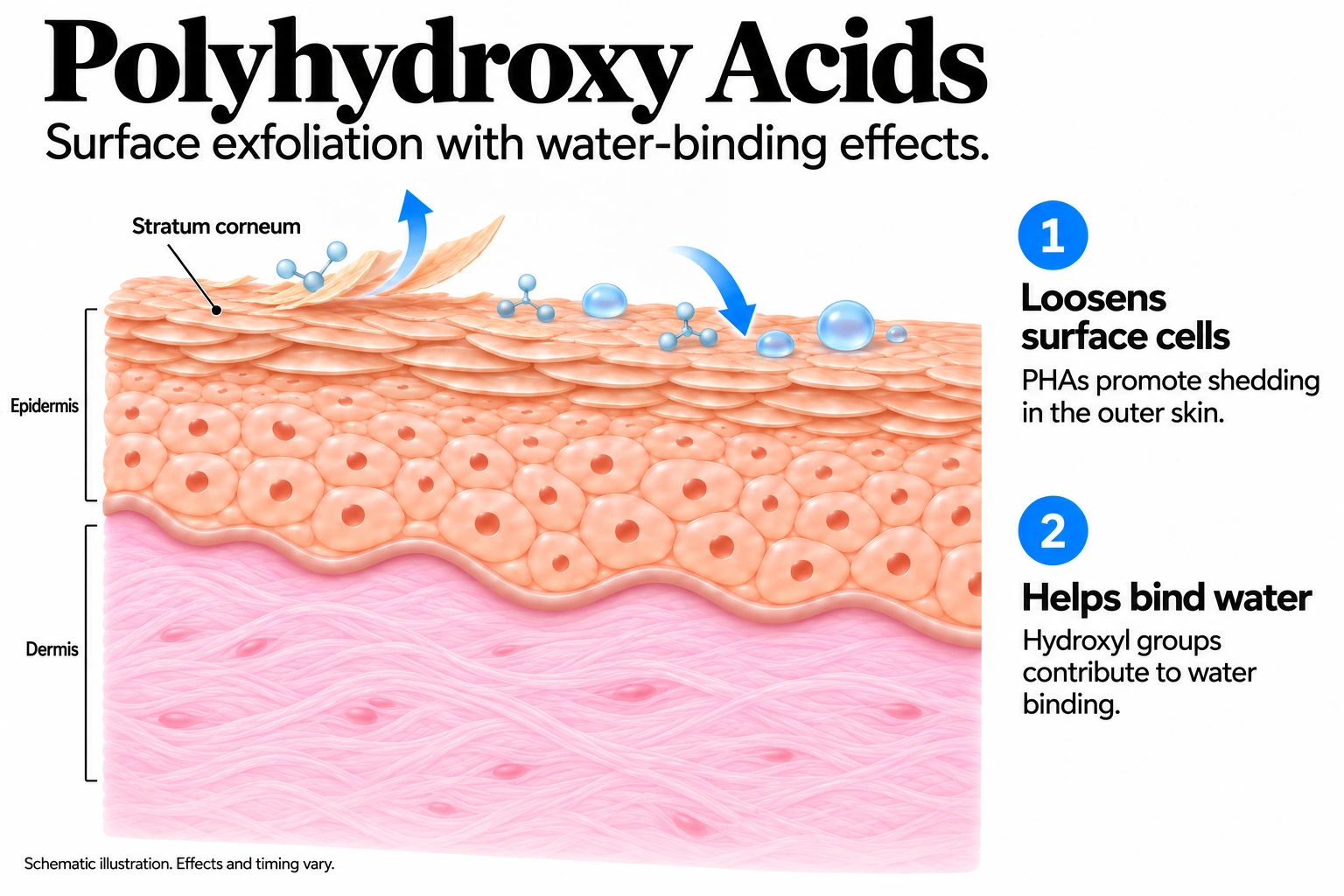
Polyhydroxy Acids mechanism diagram. Loosens surface cells: PHAs promote shedding in the outer skin. Helps bind water: Hydroxyl groups contribute to water binding.
Open full-size diagram
Diagram explanation and sources

Loosens surface cells: PHAs promote shedding in the outer skin. Helps bind water: Hydroxyl groups contribute to water binding.

Schematic illustration; not a measurement of skin penetration. Effects vary with ingredient identity and formulation.

Source 1 · Source 2 · Source 3

Using both in one routine

Built from where each one usually sits in a routine. Introduce one at a time.

Morning
Step 1
Cleanser
Step 2
Polyhydroxy AcidsMorning or night
Step 3
CicaMorning or night
Step 4
Sunscreen
Night
Step 1
Cleanser
Step 2
Polyhydroxy AcidsMorning or night
Step 3
CicaMorning or night

Strengths and forms

Concentrations

Cica usually means Centella asiatica extract, a mixture whose composition varies with extraction and standardization. There is no established percentage scale that makes different cica products equally potent.

Choosing a strength: Check whether the label names whole Centella extract, madecassoside, asiaticoside, or another purified compound.

Higher strengths: A higher extract percentage does not necessarily mean more of the compounds studied in clinical research.

Formula matters: A study of 0.1% madecassoside with 5% vitamin C cannot be used as a recommended percentage for whole cica extract.

PHA is a family name, not one ingredient or one standard strength. A clinical acne trial used 14% gluconolactone; that result cannot be transferred directly to lactobionic acid or mixed-PHA products.

14%

Studied gluconolactone lotion

An older controlled acne trial tested this specific formula. It does not establish the best percentage for all PHA skincare.

Choosing a strength: Check which PHA is listed, whether the product stays on or washes off, and whether it also contains other exfoliating acids.

Higher strengths: A PHA product can still irritate, particularly when combined with other acids. A high total-acid percentage is not a validated benefit rating.

Formula matters: The individual acid, acidity and base formula matter. A blended-acid percentage does not reveal the amount of each PHA.

Forms
Cream · Serum · Mask
Toner · Serum · Cleanser

When you’ll see results

Approximate windows, not promises.

● Cica
● Polyhydroxy Acids
First few weeks

First few weeksSkin may feel softer soon after use; relief depends on the formula.

First few weeksAssess tolerance and texture; immediate softness can come from the base formula.

4–8 weeks

4–8 weeksJudge hydration, comfort and whether dryness is recurring.

4–8 weeksSubtle changes may appear in some tested products; evidence varies.

8–12 weeks

8–12 weeksPersistent cracking, itch or a rash needs reassessment.

8–12 weeksCompare photographs in the same lighting and reassess benefit.

3–6 months

3–6 monthsContinue if comfortable; hydration usually requires ongoing use.

3–6 monthsPhotoaging trials often need several months; expect modest rather than dramatic change.

6–12 months

6–12 monthsMoisturizing does not establish reversal of structural ageing or scars.

6–12 monthsLong-term evidence is limited for many cosmetic actives; continue only if useful.

Safety and sensitive skin

Common reactions

Can cause a contact rash; avoid assuming botanical products are allergy-free.

Can still sting or cause a rash; sensitive skin does not guarantee tolerance.

When to stop

Stop for persistent burning, swelling, blistering or a new rash. Seek urgent care for breathing difficulty or a severe allergic reaction.

Stop for persistent burning, swelling, blistering or a new rash. Seek urgent care for breathing difficulty or a severe allergic reaction.

Sensitive or inflamed skin

Choose a simple formula and test a small area first. Individual tolerance matters more than an ingredient’s reputation for being gentle.

Choose a simple formula and test a small area first. Avoid actively inflamed or broken skin unless the product is specifically directed for it.

Important limits

Do not use a cosmetic product as a substitute for diagnosis of an unexplained, changing or persistent skin problem.

Do not use a cosmetic product as a substitute for diagnosis of an unexplained, changing or persistent skin problem.

Pregnancy

Applied to the skin, very little is expected to be absorbed, but ask the doctor managing your pregnancy. Mention it separately if you also take gotu kola by mouth.

Low-strength leave-on acids are generally considered acceptable; ask the clinician managing your pregnancy.

How it works

In the skin

On the skin. The finished product delivers cica in a particular vehicle.

Entering skin. No single molecular mass. The 500 Da guideline cannot be applied to this whole ingredient family or mixture.

Conversion. No activation step is established as necessary for its intended topical role.

Skin response. Contains plant compounds studied for inflammatory and repair signalling; extracts are not chemically identical.

Additional effects. Proposed pathways do not establish a measured depth of delivery or clinical benefit beyond the studies cited.

On the skin. The finished product delivers polyhydroxy acids in a particular vehicle.

Entering skin. No single molecular mass. The 500 Da guideline cannot be applied to this whole ingredient family or mixture.

Conversion. No activation step is established as necessary for its intended topical role.

Skin response. PHA ingredients promote surface exfoliation and may also bind water; individual acids and formulas differ.

Additional effects. Proposed pathways do not establish a measured depth of delivery or clinical benefit beyond the studies cited.

Getting in
No single molecular mass. The 500 Da guideline cannot be applied to this whole ingredient family or mixture.

Product examples

Cica
  • SKIN1004 Madagascar Centella Tone Brightening Boosting Toner
  • La Roche-Posay Cicaplast Baume B5 — A thick repair balm for damaged, irritated skin. For after a procedure, a retinoid overdose, or a barrier meltdown.
Polyhydroxy Acids
  • Isntree Hyper Acid 4 AHA BHA PHA LHA 30 Serum
  • NeoStrata Ultra Moisturizing Face Cream
  • Gold Bond Ultimate Pedi Smooth Foot Cream

Common questions

Cica:What should I choose cica for?

Consider for a gentle moisturizer; check the complete formula and your tolerance.

Cica:How strong is the evidence?

A 20-person study tested madecassoside together with vitamin C for six months. It cannot isolate Centella extract or establish treatment of acne, eczema or scars.

Polyhydroxy Acids:What should I choose polyhydroxy acids for?

Choose for mild exfoliation when stronger acids are uncomfortable; tolerance still varies.

Polyhydroxy Acids:How strong is the evidence?

A 150-person trial tested 14% gluconolactone for acne. Evidence from that molecule or a mixed-acid serum does not establish identical effects for all PHAs.

Sources
Sources and further reading

  1. Clinical, biometric and structural evaluation of the long-term effects of a topical treatment with ascorbic acid and madecassoside in photoaged human skin. (2008)
  2. A comparative study of gluconolactone versus benzoyl peroxide in the treatment of acne. (1992)
  3. Efficacy and safety of a new peeling formulated with a pool of PHAs for the treatment of all skin types, even sensitive. (2023)
  4. FDA alpha-hydroxy acid sun-sensitivity guidance
Dermapedia on YouTube