Eczema
Treats and prevents flares.
Eucrisa: A non-steroid ointment for mild to moderate eczema. It can be used on the face and in skin folds, and there is no limit on how long it can be used. Protopic: A non-steroid ointment for eczema, used where steroids are hardest to keep using: the face, the eyelids, and skin folds. It carries a boxed warning that twenty years of follow-up have not supported.
Choose for mild to moderate eczema when you want a non-steroid you can use anywhere, for as long as needed.
Choose for eczema where steroids are hardest to keep using — face, eyelids, folds — or to prevent flares twice a week.
Can you take them together?
Both are steroid-free eczema creams for sensitive areas. Most people use one or the other.
Compare uses by strength of evidence. Evidence level describes confidence in a benefit, not its size.
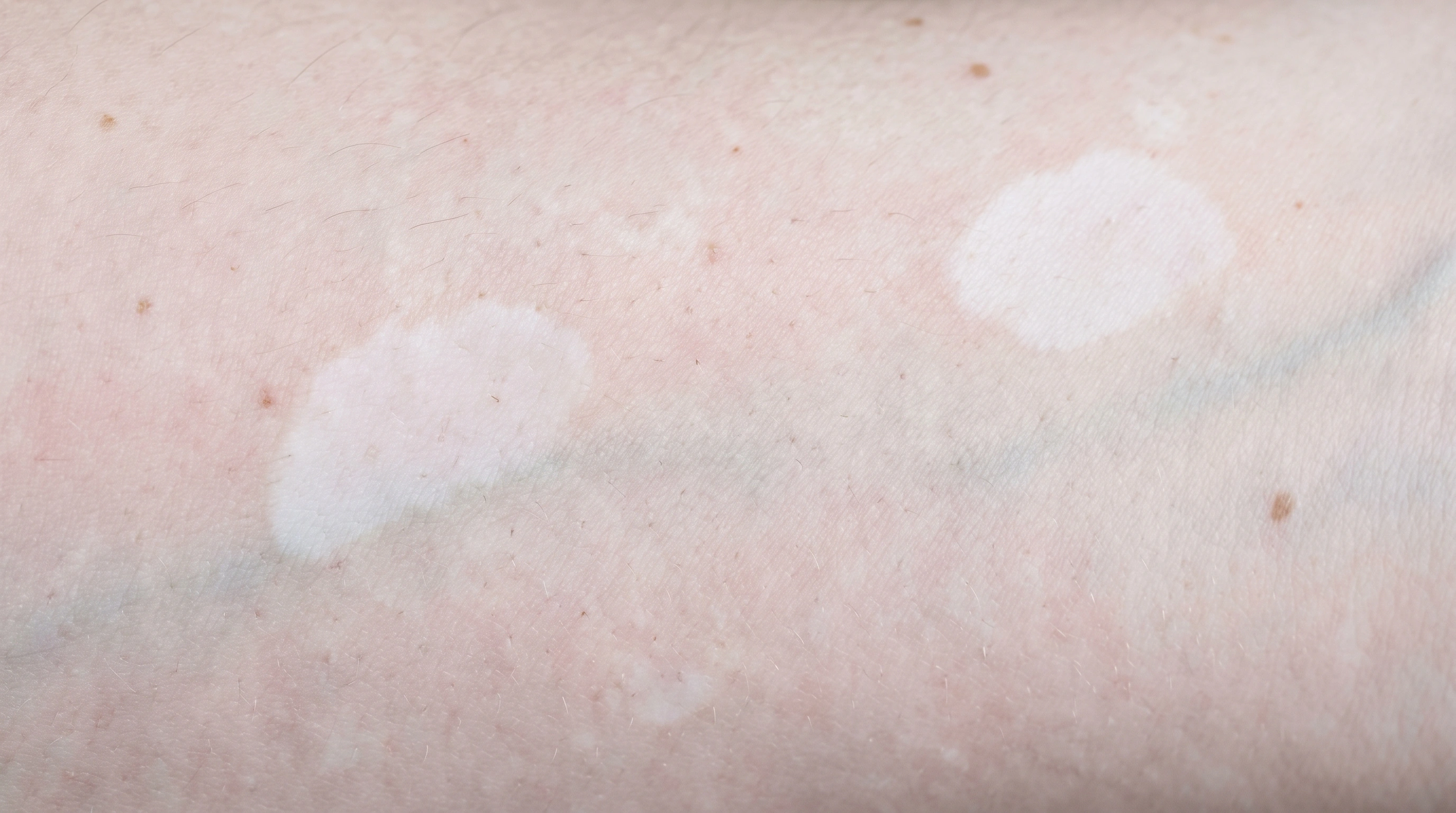


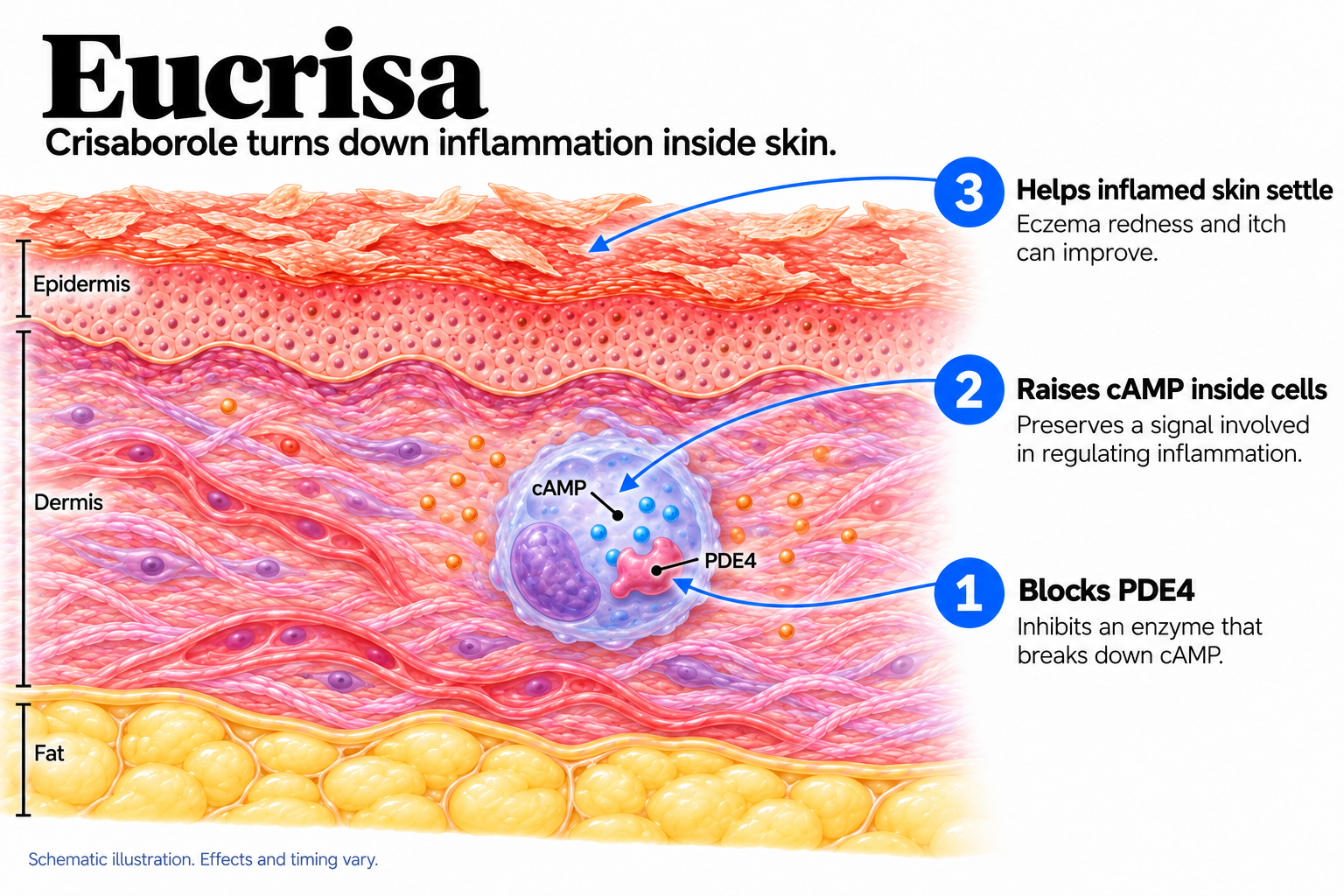
Blocks PDE4: Inhibits an enzyme that breaks down cAMP. Raises cAMP inside cells: Preserves a signal involved in regulating inflammation. Helps inflamed skin settle: Eczema redness and itch can improve.
PDE4 inhibition and increased intracellular cAMP are established. The exact link to clinical improvement is not fully defined; this is a simplified overview, not every downstream pathway.
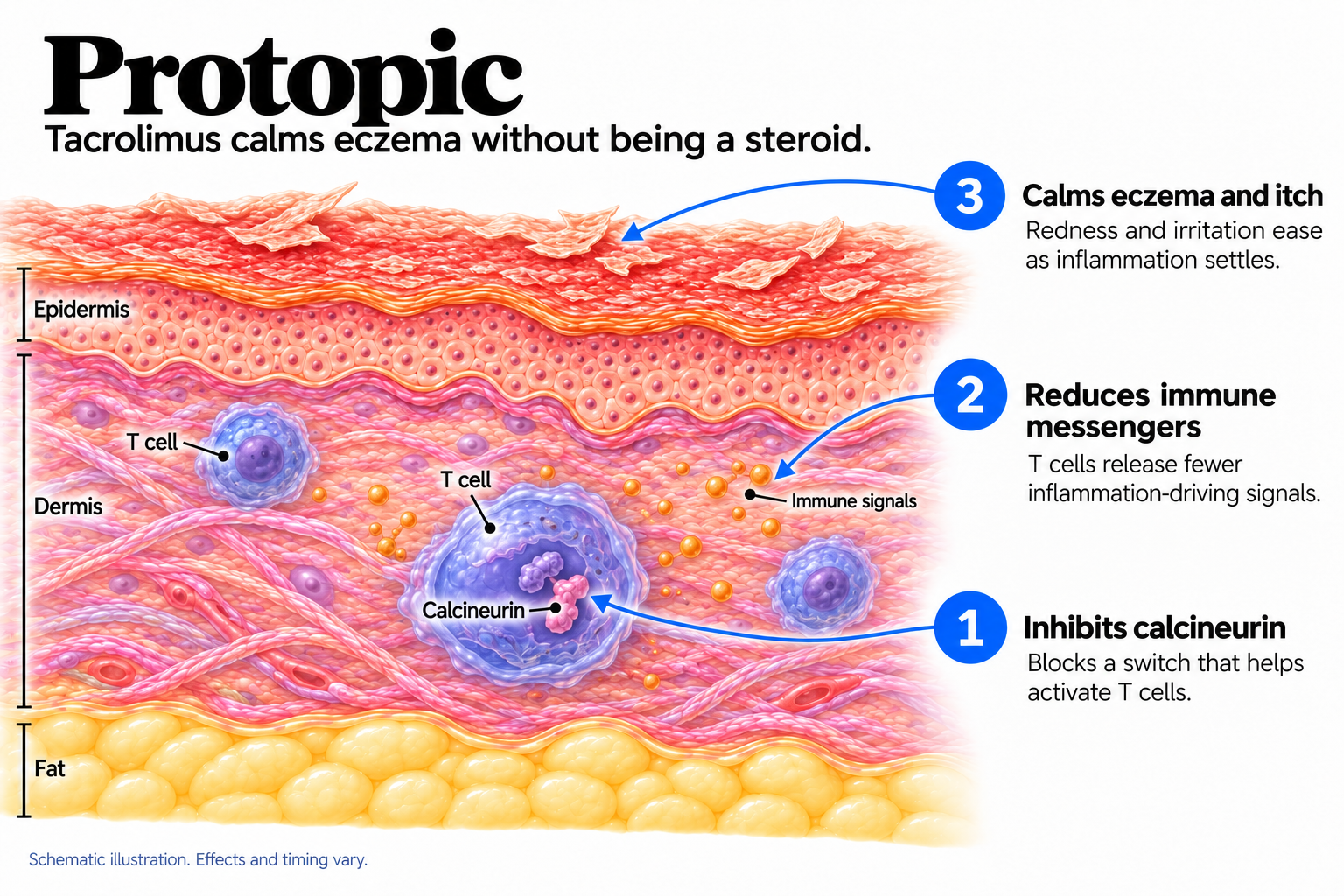
Inhibits calcineurin: Blocks a switch that helps activate T cells. Reduces immune messengers: T cells release fewer inflammation-driving signals. Calms eczema and itch: Redness and irritation ease as inflammation settles.
The drug binds FKBP-12 and inhibits calcineurin, reducing T-cell cytokine transcription; the complete atopic-dermatitis mechanism is not known. It also has other cellular effects.
When to Apply: A thin layer twice a day on the inflamed areas, on clean dry skin. Moisturizer goes everywhere, including over the top once it has settled.
How to Start: Twice daily from day one, on the flaring areas only, not over the whole body as a preventive. If the stinging is hard to tolerate, moisturize first and use the ointment straight from the fridge. The stinging usually fades within the first week.
If It Irritates: Burning or stinging for a few minutes after applying is the commonest effect, and usually not an allergy. It settles as the skin heals. Redness spreading beyond where you applied it, or stinging that gets worse rather than better after two weeks, should be reviewed.
If It's Not Working: There is one strength, so there is nothing to increase. Four weeks of proper twice-daily use is a fair trial. After that: a different non-steroid, a short steroid course to break the flare, or a look at what else is driving the rash.
When to Apply: A thin layer twice a day to the affected skin, rubbed in gently. It goes on the rash, not over clear skin. Keep moisturizer a couple of hours apart — layering one straight onto the other has not been studied.
How to Start: Twice a day until the patch clears, usually one to three weeks, then stop. Many people then move to maintenance — twice a week on the places that always flare, even when they look normal. That is well supported and makes flares less frequent.
If It Irritates: Burning or stinging for fifteen to thirty minutes after applying is very common in the first days and is not an allergy. It settles within about a week. Keeping the tube in the fridge, applying to dry rather than damp skin, and skipping alcohol early on all help.
If It's Not Working: Check it is going on twice a day — two to three weeks is a fair trial. Then the options are the higher strength if you are an adult on 0.03%, a short steroid course to break the flare, or a look at whether infection or a contact allergy is driving the rash.
No blood tests and no routine monitoring. Very little reaches the bloodstream, and what does is broken down quickly, so nothing accumulates.
Monitoring is a review at about four weeks to decide whether it is working. Long term, this is a drug people can stay on: no maximum duration, no limit on the area treated, no rest period. That is the practical difference between it and a topical steroid.
The one thing worth watching is whether it is quietly standing in for treatment that would actually control the disease. Eczema that keeps escaping it needs a different plan, not more months of the same ointment.
No blood tests are needed. Blood levels are usually undetectable with the ointment and fall further as the barrier repairs — the opposite of the oral form used after transplants. Monitoring is a check at two to three weeks on whether the rash responded, then a plan for maintenance.
The boxed warning is the part to understand. It says long-term safety is not established, that rare cases of lymphoma and skin cancer were reported in people who used these drugs, and that continuous long-term use should be avoided. It was added in 2006, based mainly on animal studies using very high doses by mouth or injection, plus scattered case reports.
What has happened since matters. Large cohort studies, and a registry that followed treated children for a decade, have not found the rise in lymphoma the warning describes. Guidelines in the United States and Europe still recommend these drugs, including on the face and eyelids and as twice-weekly maintenance. The concern was theoretical, more than twenty years of use has not borne it out, and how long to continue is still a decision to make with a doctor.
Day-to-day monitoring is simple: keep skin checks routine, use sun protection on treated areas, and pause during a skin infection.
Approximate windows, not promises.
First few minutesApplying it: A thin layer twice a day. Stinging or warmth for a few minutes is common, worst in week one.
First few minutesApplying it: A thin layer twice a day. Burning or stinging for a short while afterward is common and worst in the first week.
Days 1 to 7Adjusting: Stinging is at its worst now. Itch eases before the rash looks different.
Days 1 to 7Adjusting: Burning is at its worst now. Itch often improves in the same week, which is what gets most people through.
Week 2Settling: Redness and scaling fade. Most of the stinging has gone.
Week 4Judge it here: The point the trials measured. A meaningful share of people reach clear or almost clear skin; a meaningful share do not. No change by four weeks means more time will not help.
OngoingFace, eyelids and folds: Its strongest case. Use it on and off as needed: no cumulative limit, no rest period, none of the thinning that limits steroids on thin skin.
Weeks 1 to 3Working: Redness and thickening settle and the burning has usually stopped. Most people reach their best result here.
MaintenanceKeeping flares apart: Once clear, twice-weekly use on the trouble spots lengthens the gaps between flares. Licensed, not an improvisation.
Sorted by what to do about them.
Cost is the obstacle here, not safety. It has been brand-name with no stocked generic for most of its life, and the cash price for a large tube is high. Generic availability changes, so ask the pharmacy.
Prior authorization is common. Plans usually want a topical steroid first, sometimes a calcineurin inhibitor too, which is cheaper as a generic. A savings card exists for people with commercial insurance, with terms that change often.
Tube size matters more than with most creams, because it goes on twice a day over an area. A small tube covering a child's whole body lasts days. Ask for the size that matches the area treated.
Both strengths come as generics, which brought the price down a long way, though it still costs more than a generic steroid ointment. Prices vary widely between pharmacies and discount cards sometimes beat insurance, so check more than one.
Prior authorization is still common, usually asking that a topical steroid was tried first. Tube size is the practical variable: twice-daily use means a small tube treating a child's face lasts far longer than the same tube on two hands.
Probably the drug itself acting on inflamed skin, not the base. It is the commonest complaint, worst in the first days, and fades within a week.
Thin skin is where it makes the most sense and it is used there, but not in the eye itself. Keep it off the lid margin.
No, it is milder. Its advantage is delicate skin and long stretches without the thinning that limits steroids.
There is no set limit. On during flares, off in between, for as long as it helps.
It is licensed from three months of age.
Licensed for atopic dermatitis. Doctors sometimes use it off-label for other inflammatory rashes, where the evidence is thinner.
Yes, and it is printed on the label — long-term safety is not established, and rare cases were reported. Studies following large groups for years have not found the increased risk. A caution, not a demonstrated harm.
It acts on nerve endings in inflamed skin as well as on immune cells. Burning is worst in the first few days and gone within a week as the rash heals.
Yes — eyelid eczema is one of the main reasons it gets prescribed. Keep it off the eye itself and the lid margin.
Alcohol flushing is a known effect while using it. Harmless, and it stops when the treatment does.
The label asks for the shortest suitable use and for breaks. Twice-weekly maintenance on trouble spots is licensed and widely used. Make that decision with a doctor rather than leaving a prescription running.
No. Blood levels are usually undetectable with the ointment. The tablets are a different treatment entirely.