PRODUCT REVIEW
Vanicream Vitamin C Serum
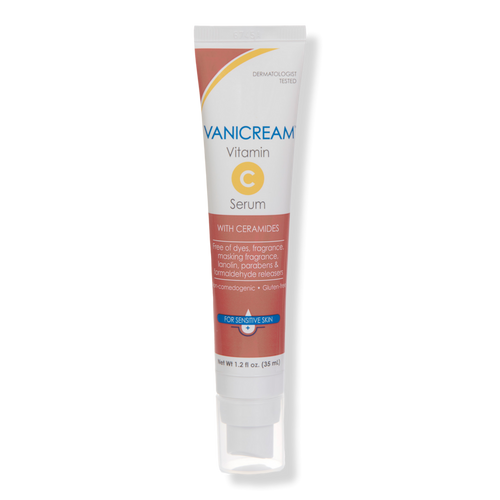
THD ascorbate at 5% in an airless pump. Vanicream chose tolerability over potency — a deliberate, honest trade.
Key facts
Vanicream Vitamin C Serum at a glance.
THD ascorbate 5%
Key active
Lightweight gel
Texture
Very sensitive skin; anyone who stings with regular vitamin C
Best for
$15–$18
Approximate price
Fragrance free
Fragrance
1.2 oz
Size
$19.99
Price
Serum
Type
What is it?
Top things to know about Vanicream Vitamin C Serum
- Vanicream Vitamin C Serum is a light, fragrance-free gel in an airless pump, about $15 to $18. It is a daily antioxidant serum, aimed squarely at people who cannot use ordinary vitamin C.
- The active is THD ascorbate at 5%, an oil-soluble form the skin has to convert before it can use it. Around it sit five ceramides, the fats that hold the outer layer together, plus glycerin and carnosine. No fragrance, no dye, no essential oil, and no sting — the entire point of the formula.
Built for people who sting with ordinary vitamin C. THD ascorbate works at normal skin pH, so it does not burn, and the airless pump keeps air off an ingredient that hates it. At 5% expect subtle change over months. If your skin tolerates L-ascorbic acid, that has far better evidence.
— Dr. Schwarz
Skin fit
Is it right for your skin?
Sensitive Skin
Pure vitamin C is L-ascorbic acid, and it only stays active below about pH 3.5. That acidity is what stings. THD ascorbate does not need a low pH, so this serum works at the skin's own pH and does not burn. If every vitamin C has left your face red, try this one.
Rosacea
Rosacea skin stings easily, and low-pH actives are among the most reliable triggers. This one avoids that by design, and the ceramides give the outer layer some fats back. It will not treat the redness. It is an antioxidant, not a rosacea medicine.
Sun Damage
Ultraviolet light damages skin partly by throwing off free radicals, unstable molecules that tear at collagen. Vitamin C mops those up, which is why it belongs in the morning under sunscreen rather than instead of it.
Hyperpigmentation
Vitamin C slows tyrosinase, the enzyme that starts melanin production, so it can lift dullness. Be honest about the dose. 5% of a derivative that still has to convert inside the skin is a light touch, and stubborn dark patches need something stronger.
Texture
What it feels like on skin.
Serum
A thin, clear gel that spreads easily and sinks in within a minute. No oil slick, no tackiness. It does not sting at all, unusual enough for a vitamin C to be the headline. Some people read that as it not working. A low-pH serum stings because of the pH, not the vitamin C. The airless pump is the best part of the packaging. Vitamin C breaks down in air, and an airless pump never lets any in, so the last dose is as good as the first. No fragrance, no color to stain.
Alternatives
If this isn’t the right product for you
The Ordinary Ascorbyl Tetraisopalmitate Solution 20% in Vitamin F
The same THD ascorbate at 20%, about $20, but in an oil base that does not suit oily skin.
Timeless Vitamin C
10% L-ascorbic acid with vitamin E and ferulic acid — the better-evidenced form, and the step up if 5% feels too subtle. It can sting.
Revision C+ Correcting Complex 30%
The same derivative at 30% in an airless pump. $164 is a lot for evidence thinner than L-ascorbic acid's.
Ingredients · Interactive
What’s in it, and where each ingredient works.
Full ingredient list · 20 ingredients, in label order. Click one.
The base the other ingredients are dissolved in. Most of it evaporates soon after the product goes on.
A small humectant. It moves into the outer layer of skin and holds water there.
One of the main fats between skin cells in the outer layer. It helps refill gaps in the barrier.
A long-chain ceramide that helps the barrier fats stack into tight, orderly layers.
A second skin ceramide. It works with the others to rebuild the barrier.
How to use it
How to use it.
How to apply it
- How muchOne or two pumps for the whole face. More does not convert faster.
What to pair it with
- LayeringThin enough to go under anything. If you also use a low-pH vitamin C or an exfoliating acid, put them on different days.
What to expect
- What to expectNothing dramatic and nothing quick. Brightness and evenness shift over two to three months. No sting, no purge, no adjustment period. If a dark patch has not moved by month three, the dose is too low.
Questions
Common questions.
Will Vanicream Vitamin C Serum sting?
No. It works at skin-friendly pH.
Is the 5% vitamin C in Vanicream Vitamin C Serum strong enough?
A low dose. Expect subtle brightening.
Why is the Vanicream Vitamin C Serum packaging notable?
An airless pump keeps air out and protects the vitamin C.
Is Vanicream Vitamin C Serum fragrance-free?
Yes. No fragrance, dyes or essential oils.
Who is Vanicream Vitamin C Serum best for?
Very sensitive skin that stings with regular vitamin C.
References
Sources.
- 1. Topical L-ascorbic acid: percutaneous absorption studies (https://pubmed.ncbi.nlm.nih.gov/11207686/) — Demonstrates that pure L-ascorbic acid must be formulated at a pH below 3.5 to penetrate the skin, supporting the claim that L-ascorbic acid requires low, acidic pH to work. Link
- 2. Topical Vitamin C and the Skin: Mechanisms of Action and Clinical Applications (https://jcadonline.com/topical-vitamin-c-and-the-skin-mechanisms-of-action-and-clinical-applications/) — Confirms L-ascorbic acid needs pH below 3.5 for stability and permeability while esterified vitamin C derivatives are more stable at neutral/higher pH, supporting the contrast drawn between L-ascorbic acid and pH-flexible derivatives. Link
- 3. Antioxidant Skincare Treatment for Hyperpigmented and Photodamaged Skin: Multi-Center, Open-Label, Cross-Seasonal Case Study (https://jcadonline.com/antioxidant-skincare-treatment-hyperpigmented-photodamaged-skin/) — Clinically evaluates a tetrahexyldecyl ascorbate (THD) serum showing statistically significant, well-tolerated improvement in photodamaged/hyperpigmented skin, supporting THD ascorbate as an evidence-backed vitamin C derivative. Link
- 4. Vanicream Vitamin C Serum (product page) (https://www.vanicream.com/product/vitamin-c-serum) — Manufacturer page confirming the serum uses THD ascorbate, an airless pump to prevent oxidation, five ceramides, and no dyes or fragrance. Link