PRODUCT REVIEW
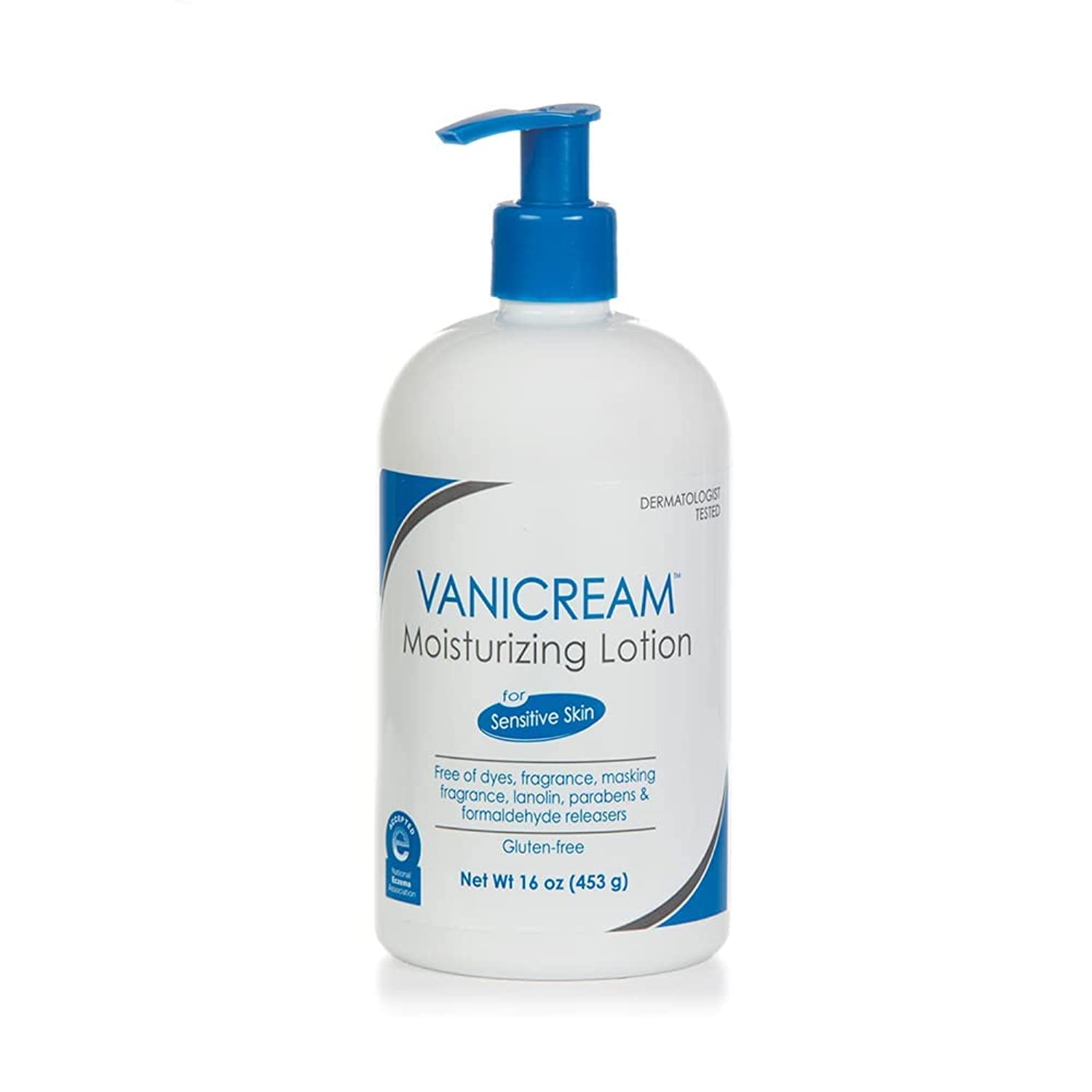
Vanicream Moisturizing Lotion
Eleven ingredients, no fragrance, dye or lanolin. No glycerin either, and the main humectant is a recognized sensitizer.
Key facts
Vanicream Moisturizing Lotion at a glance.
Petrolatum + propylene glycol + sorbitol
Key active
Light lotion
Texture
Very sensitive skin; body; anyone reacting to everything
Best for
$10–16 (by size)
Approximate price
Fragrance free
Fragrance
16 oz
Size
$14.20
Price
Moisturizer
Type
What is it?
Top things to know about Vanicream Moisturizing Lotion
- Vanicream Moisturizing Lotion is a light, fragrance-free lotion in a pump bottle, sold for around $10 to $16. It is a plain moisturizer for face and body, not a treatment — no ceramides, no niacinamide, no actives of any kind, and the brand says so plainly.
- Eleven ingredients in total. Petrolatum seals the surface so water cannot evaporate, propylene glycol and sorbitol pull water in, and cetearyl alcohol and glyceryl stearate hold it together as a lotion. No fragrance, no dye, no lanolin, no paraben, no formaldehyde releaser — the entire point of it.
Eleven ingredients doing exactly what they promise — petrolatum seals the surface, propylene glycol and sorbitol pull water in. No ceramides, no glycerin. If you have ever reacted to Vanicream, suspect the propylene glycol, a recognized contact sensitizer. For something richer, buy the Moisturizing Cream.
— Dr. Schwarz
Skin fit
Is it right for your skin?
Sensitive Skin
A short ingredient list is a real advantage — fewer suspects, and a product you can troubleshoot. Eleven ingredients here, no fragrance, dye or lanolin. Propylene glycol is the one to watch: a recognized contact sensitizer, and the main humectant in this formula.
Eczema
Eczema-prone skin does not make enough filaggrin, the protein that becomes the skin's own natural moisturizer, so what it cannot make has to be put back daily. This lotion is bland enough for that, and cheap enough that you will not ration it.
Dry Skin
Petrolatum is the reference sealant and sits second on this list, so the lotion holds water in rather than just feeling nice for an hour. Put it on damp skin out of the shower — it traps water already there.
Contact Dermatitis
When your skin is reacting and you do not know to what, you need a moisturizer that removes variables. This one drops fragrance, dye, lanolin, parabens and formaldehyde releasers in one step. If you have reacted to Vanicream itself, suspect the propylene glycol.
Texture
What it feels like on skin.
Lotion
A light lotion that spreads easily and sinks in without a film. Thinner than the Vanicream cream in the tub, and lighter than most eczema moisturizers. No scent at all, not even the faint fatty smell some unscented products carry. It does not sting on cracked skin, which is the point of it. It contains no glycerin, which is unusual — glycerin is the cheapest, best-tolerated humectant there is. Propylene glycol does that job instead. The pump is practical for body use.
Alternatives
If this isn’t the right product for you
CeraVe Moisturizing Cream
Fragrance-free at about a dollar an ounce, adding ceramides, hyaluronic acid and glycerin alongside petrolatum. It does all three moisturizing jobs.
Vanicream Moisturizing Cream
The richer version of the same short, fragrance-free idea. Propylene glycol is fairly high in it too, so not the swap if that is your trigger.
CeraVe PM Facial Moisturizing Lotion
A light, fragrance-free face lotion with niacinamide and ceramides for $6–7 an ounce. It pills, so apply thinly.
Ingredients · Interactive
What’s in it, and where each ingredient works.
Full ingredient list · 11 ingredients, in label order. Click one.
The base the other ingredients are dissolved in. Most of it evaporates soon after the product goes on.
Forms a thin film on top of the skin that slows water loss while the barrier recovers.
A fatty alcohol that softens skin and thickens the product. Despite the name, it is not drying.
An emulsifier. It keeps the oil and water parts from separating.
How to use it
How to use it.
How to apply it
- How muchEnough to leave skin faintly shiny for a moment. On the body most people use far too little.
- CarefulIf you have reacted to this lotion, suspect the propylene glycol — third on the list, and a recognized contact sensitizer.
What to expect
- What to expectTightness and itch ease in a day or two. It works while it is on and stops when you stop. Rough patches take a couple of weeks. It does not do what a treatment does.
Questions
Common questions.
Does Vanicream Moisturizing Lotion contain glycerin?
No. Some listings say otherwise; it is not on the list.
Is Vanicream Moisturizing Lotion fragrance-free?
Yes — no masking scent, no dyes, no lanolin.
Why might my skin react to Vanicream Moisturizing Lotion?
Propylene glycol, the main humectant, is a recognized sensitizer.
Does Vanicream Moisturizing Lotion have ceramides or niacinamide?
No. A plain moisturizer, not a treatment.
Is Vanicream Moisturizing Lotion good value?
Yes. Very cheap per ounce, fine for daily use.
References
Sources.
- 1. Vanicream Moisturizing Lotion (official product page) (https://www.vanicream.com/product/vanicream-moisturizing-lotion) — Confirms the eleven-ingredient formula (water, petrolatum, propylene glycol, cetearyl alcohol, sorbitol, ceteareth-20, simethicone, glyceryl stearate, PEG-30 stearate, sorbic acid, BHT), that propylene glycol is listed third, that petrolatum is present, and that the product is free of fragrance and masking fragrance, dyes, lanolin, parabens, and formaldehyde. Link
- 2. Propylene Glycol in Contact Dermatitis: A Systematic Review (McGowan MA, Scheman A, Jacob SE. Dermatitis. 2018) (https://pubmed.ncbi.nlm.nih.gov/29064881/) — Supports the claim that propylene glycol is a recognized contact sensitizer; it was named the American Contact Dermatitis Society's Allergen of the Year for 2018 and acts as a weak sensitizer and irritant. Link
- 3. Active agents in common skin care products (Draelos ZD. Plast Reconstr Surg. 2010) (https://pubmed.ncbi.nlm.nih.gov/20124857/) — Supports that moisturizers are based on occlusive substances such as petrolatum, confirming petrolatum's role as an occlusive that does the barrier/occlusion job. Link
- 4. Safety of Petroleum-Based Emollients in Pediatric Atopic Dermatitis (Ghali H, Krenitsky A, Albers SE. Clin Pediatr. 2025) (https://pubmed.ncbi.nlm.nih.gov/40170321/) — Supports that petrolatum-based emollients are affordable occlusive agents that prevent moisture loss and form a protective layer, and reviews their safety. Link
- 5. Skin permeability barrier and occlusion: no delay of repair in irritated human skin (Welzel J, Wilhelm KP, Wolff HH. Contact Dermatitis. 1996) (https://pubmed.ncbi.nlm.nih.gov/8930477/) — Supports petrolatum's occlusive function; the study used petrolatum as an occlusive treatment and measured its effect on transepidermal water loss during skin barrier repair. Link