PRODUCT REVIEW
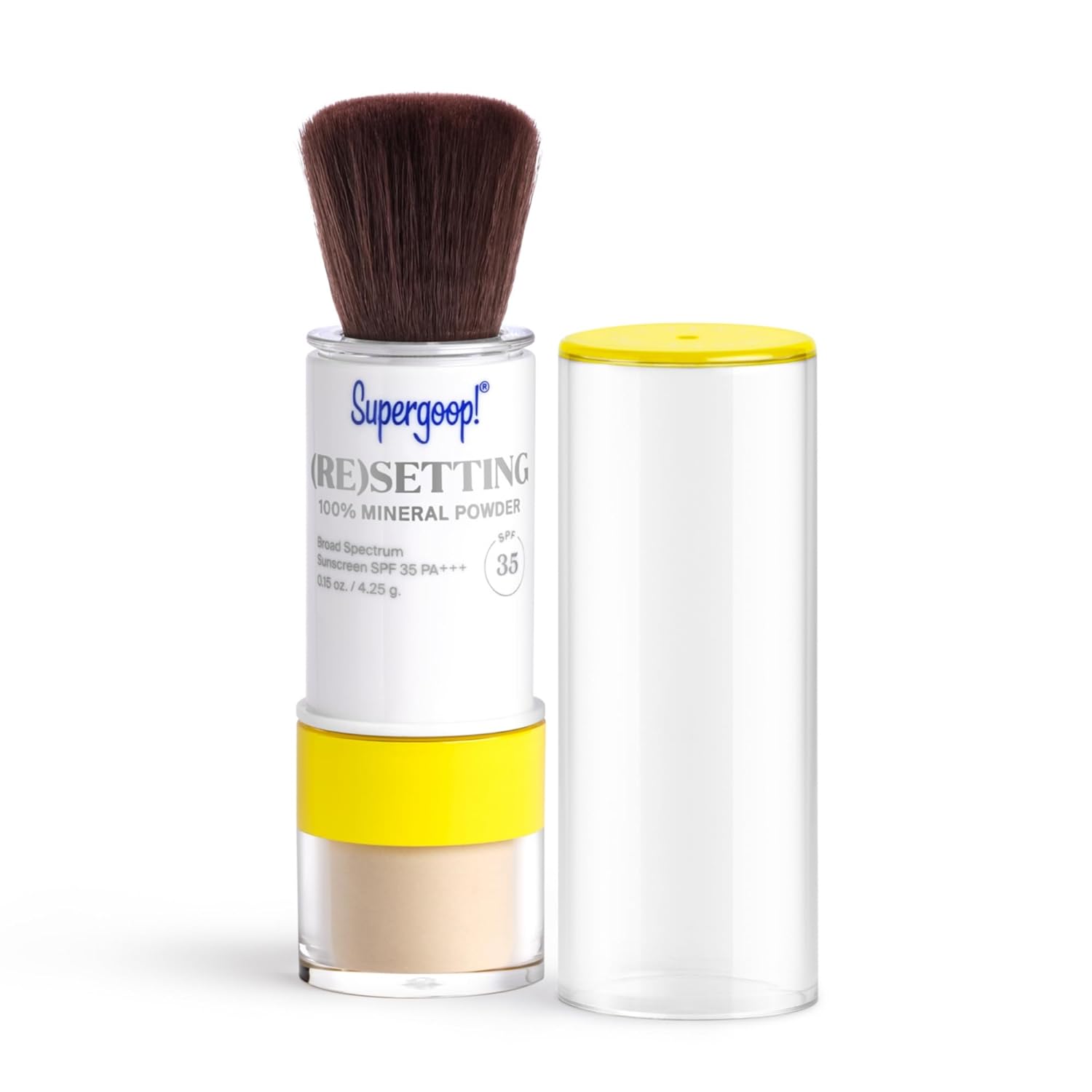
Supergoop! (Re)setting Powder
A zinc oxide powder for topping up sun protection over makeup. Not adequate as your only sunscreen.
Key facts
Supergoop! (Re)setting Powder at a glance.
Zinc oxide 24.7% (SPF 35)
Key active
SPF 35 setting powder
Texture
Reapplying over makeup at midday; controlling shine
Best for
$34–38
Approximate price
Fragrance free
Fragrance
0.15 oz
Size
$35.00
Price
Sunscreen
Type
What is it?
Top things to know about Supergoop! (Re)setting Powder
- Supergoop! (Re)setting Powder is a loose mineral powder, 0.15 oz for around $35. It is a top-up tool, not your morning sunscreen. Almost nobody brushes on enough to reach the number on the label, so use it over a sunscreen you already applied.
- The active is zinc oxide at 24.7 percent, a mineral filter that sits on the surface and scatters and absorbs ultraviolet light instead of soaking in. Silica and boron nitride soak up oil and cut shine, and ceramide 3 takes the dry edge off. It is talc-free and fragrance-free, and matte enough that people carry it for shine as much as for sun.
This is a reapplication tool, not a sunscreen. People brush on about a tenth of the film SPF is measured at, so the 35 on the label is not what your face gets. Real sunscreen in the morning, this over makeup at midday. It does control shine well.
— Dr. Schwarz
Skin fit
Is it right for your skin?
Oily Skin
Silica and boron nitride absorb oil, so the powder cuts shine while it adds zinc. That is the real reason it gets reapplied — a second job you already wanted done at one in the afternoon.
Melasma
Melasma is fed by ultraviolet light, visible light and heat, and it returns on people who apply sunscreen once and never again. Zinc oxide covers the ultraviolet part, and shades with iron oxides block some visible light. This makes the midday top-up realistic.
Sun Damage
Sunscreen wears off. Sweat, rubbing and time take a film down over a couple of hours, so what you have at noon is not what you applied at eight. This puts some back over finished makeup, and it is not enough on its own.
Texture
What it feels like on skin.
Powder
A fine loose powder that brushes on over finished makeup without disturbing it, which a lotion cannot do. It goes on matte and cuts shine straight away. Ceramide 3 offsets the tight, dusty feel powders usually leave, and mostly succeeds. The translucent shade can look chalky on deeper skin tones. At 0.15 oz the pot is small, which is fine for touch-ups.
Alternatives
If this isn’t the right product for you
EltaMD UV Clear
Use a real sunscreen as your morning layer. Oil-free and fragrance-free with 5% niacinamide, and it sits well under makeup.
ROUND LAB Birch Juice Sun Cushion
A zinc oxide 22% cushion press puts down a real film, a step up from powder. Still a top-up.
Cetaphil Mineral Stick
Another way to top up during the day, and the better tool for ears, nose and hairline. Sticks go on thin, so not your only sunscreen.
Ingredients · Interactive
What’s in it, and where each ingredient works.
Full ingredient list · 18 ingredients, in label order. Click one.
Helps the preservative work and softens the feel of the product.
How to use it
How to use it.
How to apply it
- How muchMore than feels natural. The SPF on any label is measured at a thick, even film, and studies of powder sunscreens find people apply roughly a tenth of that. Build a visible layer, not a dusting.
- WhereThe face, especially the nose, cheekbones and forehead. No help on ears or a hairline part.
- ReapplyEvery two hours outdoors, and after sweating or swimming. Powder does not survive sweat.
What to expect
- What to expectShine control immediately, and less sun protection than the number on the pot suggests. Treat it as adding to what is already there.
Questions
Common questions.
Is Supergoop!setting Powder mineral or chemical?
Mineral. The only active is zinc oxide.
Can I use Supergoop!setting Powder as my only sunscreen?
No. It is a top-up over a base sunscreen.
Can I reapply Supergoop!setting Powder over makeup?
Yes. That is its main use.
Will Supergoop!setting Powder leave a cast?
The translucent shade can look chalky on deeper skin tones.
Is Supergoop!setting Powder fragrance-free?
Yes, and talc-free.
What SPF is Supergoop!setting Powder?
SPF 35.
References
Sources.
- 1. Patient Knowledge of Sunscreen Guidelines and Frequency of Physician Counseling: A Cross-sectional Study (https://pubmed.ncbi.nlm.nih.gov/29410729/) — Supports the claim that most people do not know or follow correct sunscreen reapplication and application practices; the majority of surveyed patients lacked adequate knowledge of how much to apply and how often to reapply. Link
- 2. Assessment of thickness of photoprotective lipsticks and frequency of reapplication: results from a laboratory test and a field experiment (https://doi.org/10.1046/j.1365-2133.2003.05032.x) — Supports that in real-world use sunscreen products are applied far below the recommended 2 mg/cm2 and reapplied too infrequently, reducing photoprotection - the core rationale for a midday top-up product. Link
- 3. In vitro assessment of the broad-spectrum ultraviolet protection of sunscreen products (https://doi.org/10.1067/mjd.2000.109291) — Supports that zinc oxide is a recognized long-wave UVA / broad-spectrum sunscreen active ingredient, backing the claim that the powder 'adds real zinc oxide' for UV protection. Link
- 4. The Skin Barrier and Moisturization: Function, Disruption, and Mechanisms of Repair (https://pubmed.ncbi.nlm.nih.gov/37717558/) — Supports that ceramides and moisturizing ingredients strengthen the stratum corneum and reduce transepidermal water loss/dryness, backing the rationale that added ceramides offset the drying feel of a powder. Link