PRODUCT REVIEW
Supergoop! PLAY Lip Balm with Acai SPF 30
Properly photostabilized, so better UVA cover than Jack Black's — and fragranced, while selling itself as clean.
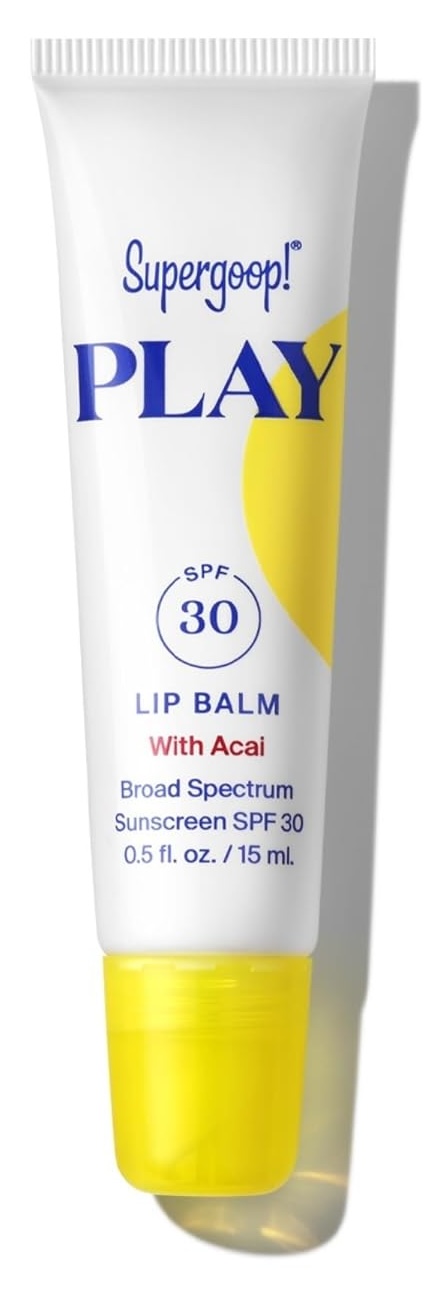
Key facts
Supergoop! PLAY Lip Balm with Acai SPF 30 at a glance.
Avobenzone + homosalate + octisalate + octocrylene
Key active
Smooth balm
Texture
Daily lip sun protection
Best for
$12
Approximate price
0.5 oz
Size
$12.00
Price
Lip
Type
What is it?
Top things to know about Supergoop! PLAY Lip Balm with Acai SPF 30
- Supergoop! PLAY Lip Balm with Acai SPF 30 is a flavored lip balm with sunscreen in it, twist-up tube, about $12. It is lip sunscreen, not lip treatment, and nothing in it repairs a chapped lip.
- The filters are avobenzone for UVA, held steady by octocrylene so it does not fade in the first hour of sun, plus homosalate and octisalate for UVB. Shea, sunflower and safflower oils carry them, so it goes on smooth rather than waxy. It also carries a full flavor and fragrance complex.
Supergoop! PLAY Lip Balm SPF 30 covers a spot most people never protect, and the lower lip is where sun damage behaves worst. Octocrylene holds the avobenzone steady, so it survives real sun. But it is flavored and fragranced, a common cause of allergic cheilitis. If your lips stay sore, stop.
— Dr. Schwarz
Skin fit
Is it right for your skin?
Sun Damage
The vermilion of the lip has a very thin outer layer and almost no melanin, the pigment that soaks up UV elsewhere. UV reaches living cells there with almost nothing in the way. Supergoop! PLAY Lip Balm covers a gap most people leave open all day.
Actinic Keratosis
Rough, scaly precancer spots form where UV has hit the same skin for years, and the lower lip takes the most direct sun on the face. Daily cover there is prevention, not treatment. A balm in a pocket gets used.
Sunburn
Lips burn, and a burned lip ruins eating and drinking for days. SPF 30 as a full layer, reapplied every two hours, holds that off. A single morning swipe does not.
Texture
What it feels like on skin.
Balm
It goes on smooth and slightly waxy with a light shine, thick enough to leave the real layer a lip SPF needs. It has a strong flavor and fragrance complex, and most people say it tastes like sunscreen. That taste is why a lip SPF stops getting reapplied. The twist-up tube makes a full layer easy without a mirror. It transfers onto cups and food, so reapply after eating.
Alternatives
If this isn’t the right product for you
La Roche-Posay Anthelios Light Fluid Facial Sunscreen
A lip balm covers lips only. This SPF 60 fluid spreads like water and leaves no cast on any skin tone.
Cetaphil Mineral Stick
A fragrance-free mineral stick for lips, ears and nose. Useful if flavored balms bother your lips, and a top-up rather than your only sunscreen.
Jack Black Intense Therapy Lip Balm SPF 25
At about 40% petrolatum an excellent balm for chapped lips, but it pairs avobenzone with octinoxate, which degrades it.
Ingredients · Interactive
What’s in it, and where each ingredient works.
Full ingredient list · 30 ingredients, in label order. Click one.
Another fatty alcohol. It softens skin and gives the product body.
Vitamin E, an antioxidant. Here it mainly keeps the oils in the product from going rancid.
How to use it
How to use it.
How to apply it
- How muchA full, even layer, not a thin swipe. SPF is tested at a thick coat, and a lip takes two passes.
- WhereThe whole lip, the corners, and the line where lip meets skin. The lower lip takes the most sun.
- ReapplyEvery two hours in the sun, and after eating, drinking or wiping your mouth. That is the whole game with a lip SPF.
- CarefulFlavored balm on chapped lips is a common trigger for allergic cheilitis, an allergic reaction on the lips. If your lips stay sore, switch to an unflavored balm.
What to expect
- What to expectNothing to feel, and it works only while it is on. It will not heal chapping, and SPF 30 on the lips does nothing for the rest of your face.
Questions
Common questions.
Does Supergoop! PLAY Lip Balm with Acai SPF 30 really protect better than Jack Black's lip balm?
For UVA, yes. This one stabilizes its avobenzone; Jack Black's pairs it with octinoxate, which breaks it down.
Is Supergoop! PLAY Lip Balm with Acai SPF 30 a clean product?
Marketed that way, but it contains a full flavor and fragrance complex.
Why does the Supergoop! PLAY Lip Balm with Acai SPF 30 label say oxybenzone- and octinoxate-free?
It uses homosalate and octocrylene instead. If you are avoiding chemical filters, this does not solve it.
Can I use Supergoop! PLAY Lip Balm with Acai SPF 30 as my only face sunscreen?
No, lips only. The rest of your face needs its own.
How often should I reapply Supergoop! PLAY Lip Balm with Acai SPF 30?
Every two hours outdoors, and after eating or drinking.
Is there a mineral version of Supergoop! PLAY Lip Balm with Acai SPF 30 that uses zinc?
No.
References
Sources.
- 1. Filter-filter interactions. Photostabilization, triplet quenching and reactivity with singlet oxygen (https://doi.org/10.1039/b9pp00158a) — Directly studies avobenzone photostability in combination with other UV filters including octocrylene and octyl methoxycinnamate, supporting the claim that filter pairings can either stabilize or accelerate breakdown of avobenzone. Link
- 2. Relevance of UV filter/sunscreen product photostability to human safety (https://doi.org/10.1111/phpp.12113) — Explicitly identifies octyl methoxycinnamate (octinoxate) plus avobenzone as a photo-unstable combination, backing the claim that octinoxate destabilizes avobenzone. Link
- 3. 3-(3,4,5-Trimethoxybenzylidene)-2,4-pentanedione: Design of a novel photostabilizer with in vivo SPF boosting properties and its use in developing broad-spectrum sunscreen formulations (https://doi.org/10.1111/ics.12344) — Confirms octocrylene is an established commercial photostabilizer used to protect avobenzone from UV-induced degradation, supporting the claim that octocrylene stabilizes avobenzone. Link
- 4. Sunscreen: How to Help Protect Your Skin from the Sun (https://www.fda.gov/drugs/understanding-over-counter-medicines/sunscreen-how-help-protect-your-skin-sun) — FDA lists avobenzone among approved sunscreen active ingredients and explains broad-spectrum products protect against UVA, supporting that avobenzone is a US-recognized UVA filter. Link