PRODUCT REVIEW
SkinCeuticals Triple Lipid Restore 2:4:2
A $155 cream labeled "fragrance-free" that contains lavender, rosemary and peppermint oil, plus two declared fragrance allergens.
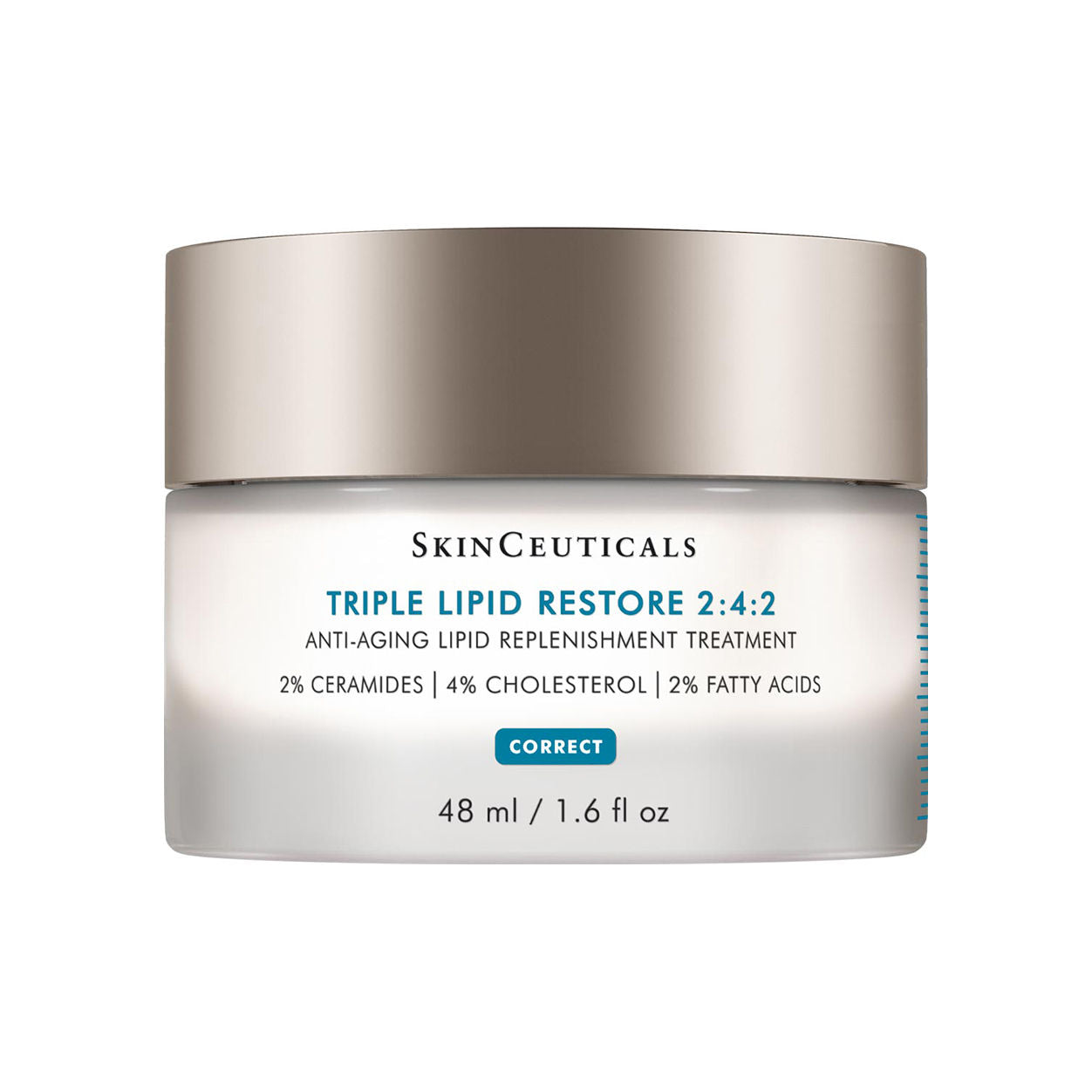
Key facts
SkinCeuticals Triple Lipid Restore 2:4:2 at a glance.
2% ceramides + 4% cholesterol + 2% fatty acids
Key active
Emollient cream
Texture
Dry, mature skin — if you tolerate essential oils
Best for
$155 for 1.6 oz
Approximate price
1.6 oz
Size
$155.00
Price
Moisturizer
Type
What is it?
Top things to know about SkinCeuticals Triple Lipid Restore 2:4:2
- SkinCeuticals Triple Lipid Restore 2:4:2 is a rich cream, 1.6 oz for $155, sold mostly through dermatology offices and online. It repairs the barrier. It does not treat acne, pigment or lines.
- The name is the formula: 2 percent ceramides, 4 percent cholesterol, 2 percent fatty acids, the three fats that glue skin cells together. Dimethicone and hydrogenated polyisobutene hold the cream together and seal the surface. It also carries lavender, rosemary and peppermint oil, which is why a cream labeled fragrance free has a clear herbal scent.
SkinCeuticals Triple Lipid Restore 2:4:2 gets the ratio right, cholesterol-dominant and printed on the box, which is what barrier repair needs. Then it adds lavender, rosemary and peppermint oil and calls itself fragrance-free. Compromised skin is the most likely to react. If you are reactive, buy a plain ceramide cream instead.
— Dr. Schwarz
Skin fit
Is it right for your skin?
Dry Skin
Dry skin runs short on the fats that hold the outer layer together, so water walks out through the gaps. SkinCeuticals Triple Lipid Restore 2:4:2 replaces all three and prints the amounts on the box. Almost no other cream does.
Damaged Skin Barrier
Barrier-repair research found a lipid mix sped recovery only when cholesterol was the dominant fat, and a fatty-acid-heavy mix could slow it down. This one is cholesterol-dominant at 4 percent against 2 and 2. The catch is the lavender, rosemary and peppermint oil, since sore skin reacts most.
Sun Damage
Skin makes fewer barrier fats with age and sun exposure, which is part of why mature skin feels tight and crepey. Replacing them does not undo sun damage. It changes how skin feels and how it catches light, which is comfort and texture, not correction.
Texture
What it feels like on skin.
Cream
A rich cream that stays soft rather than greasy. A little covers the face. Dimethicone is the second ingredient, so it glides on to a smooth, silky finish. It can pill under silicone-heavy sunscreens. Despite the fragrance-free label it smells herbal, from lavender, rosemary and peppermint oil. Those oils oxidize once the bottle is open, and get more likely to cause a reaction as they do.
Troubleshooting
If it didn’t work for you.
If it pills
Try thisUse less, wait a minute, press it in instead of rubbing. Layering it under a silicone-heavy sunscreen is the usual trigger.
Alternatives
If this isn’t the right product for you
Paula's Choice 10% Niacinamide Booster
Fragrance-free, with licorice root, beta-glucan and panthenol. A tone and pore treatment, not a barrier cream.
The Inkey List Tranexamic Acid Serum
A short, fragrance-free list with two mild actives, so stinging is unlikely. It targets pigment, not the barrier.
SkinCeuticals Discoloration Defense Serum
Also fragrance-free, and it discloses its percentages. A $115 pigment serum, so a different job at a high price.
Ingredients · Interactive
What’s in it, and where each ingredient works.
Full ingredient list · 37 ingredients, in label order. Click one.
The base the other ingredients are dissolved in. Most of it evaporates soon after the product goes on.
A silicone that smooths the surface and adds to the protective film.
A small humectant. It moves into the outer layer of skin and holds water there.
A barrier fat that works alongside ceramides. The barrier needs both to repair well.
One of the main fats between skin cells in the outer layer. It helps refill gaps in the barrier.
The preservative. It stops bacteria and mold from growing in the product.
Binds minerals in the water so the preservative works better and the formula stays stable.
A long-chain ceramide that helps the barrier fats stack into tight, orderly layers.
Vitamin E, an antioxidant. Here it mainly keeps the oils in the product from going rancid.
How to use it
How to use it.
How to apply it
- How muchA pea-sized amount for the whole face. More than that is what makes it pill.
What to expect
- What to expectComfort the same day, from the sealing. Barrier repair takes two to four weeks. Itching, stinging or bumps in the first week point to the essential oils, and that is a reason to stop.
Questions
Common questions.
Is SkinCeuticals Triple Lipid Restore 2:4:2 really fragrance-free?
No. It contains lavender, rosemary and peppermint oils plus linalool and limonene.
What makes the SkinCeuticals Triple Lipid Restore 2:4:2 formula good?
It discloses its lipid amounts, and the cholesterol-dominant ratio matches barrier-repair research.
Is SkinCeuticals Triple Lipid Restore 2:4:2 worth $155?
Well reasoned, but far cheaper ceramide creams cover the basics. You pay a large premium.
Does SkinCeuticals Triple Lipid Restore 2:4:2 contain hyaluronic acid, vitamin C, or peptides?
No, though it contains vitamin E. The chip mentions them; the ingredient list does not.
Is SkinCeuticals Triple Lipid Restore 2:4:2 good for oily skin?
It is rich and can pill. Better for dry skin.
References
Sources.
- 1. Optimal ratios of topical stratum corneum lipids improve barrier recovery in chronologically aged skin (Zettersten, Ghadially, Feingold, Crumrine, Elias; J Am Acad Dermatol, 1997) (https://pubmed.ncbi.nlm.nih.gov/9308554/) — This is the 1997 barrier-repair study the page cites: a 3:1:1:1 mixture accelerated barrier recovery only when cholesterol was the dominant lipid, while a fatty-acid-dominant mixture significantly delayed recovery, supporting the claim that a cholesterol-dominant ratio is what the research supports. Link
- 2. SkinCeuticals Triple Lipid Restore 2:4:2 ingredients explained (INCIDecoder) (https://incidecoder.com/products/skinceuticals-triple-lipid-restore-2-4-2) — Confirms the product is formulated with the disclosed concentrations of 2% pure ceramides, 4% natural cholesterol, and 2% fatty acids, backing the page's claim that SkinCeuticals prints actual numbers on the box. Link
- 3. Role of lipids in the formation and maintenance of the cutaneous permeability barrier (Feingold & Elias; Biochim Biophys Acta, 2013) (https://pubmed.ncbi.nlm.nih.gov/24262790/) — Establishes the underlying mechanism that the stratum corneum permeability barrier is formed by lamellar membranes composed of ceramides, cholesterol, and free fatty acids, the three lipids the product supplies. Link
- 4. Stratum Corneum Lipids: Their Role for the Skin Barrier Function in Healthy Subjects and Atopic Dermatitis Patients (van Smeden & Bouwstra; Curr Probl Dermatol, 2016) (https://pubmed.ncbi.nlm.nih.gov/26844894/) — Confirms the stratum corneum lipid matrix is dominated by three lipid classes (cholesterol, free fatty acids, and ceramides) whose composition and ratios determine barrier organization, supporting the rationale for a lipid-ratio-based barrier cream. Link
- 5. Ceramides and skin function (Coderch, Lopez, de la Maza, Parra; Am J Clin Dermatol, 2003) (https://pubmed.ncbi.nlm.nih.gov/12553851/) — Explains that the intercellular barrier lipids are roughly equimolar ceramides/cholesterol/fatty acids and that complete physiologic-lipid mixtures restore normal lamellar structure, supporting the barrier-repair premise of a ceramide-cholesterol-fatty acid cream. Link