PRODUCT REVIEW
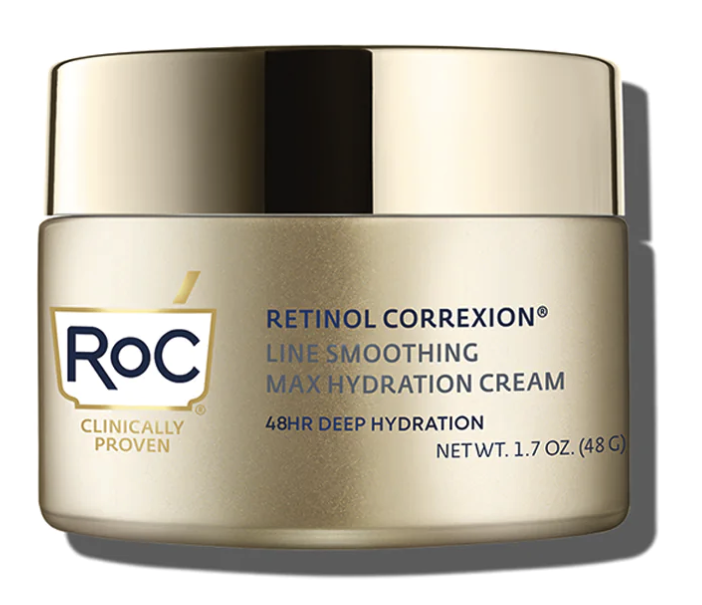
RoC Retinol Max Hydration Cream
The same undisclosed retinol as the rest of the Correxion line, in a richer base and the same jar.
Key facts
RoC Retinol Max Hydration Cream at a glance.
Retinol (percentage not disclosed)
Key active
Rich, hydrating cream
Texture
Dry skin on a retinoid
Best for
$20–$28
Approximate price
1.7 oz
Size
$28.49
Price
Retinoid
Type
What is it?
Top things to know about RoC Retinol Max Hydration Cream
- RoC Retinol Max Hydration Cream is a rich night cream with retinol, in a screw-top jar at drugstores for about $20 to $28. It is a treatment rather than a plain moisturizer, but not a strong one, and RoC does not print the retinol percentage.
- Retinol is the form of vitamin A that skin converts into retinoic acid. Around it sit glycerin and sodium hyaluronate, humectants that pull water into the outer layer, plus dimethicone to slow it escaping. That is why the cream feels cushioned, and why early flaking is usually milder than with a plain retinol serum.
Pairing retinol with a rich base is the right idea, because dryness and flaking are why people quit retinoids. But RoC will not print the strength, and the jar exposes the retinol to air every time you open it. Buy a retinol in an opaque tube that states its percentage.
— Dr. Schwarz
Skin fit
Is it right for your skin?
Dry Skin
Retinoids speed up how fast skin cells shed, and dry skin has the least to spare. The rich base replaces some of the water it costs you as you go.
Sun Damage
Sun damage breaks down collagen in the deeper layer, and retinol has the strongest evidence for rebuilding it. Expect slow work, because RoC will not say how much is in the jar.
Damaged Skin Barrier
A retinoid weakens the outer layer for a few weeks before skin adapts, and that is when stinging and flaking show up. The hydrating base is aimed straight at it. If your barrier is already sore, let it settle first.
Texture
What it feels like on skin.
Cream
A rich cream, thicker than most night creams that carry an active. It sinks in slowly and leaves a soft cushion. On oily skin that is too much. It comes in a screw-top jar with no inner seal, so every opening exposes the whole pot to air and light. The standard version is scented; a fragrance-free version exists.
Alternatives
If this isn’t the right product for you
Good Molecules Gentle Retinol Cream
Discloses retinol 0.11% and bakuchiol 0.30%, fragrance-free, about $10. You know what strength you are buying.
Neutrogena Rapid Wrinkle Repair Retinol Regenerating Cream
Real retinol at an undisclosed strength, a similar price, also in a jar. A fragrance-free version exists there too.
RoC Retinol Correxion Deep Wrinkle Night Cream
The same undisclosed retinol from the same line, but it stacks glycolic acid, fragrance and parabens onto an already irritating product.
Ingredients · Interactive
What’s in it, and where each ingredient works.
Full ingredient list · 35 ingredients, in label order. Click one.
The base the other ingredients are dissolved in. Most of it evaporates soon after the product goes on.
A small humectant. It moves into the outer layer of skin and holds water there.
A silicone that smooths the surface and adds to the protective film.
A form of hyaluronic acid. Its molecule is large, so it stays on the surface and holds water there.
Vitamin E, an antioxidant. Here it mainly keeps the oils in the product from going rancid.
A fatty alcohol that softens skin and thickens the product. Despite the name, it is not drying.
An emulsifier. It keeps the oil and water parts from separating.
Binds minerals in the water so the preservative works better and the formula stays stable.
The preservative. It stops bacteria and mold from growing in the product.
Helps the preservative work and softens the feel of the product.
How to use it
How to use it.
How to apply it
- How muchA pea-sized amount for the whole face. More does not work faster, it only irritates faster.
- CarefulAdd one night at a time, and wear sunscreen every morning, because retinoids leave skin more sensitive to sun. Keep it off the immediate eye area, and no exfoliating acid the same night until your skin is used to both.
What to expect
- What to expectDryness, light flaking and stinging are normal for two to four weeks. Texture usually looks better by twelve weeks. Still angry after a month means fewer nights.
Questions
Common questions.
How strong is RoC Retinol Max Hydration Cream?
RoC does not disclose it.
Is there a fragrance-free version of RoC Retinol Max Hydration Cream?
Yes. The standard version is scented; choose the fragrance-free one if you are sensitive.
Is RoC Retinol Max Hydration Cream real retinol?
Yes, retinol rather than a weaker ester.
Why does RoC Retinol Max Hydration Cream pair retinol with a rich moisturizer?
Retinoids dry skin out. A hydrating base makes one easier to keep using.
Is RoC Retinol Max Hydration Cream good for dry skin?
Yes. The richer base is aimed at dry skin on a retinoid.
References
Sources.
- 1. Human Skin Aging and the Anti-Aging Properties of Retinol (https://www.mdpi.com/2218-273X/13/11/1614) — Confirms that topical retinol is a genuine active that improves skin texture, reduces fine lines and thickens the epidermis/dermis, backing the claim that the product contains real, effective retinol. Link
- 2. Prospective, randomized, double-blind assessment of topical bakuchiol and retinol for facial photoageing (https://academic.oup.com/bjd/article-abstract/180/2/289/6601687) — Randomized trial found retinol users reported more facial skin scaling and stinging, supporting that irritation, flaking and stinging are expected with a real retinol. Link
- 3. Use of Retinoids in Topical Antiaging Treatments: A Focused Review of Clinical Evidence for Conventional and Nanoformulations (https://link.springer.com/article/10.1007/s12325-022-02319-7) — Explains that retinol is a distinct compound metabolized to retinoic acid (not an ester like retinyl palmitate) and that retinoid dermatitis is dose-dependent, supporting the 'real retinol, not an ester' claim and that persistent irritation means the dose is too high. Link
- 4. 50 Years of Topical Retinoids for Acne: Evolution of Treatment (https://link.springer.com/article/10.1007/s40257-021-00594-8) — States that for all topical retinoids local irritation is associated with poor tolerability and suboptimal adherence, backing the claim that irritation is the single biggest reason people quit retinoids. Link