PRODUCT REVIEW
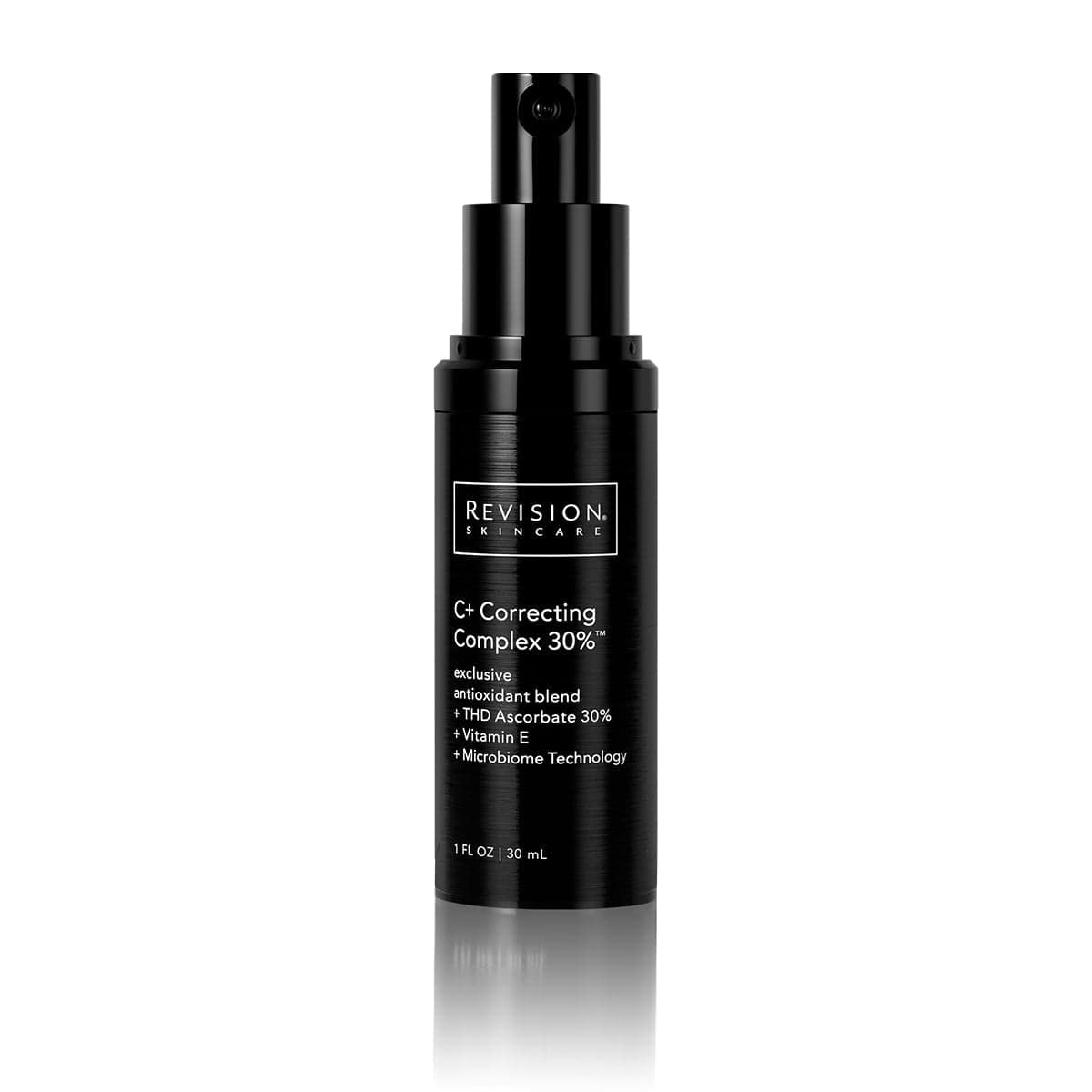
Revision C+ Correcting Complex 30%
A $164 serum whose "30%" is a derivative, not pure vitamin C. The number is real; the comparison is not.
Key facts
Revision C+ Correcting Complex 30% at a glance.
THD ascorbate 30%
Key active
Lightweight, non-greasy serum
Texture
Sensitive or melasma-prone skin that cannot use pure vitamin C
Best for
$155–$164
Approximate price
Fragrance free
Fragrance
1 oz
Size
$190.00
Price
Serum
Type
What is it?
Top things to know about Revision C+ Correcting Complex 30%
- Revision C+ Correcting Complex 30% is a fragrance-free vitamin C serum in an airless pump, $155 to $164, sold through dermatology and medical spa offices. It is an antioxidant and tone serum. Nothing in it resurfaces skin.
- The 30 percent is tetrahexyldecyl ascorbate, or THD ascorbate, an oil-soluble form of vitamin C rather than the pure L-ascorbic acid most serums use. Acetyl zingerone, ergothioneine, CoQ10 and vitamin E sit around it, mopping up the same damage from other angles. THD works at normal skin pH, so the serum feels light and does not sting.
Well built, and the number invites the wrong comparison. The 30% is THD ascorbate, an oil-soluble derivative, so it is not stronger than a 20% L-ascorbic acid serum. What it buys is comfort — no sting, no browning — which genuinely helps melasma-prone skin, because irritation drives pigment. The evidence for THD is thinner.
— Dr. Schwarz
Skin fit
Is it right for your skin?
Melasma
Melasma-prone skin makes pigment in response to almost any irritation, so a serum that stings can leave skin darker than it started. THD ascorbate works at normal skin pH, not the acidic pH pure vitamin C needs, so Revision C+ Correcting Complex 30% gives the antioxidant step without that risk.
Sensitive Skin
Most of what makes a vitamin C serum sting is the acidity it has to be dissolved in. There is none here, so people who have failed every L-ascorbic acid serum usually get through this one.
Hyperpigmentation
Vitamin C slows tyrosinase, the enzyme that starts pigment production, so spots fade gradually rather than lift. Expect a slow evening of tone over months. The evidence for the derivative is thinner than for pure vitamin C.
Sun Damage
Ultraviolet light creates free radicals, and antioxidants neutralize them before they break down collagen. This serum stacks several. It backs up sunscreen; it never replaces it.
Texture
What it feels like on skin.
Serum
A light, non-greasy serum that absorbs cleanly and leaves no film. It does not sting or tingle, which is the practical argument for the oil-soluble form. It does not turn brown either, because THD does not oxidize the way L-ascorbic acid does. The airless pump keeps light and air off the active. It layers under sunscreen and makeup without pilling.
Alternatives
If this isn’t the right product for you
The Ordinary Ascorbyl Tetraisopalmitate Solution 20% in Vitamin F
The same THD ascorbate at 20%, in an oil base, about $20. The extra money does not buy eight times the C.
Vanicream Vitamin C Serum
Also THD ascorbate, at 5%, in an airless pump with ceramides and no fragrance, about $15. Low dose, gentle, cheap.
Sunday Riley CEO 15% Vitamin C Brightening Serum
Also THD ascorbate, at a lower 15%, in a dropper bottle that lets air in, plus citrus oils and low-level glycolic acid.
Ingredients · Interactive
What’s in it, and where each ingredient works.
Full ingredient list · 29 ingredients, in label order. Click one.
A small humectant. It moves into the outer layer of skin and holds water there.
Vitamin E, an antioxidant. Here it mainly keeps the oils in the product from going rancid.
The preservative. It stops bacteria and mold from growing in the product.
Binds minerals in the water so the preservative works better and the formula stays stable.
A thickener that keeps the texture even.
How to use it
How to use it.
How to apply it
- How muchA small pump on clean, dry skin, over the whole face rather than onto spots. Pigment problems are rarely as sharply edged as they look.
What to pair it with
- LayeringBefore moisturizer and sunscreen. It is not acidic, so it will not clash with a retinoid or niacinamide.
What to expect
- What to expectNothing for the first month. Tone changes take three to six months, because existing pigment has to shed. Daily sunscreen protects the progress; one unprotected weekend undoes weeks.
Questions
Common questions.
Is the "30%" in Revision C+ Correcting Complex 30% the same as 30% pure vitamin C?
No. It is 30% of a derivative, not L-ascorbic acid.
Will Revision C+ Correcting Complex 30% sting?
No. It works at skin-friendly pH.
Who is Revision C+ Correcting Complex 30% best for?
Sensitive or melasma-prone skin that cannot use pure vitamin C.
Is Revision C+ Correcting Complex 30% fragrance-free?
Yes.
Is Revision C+ Correcting Complex 30% worth the price?
Well built, but very expensive for a derivative.
References
Sources.
- 1. Hydroquinone-Free, Tetrahexyldecyl Ascorbate Antioxidant Serum for Hyperpigmented and Photodamaged Skin to Achieve Skin Health (https://pmc.ncbi.nlm.nih.gov/articles/PMC13058394/) — A 30% THD ascorbate serum reduced blue-light ROS by 82-88% and cut melanin production in tissue models, supporting the claims that THD ascorbate is a stable, broadly antioxidant vitamin C with real pigmentation benefit for hyperpigmented skin. Link
- 2. Topical Vitamin C and the Skin: Mechanisms of Action and Clinical Applications (https://pmc.ncbi.nlm.nih.gov/articles/PMC5605218/) — Confirms L-ascorbic acid needs a pH below 3.5 for stability and penetration (contrasting with THD ascorbate working at normal pH without stinging) and that vitamin C inhibits tyrosinase and reduces melanin, supporting the melasma/pigmentation rationale. Link
- 3. Tetrahexyldecyl Ascorbate (Explained + Products) (https://incidecoder.com/ingredients/tetrahexyldecyl-ascorbate) — Confirms THD ascorbate is an oil-soluble, stable ester derivative of vitamin C that must be converted to pure vitamin C in skin, supporting the claim that '30%' is 30% of a derivative and not 30% L-ascorbic acid. Link
- 4. C+ Correcting Complex 30% - Vitamin C / Revision Skincare (https://revisionskincare.com/products/c-correcting-complex-30) — Manufacturer page confirms the product contains 30% THD ascorbate plus antioxidants ubiquinone (CoQ10), tocopherol (vitamin E) and ergothioneine, dispensed via a pump. Link