PRODUCT REVIEW
Peter Thomas Roth Retinol Fusion PM
1.5% microencapsulated retinol, one of the highest disclosed doses sold without a prescription, and exactly as strong as that sounds.
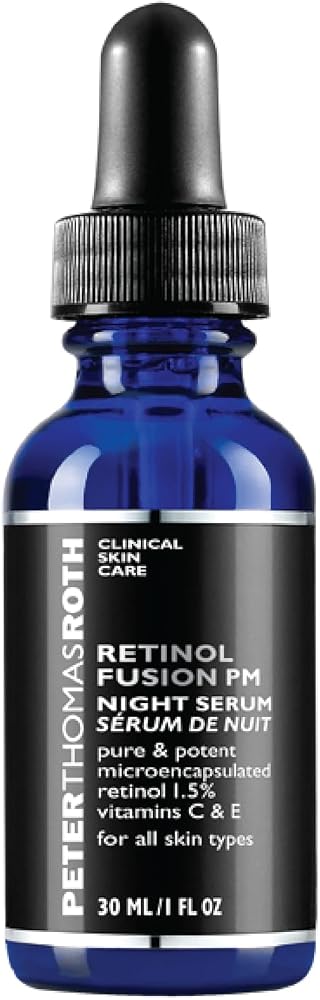
Key facts
Peter Thomas Roth Retinol Fusion PM at a glance.
Retinol 1.5%
Key active
Lightweight silicone serum
Texture
Experienced users only
Best for
$55–$65
Approximate price
Fragrance free
Fragrance
1 oz
Size
$65.00
Price
Retinoid
Type
What is it?
Top things to know about Peter Thomas Roth Retinol Fusion PM
- Peter Thomas Roth Retinol Fusion PM is a lightweight night serum with 1.5 percent retinol, sold in an opaque pump for about $55 to $65. It treats lines and rough texture, not dryness, and 1.5 percent is one of the highest disclosed retinol doses sold without a prescription.
- The list runs to twelve items. Cyclopentasiloxane, a silicone, and squalane carry the retinol. Vitamin E and ascorbyl palmitate keep it stable; bisabolol soothes. The retinol is microencapsulated, each particle wrapped so air cannot reach it and released gradually. Very little else is in the bottle, which is why it feels weightless and why almost nothing cushions the dose.
Retinol at 1.5%, one of the highest doses sold without a prescription, and that is the whole story. Encapsulation softens the peak; it does not make a high dose gentle, and the peeling reviewers report is the dose behaving as expected. If you have never used a retinoid, start nearer 0.3%.
— Dr. Schwarz
Skin fit
Is it right for your skin?
Sun Damage
Lines and leathery texture come from collagen broken down by years of ultraviolet light. Retinol switches collagen production back on, and dose is the lever. At 1.5 percent this goes about as far as over-the-counter gets. Not a starting dose.
Acne Scarring
Shallow rolling scars soften slightly as new collagen builds underneath. Progress takes months, and deep scars need a procedure, not a cream.
Oily Skin
Silicone and squalane, no heavy fats, so it sits well on skin that already makes plenty of oil. Retinoids also cut sebum over time.
Texture
What it feels like on skin.
Serum
A thin, slippery serum. The silicone base spreads a pea-sized drop over the whole face and it vanishes in seconds, leaving a smooth, dry finish. It is fragrance-free, and the opaque pump keeps air and light off the retinol. A jar would not. Expect real peeling in the first weeks at this strength. Nothing in the formula offsets it, and there is alcohol in the list, so a plain moisturizer on top is close to essential.
Troubleshooting
If it didn’t work for you.
If it stings
Try thisMoisturizer first, then the serum, then moisturizer again. Buffering slows the retinol down without stopping it working.
Alternatives
If this isn’t the right product for you
Drunk Elephant A-Passioni Retinol Cream
1.0% pure retinol, disclosed, no fragrance or essential oils, in a rich cream base. A high dose with cushioning.
Good Molecules Gentle Retinol Cream
Retinol 0.11% and bakuchiol 0.30%, disclosed, fragrance-free, about $10. The right start if 1.5% is too much.
SkinCeuticals Retinol 0.5
Disclosed 0.5% retinol in an opaque tube, part of a 0.3, 0.5 and 1.0 ladder. It also contains alcohol, high in the list.
Ingredients · Interactive
What’s in it, and where each ingredient works.
Full ingredient list · 12 ingredients, in label order. Click one.
The base the other ingredients are dissolved in. Most of it evaporates soon after the product goes on.
A buffer that keeps the product at a skin-friendly pH.
How to use it
How to use it.
How to apply it
- How muchOne pea-sized amount for the whole face. At 1.5 percent, using more is the fastest way to a raw face.
- CarefulNot a beginner dose. If you have never used a retinoid, start nearer 0.2 or 0.3 percent. Add one night at a time, no sooner than every two weeks, and wear sunscreen daily — a retinoid brings newer cells up to meet the sun.
What to expect
- What to expectDryness, flaking and tightness peak around weeks two to four — the dose working, not a defect. Fine lines and texture take three to six months. If skin is still angry after a month, the dose is too high.
Questions
Common questions.
Is Peter Thomas Roth Retinol Fusion PM at 1.5% too strong for beginners?
For most people, yes. Start lower.
Does encapsulation make Peter Thomas Roth Retinol Fusion PM gentler?
It flattens the peak. A high dose is still a high dose.
Is Peter Thomas Roth Retinol Fusion PM fragrance-free?
Yes.
Why is there alcohol in Peter Thomas Roth Retinol Fusion PM?
Texture. It can feel drying.
How should I start using Peter Thomas Roth Retinol Fusion PM?
Twice a week at night, buffered with moisturizer.
References
Sources.
- 1. An Innovative Dendrimer-Based Retinol Delivery System for Xerosis Care: Stability, Tolerance, and Sustained Hydration (https://www.mdpi.com/2077-0383/15/12/4435) — Encapsulation of retinol protects it from oxidation and UV/photodegradation and enables controlled/sustained release while remaining well tolerated with no signs of irritation, backing the page's claim that encapsulation shields retinol from air and light and slows release. Link
- 2. Prospective, randomized, double-blind assessment of topical bakuchiol and retinol for facial photoageing (https://academic.oup.com/bjd/article-abstract/180/2/289/6601687) — In this randomized trial retinol users reported more facial skin scaling and stinging, supporting the page's claim that irritation such as redness, flaking and stinging is expected with retinol. Link
- 3. Efficacy and tolerability of a double-conjugated retinoid cream vs 1.0% retinol cream or 0.025% tretinoin cream in subjects with mild to severe photoaging (https://pubmed.ncbi.nlm.nih.gov/28762645/) — Documents that topical retinoids are efficacious for photoaging but irritating, and that 1.0% retinol induced measurable erythema, supporting that irritation accompanies retinol use rather than being a sign it is 'working.' Link
- 4. Molecular mechanisms of photoaging and its prevention by retinoic acid: ultraviolet irradiation induces MAP kinase signal transduction cascades that induce AP-1-regulated matrix metalloproteinases that degrade human skin in vivo (https://pubmed.ncbi.nlm.nih.gov/9732061/) — Explains the biological mechanism by which retinoic acid (the active metabolite of retinol) works in skin, inhibiting UV-induced matrix metalloproteinases that degrade collagen, underpinning retinol's role as an active anti-aging retinoid. Link