PRODUCT REVIEW
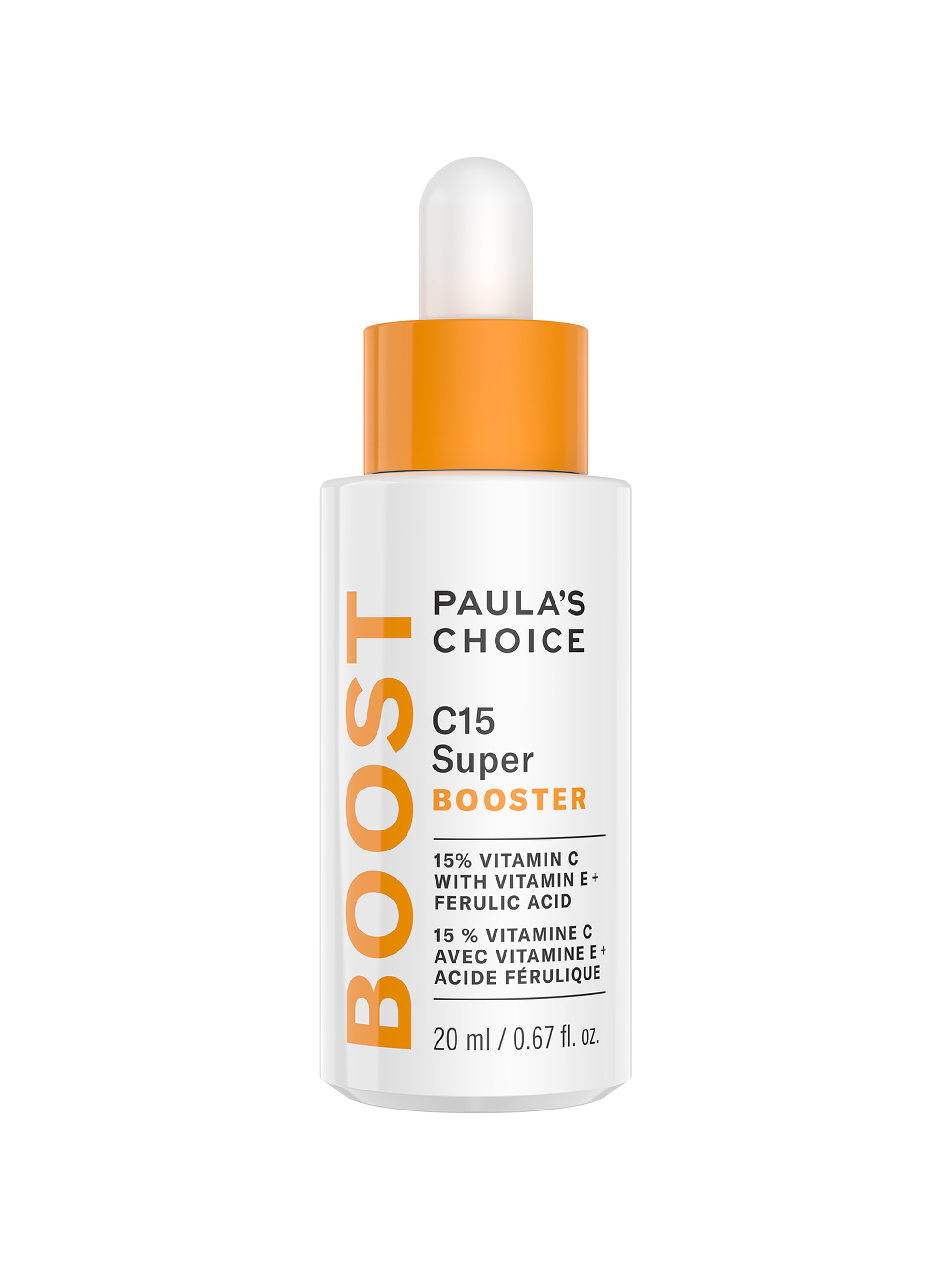
Paula's Choice BOOST C15 Super Booster
15% pure L-ascorbic acid with vitamin E and ferulic acid, in opaque packaging — the classic clinical formula.
Key facts
Paula's Choice BOOST C15 Super Booster at a glance.
L-ascorbic acid 15% + ferulic acid + vitamin E
Key active
Lightweight liquid
Texture
Anyone wanting the evidence-backed vitamin C formula
Best for
$46–$49
Approximate price
Fragrance free
Fragrance
0.68 oz
Size
$59.00
Price
Serum
Type
What is it?
Top things to know about Paula's Choice BOOST C15 Super Booster
- Paula's Choice BOOST C15 Super Booster is a fragrance free vitamin C serum in a 20 ml opaque bottle with a separate dropper, about $46 to $49. It is a daily antioxidant step, and the small bottle makes it expensive per milliliter.
- The formula is the classic three-ingredient antioxidant system: 15% L-ascorbic acid, which is pure vitamin C, with vitamin E and ferulic acid, which extend the protection and hold the vitamin C together. Bisabolol, panthenol and rice bran extract take the edge off — L-ascorbic acid needs a low pH to work, and low pH stings.
This runs the formula the photoprotection research is built on — 15% L-ascorbic acid with vitamin E and ferulic acid, better together than vitamin C alone. The opaque bottle does real work, because air and light kill this active. Replace it once it yellows. Reactive skin will feel the sting.
— Dr. Schwarz
Skin fit
Is it right for your skin?
Sun Damage
Ultraviolet light damages skin partly through free radicals, unstable molecules that tear at collagen. Vitamin C neutralizes them, vitamin E does the same in the oily parts of the cell vitamin C cannot reach, and ferulic acid stabilizes both. That full system is what the photoprotection research is built on.
Hyperpigmentation
Vitamin C blocks tyrosinase, the enzyme that builds melanin, so less new pigment forms while marked cells shed. At 15% this is the high end of the everyday range — it brightens more and stings more, both from the low pH.
Normal Skin
Nothing has to be wrong with your skin to use an antioxidant. It soaks up free-radical damage from an ordinary day of daylight before it reaches collagen. If you wear sunscreen already and want one more step, this is the one with evidence.
Texture
What it feels like on skin.
Serum
It is a thin, water-light liquid that spreads instantly and dries within about thirty seconds. It leaves nothing on the skin and layers cleanly under moisturizer, sunscreen and makeup. Four or five drops covers the whole face. It stings, most sharply in the first week and on reactive skin. That is the low pH the acid needs in order to work, not a fault. The bottle is opaque and the dropper separate, fiddly but it keeps air out.
Alternatives
If this isn’t the right product for you
Timeless Skin Care 20% Vitamin C + E Ferulic Acid Serum
The same three-ingredient system at 20% L-ascorbic acid, about $28, in an airtight glass pump. No published pH.
Timeless Vitamin C
The same formula at 10% L-ascorbic acid — the gentler entry point if 15% is too much.
Youth To The People 15% Vitamin C + Clean Caffeine Energy Serum
Its "15%" is three derivatives with no L-ascorbic acid, at a higher price. Gentler, much weaker evidence.
Ingredients · Interactive
What’s in it, and where each ingredient works.
Full ingredient list · 25 ingredients, in label order. Click one.
The base the other ingredients are dissolved in. Most of it evaporates soon after the product goes on.
A small humectant. It moves into the outer layer of skin and holds water there.
A form of hyaluronic acid. Its molecule is large, so it stays on the surface and holds water there.
Vitamin E, an antioxidant. Here it mainly keeps the oils in the product from going rancid.
The preservative. It stops bacteria and mold from growing in the product.
How to use it
How to use it.
How to apply it
- How muchFour or five drops for the whole face. Keep it out of the eye area.
- CarefulStart every other morning if your skin is reactive, building to daily over two or three weeks. Do not stack it with an acid or a retinoid while you ramp up.
- StorageKeep it from light and heat, and close it properly. L-ascorbic acid oxidizes in air — once it yellows or browns, replace it.
What to expect
- What to expectA sting for the first few uses that fades. Tone evens out over two to three months. It is not sun protection.
Questions
Common questions.
Is Paula's Choice BOOST C15 Super Booster the classic vitamin C formula?
Close. L-ascorbic acid, vitamin E and ferulic acid at 15%.
Will Paula's Choice BOOST C15 Super Booster sting?
It can, at 15% and low pH. Ease in if you are sensitive.
Why is the Paula's Choice BOOST C15 Super Booster bottle so small?
It is 20 ml, so cost per ml is high.
Is Paula's Choice BOOST C15 Super Booster fragrance-free?
Yes.
Do I still need sunscreen with Paula's Choice BOOST C15 Super Booster?
Yes. Vitamin C does not replace SPF.
References
Sources.
- 1. Ferulic acid stabilizes a solution of vitamins C and E and doubles its photoprotection of skin (https://doi.org/10.1111/j.0022-202X.2005.23768.x) — Establishes the exact three-ingredient system cited on the page — 15% L-ascorbic acid + 1% alpha-tocopherol (vitamin E) + ferulic acid — showing ferulic acid improves vitamin C/E chemical stability and doubles UV photoprotection of skin. Link
- 2. A topical antioxidant solution containing vitamins C and E stabilized by ferulic acid provides protection for human skin against damage caused by ultraviolet irradiation (https://doi.org/10.1016/j.jaad.2008.05.004) — In vivo human clinical trial confirming that the 15% L-ascorbic acid, 1% alpha-tocopherol, 0.5% ferulic acid formulation provides significant UV photoprotection — the 'published photoprotection research' the page refers to. Link
- 3. Topical L-ascorbic acid: percutaneous absorption studies (https://doi.org/10.1046/j.1524-4725.2001.00264.x) — Shows L-ascorbic acid must be formulated at a low pH (below 3.5) to penetrate skin, supporting the page's statements about the product's inherently low pH and why 15% L-ascorbic acid can sting. Link
- 4. The Roles of Vitamin C in Skin Health (https://doi.org/10.3390/nu9080866) — Peer-reviewed review documenting topical vitamin C's antioxidant protection against UV-induced photodamage and its role in collagen synthesis, backing the general scientific rationale for a 15% L-ascorbic acid serum. Link