PRODUCT REVIEW
Ole Henriksen Truth Serum Collagen Booster
A pleasant vitamin C serum built on mild derivatives, with fragrance. More cosmetic than corrective.
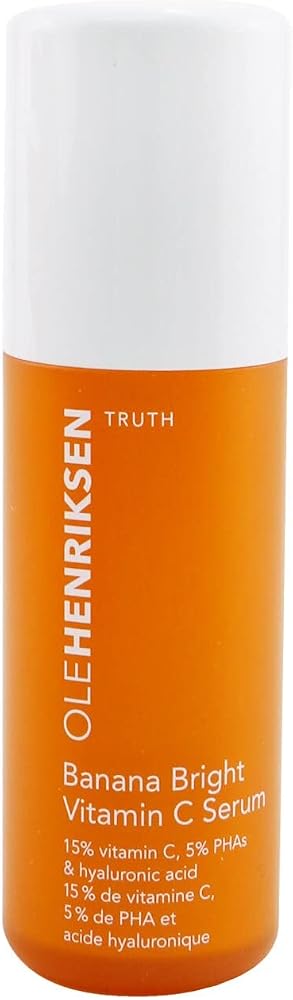
Key facts
Ole Henriksen Truth Serum Collagen Booster at a glance.
Sodium ascorbyl phosphate + calcium ascorbate (percentages not disclosed)
Key active
Lightweight gel
Texture
Everyday glow; not for treating stubborn pigmentation
Best for
$52–$56
Approximate price
1.01 oz
Size
$58.00
Price
Serum
Type
What is it?
Top things to know about Ole Henriksen Truth Serum Collagen Booster
- Ole Henriksen Truth Serum Collagen Booster is a lightweight orange gel serum in a pump bottle, about $52 to $56 at Sephora. It is a daily glow serum, not a corrective — nothing in it is dosed or evidenced well enough to move stubborn pigmentation.
- The vitamin C comes as sodium ascorbyl phosphate and calcium ascorbate, two derivatives that stay stable in water and have to be converted by the skin before anything happens. Neither percentage is printed. The rest is glycerin, aloe, green tea, rosehip, and a fragrance blend that includes limonene, linalool and citral.
This is a glow product, not a corrective one. Its vitamin C is sodium ascorbyl phosphate and calcium ascorbate, two mild derivatives the skin has to convert first, and neither percentage is printed. It also contains fragrance and three declared allergens. For stubborn pigment, use a serum built on L-ascorbic acid.
— Dr. Schwarz
Skin fit
Is it right for your skin?
Normal Skin
A light daily serum for skin with nothing much wrong with it. It layers cleanly under moisturizer and makeup, and the finish is most of what people like.
Sun Damage
Ultraviolet light leaves unstable molecules in skin that go on to break collagen. Antioxidants neutralize them, and vitamin C is the best studied. The forms here are mild and the amounts are not printed, so treat this as a small daily top-up. Sunscreen does far more of that work.
Hyperpigmentation
Vitamin C slows tyrosinase, the enzyme that starts pigment production, and the effect depends on how much you apply. This serum states no dose for either derivative. For stubborn marks, a serum with a printed percentage of L-ascorbic acid is the better bet.
Sensitive Skin
It does not sting — the real advantage of a derivative. But it contains fragrance plus limonene, linalool and citral, three recognized allergens. Read that list before spending $56.
Texture
What it feels like on skin.
Serum
It is a light gel, faintly slippery going on, and it absorbs in under a minute. It leaves a soft, slightly tacky finish that makeup sits on well, and it layers under moisturizer and sunscreen without pilling if you use a few drops rather than a full pump. It smells strongly of orange. The yellow-orange color is added Yellow 6, not oxidation, so it will not turn brown in the bottle.
Alternatives
If this isn’t the right product for you
Paula's Choice BOOST C15 Super Booster
15% L-ascorbic acid with vitamin E and ferulic acid, printed on the panel, fragrance-free. It stings — the trade for the better-evidenced form.
The Ordinary Ascorbyl Tetraisopalmitate Solution 20% in Vitamin F
Also non-stinging, but it states its dose — 20% THD ascorbate — and costs about $20. THD is a better-evidenced derivative.
Vanicream Vitamin C Serum
Fragrance-free, non-stinging, a stated 5% THD ascorbate in an airless pump, plus ceramides. Low dose, nothing hidden.
Ingredients · Interactive
What’s in it, and where each ingredient works.
Full ingredient list · 39 ingredients, in label order. Click one.
A small humectant. It moves into the outer layer of skin and holds water there.
The preservative. It stops bacteria and mold from growing in the product.
A form of hyaluronic acid. Its molecule is large, so it stays on the surface and holds water there.
How to use it
How to use it.
How to apply it
- How muchA few drops on clean skin, before moisturizer.
- CarefulVitamin C is not sun protection. Follow it with sunscreen in the morning.
What to pair it with
- LayeringIt goes under everything. If it pills, use less and let it dry before the next step.
What to expect
- What to expectSkin looks fresher and a little more even within a couple of weeks. Stubborn pigmentation will not move. The derivatives are mild and the doses are not stated, so judge it on how your skin looks, not on marks clearing.
Questions
Common questions.
Is Ole Henriksen Truth Serum Collagen Booster strong vitamin C?
No. Mild derivatives, not L-ascorbic acid.
How much vitamin C is in Ole Henriksen Truth Serum Collagen Booster?
Not disclosed.
Will Ole Henriksen Truth Serum Collagen Booster fade stubborn dark spots?
Unlikely. It is an everyday glow serum.
Is Ole Henriksen Truth Serum Collagen Booster fragrance-free?
No. It contains fragrance and declared allergens.
Why does Ole Henriksen Truth Serum Collagen Booster cost so much?
The brand and the experience. The actives are mild and undisclosed.
References
Sources.
- 1. The Roles of Vitamin C in Skin Health (https://www.mdpi.com/2072-6643/9/8/866) — Peer-reviewed review documenting vitamin C's roles in collagen synthesis and antioxidant photoprotection, and comparing topical vitamin C derivatives including ascorbyl phosphate esters for stability and skin penetration. Link
- 2. Sodium Ascorbyl Phosphate / C6H6Na3O9P / CID 10990876 - PubChem (https://pubchem.ncbi.nlm.nih.gov/compound/Sodium-ascorbyl-phosphate) — NIH/NLM compound record confirming sodium ascorbyl phosphate is a phosphate-ester (phosphorylated) derivative of ascorbic acid, the chemical basis for its use as a stable vitamin C form, backing the claim that SAP is a stable derivative. Link
- 3. Sodium L-ascorbyl-2-phosphate 5% lotion for the treatment of acne vulgaris: a randomized, double-blind, controlled trial (https://pubmed.ncbi.nlm.nih.gov/20367669/) — Randomized controlled trial showing topical 5% sodium ascorbyl phosphate is efficacious with a tolerability/safety profile similar to vehicle, supporting the claim that SAP is a mild, well-tolerated (non-stinging) vitamin C derivative. Link
- 4. Topical vitamin C / DermNet (https://dermnetnz.org/topics/topical-vitamin-c) — Reputable clinical dermatology reference stating that L-ascorbic acid is highly unstable when exposed to oxygen and describing vitamin C's antioxidant UV protection and collagen roles, contextualizing why stable derivatives like SAP are used and that SAP will not oxidize like free ascorbic acid. Link