PRODUCT REVIEW
Naturium Tranexamic Topical Acid
5% tranexamic acid with kojic acid and niacinamide, for $20. Well built, and no serum fixes melasma alone.
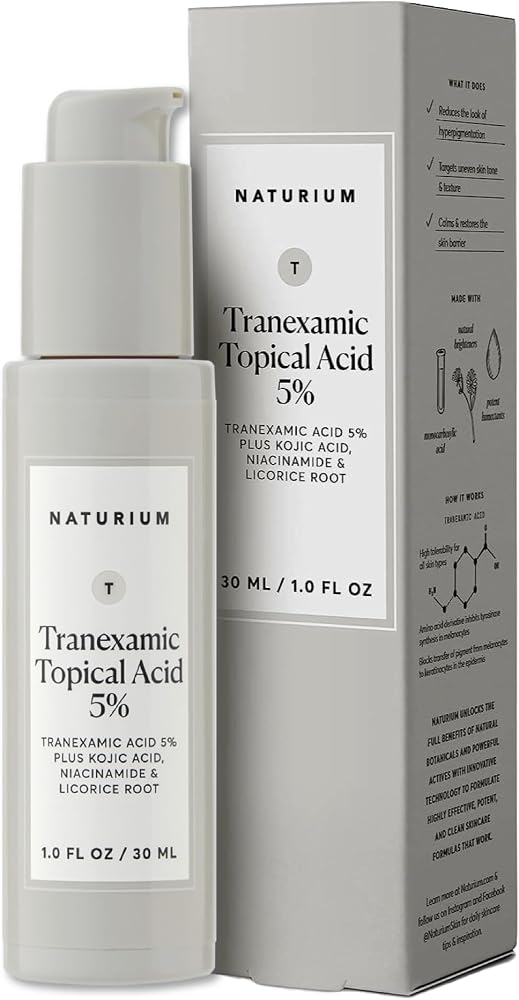
Key facts
Naturium Tranexamic Topical Acid at a glance.
Tranexamic acid 5% + kojic acid + niacinamide
Key active
Lightweight water-gel
Texture
Melasma, dark spots, uneven tone — alongside daily sunscreen
Best for
$18–$22
Approximate price
Fragrance free
Fragrance
1 oz
Size
$19.99
Price
Serum
Type
What is it?
Top things to know about Naturium Tranexamic Topical Acid
- Naturium Tranexamic Topical Acid is a thin, fragrance-free water-gel serum for dark patches and uneven tone, about $20. It is a pigment serum, not a sunscreen or an exfoliant, and nothing in it blocks the light that makes the pigment in the first place.
- It is built around tranexamic acid at 5%, which quiets the chemical messages skin cells send to pigment cells. Around it sit kojic acid and licorice root extract, which slow the enzyme that assembles pigment, and niacinamide, which reduces how much finished pigment gets handed to the surface cells. It is mostly water, so it soaks in within seconds.
Naturium Tranexamic Topical Acid is a well-built pigment serum. Tranexamic acid at 5% quiets the messages skin cells send to pigment cells, and in one twelve-week trial it performed comparably to 3% hydroquinone. Wear sunscreen daily, ideally tinted, because without it this serum is close to pointless.
— Dr. Schwarz
Skin fit
Is it right for your skin?
Melasma
Melasma is not simply too much sun. The pigment cells in a melasma patch are over-responsive, kept switched on by messages from the skin cells and blood vessels around them. Tranexamic acid works on those messages rather than the pigment cell alone, which is why it suits melasma better than most brighteners. Kojic acid, niacinamide and licorice root slow several other steps at once.
Post-Inflammatory Hyperpigmentation
When a spot heals, the inflammation leaves nearby pigment cells running hot for weeks, and the brown mark outlasts the injury. Slowing pigment production while the mark fades is the whole job. Being fragrance-free, it layers over healing skin without adding another irritant.
Hyperpigmentation
Years of sun leave scattered patches where pigment cells stayed switched on. This works on the switch rather than the patch, so tone evens out gradually. Expect months, not weeks.
Texture
What it feels like on skin.
Serum
A thin water-gel, closer to water than gel. A few drops cover the whole face. It sinks in within seconds and leaves no film, no tack and no shine. Sunscreen and makeup go over it without pilling. It is fragrance-free and has almost no smell.
Alternatives
If this isn’t the right product for you
Tranexamic Acid 5% Serum with Niacinamide 5%
Also 5% tranexamic acid, with 5% niacinamide and no kojic acid. A sensible swap if kojic acid sensitizes you.
Anua Dark Spot Correcting Serum
4% tranexamic acid with alpha-arbutin, similar price. Its niacinamide is 10%, more than the evidence calls for.
SkinCeuticals Discoloration Defense Serum
The same class of actives at $115, with 3% tranexamic acid — a lower dose of the lead active.
Ingredients · Interactive
What’s in it, and where each ingredient works.
Full ingredient list · 22 ingredients, in label order. Click one.
The base the other ingredients are dissolved in. Most of it evaporates soon after the product goes on.
A small humectant. It moves into the outer layer of skin and holds water there.
A thickener that keeps the texture even.
The preservative. It stops bacteria and mold from growing in the product.
Helps the preservative work and softens the feel of the product.
A form of hyaluronic acid. Its molecule is large, so it stays on the surface and holds water there.
Vitamin E, an antioxidant. Here it mainly keeps the oils in the product from going rancid.
How to use it
How to use it.
How to apply it
- How muchA few drops for the whole face. More does not work faster.
- CarefulKojic acid can sensitize skin. Start every other day, and stop if you get bumps or stinging that does not settle.
What to pair it with
- LayeringSunscreen goes over it every morning. Pigment is driven by UV and visible light, so without it this serum is close to pointless.
What to expect
- What to expectPigment fades slowly. Give it 12 weeks, and take a photo now, because day-to-day change is too small to see.
Questions
Common questions.
Does the tranexamic acid in Naturium Tranexamic Topical Acid work on melasma?
It has real, if modest, evidence, and at 5% it has trial support.
Do I need sunscreen with Naturium Tranexamic Topical Acid?
Yes. The serum is only an adjunct.
Why might Naturium Tranexamic Topical Acid irritate?
Kojic acid can sensitize some skin. Ease in.
Is Naturium Tranexamic Topical Acid fragrance-free?
Yes.
Is Naturium Tranexamic Topical Acid good value?
Yes, genuinely, for this combination.
References
Sources.
- 1. A Randomized Controlled Study Comparing the Efficacy of Topical 5% Tranexamic Acid Solution versus 3% Hydroquinone Cream in Melasma (https://jcasonline.com/a-randomized-controlled-study-comparing-the-efficacy-of-topical-5-tranexamic-acid-solution-versus-3-hydroquinone-cream-in-melasma/) — Backs the claim that a 12-week randomized trial found topical 5% tranexamic acid performed comparably to 3% hydroquinone, with both significantly improving melasma (MASI) scores. Link
- 2. Mechanism of Action of Topical Tranexamic Acid in the Treatment of Melasma and Sun-Induced Skin Hyperpigmentation (https://www.mdpi.com/2079-9284/9/5/108) — Supports the claim that tranexamic acid works differently from typical brighteners by interrupting keratinocyte-to-melanocyte signaling (the plasmin/uPA pathway) rather than blocking pigment production directly. Link
- 3. Review on the Use of Kojic Acid—A Skin-Lightening Ingredient (https://www.mdpi.com/2079-9284/9/3/64) — Supports the claim that kojic acid inhibits pigment formation by acting as a tyrosinase inhibitor (chelating copper at the enzyme's active site). Link
- 4. The effect of niacinamide on reducing cutaneous pigmentation and suppression of melanosome transfer (https://academic.oup.com/bjd/article-abstract/147/1/20/6635091) — Supports the claim that niacinamide reduces pigmentation, specifically by suppressing melanosome transfer from melanocytes to keratinocytes. Link