PRODUCT REVIEW
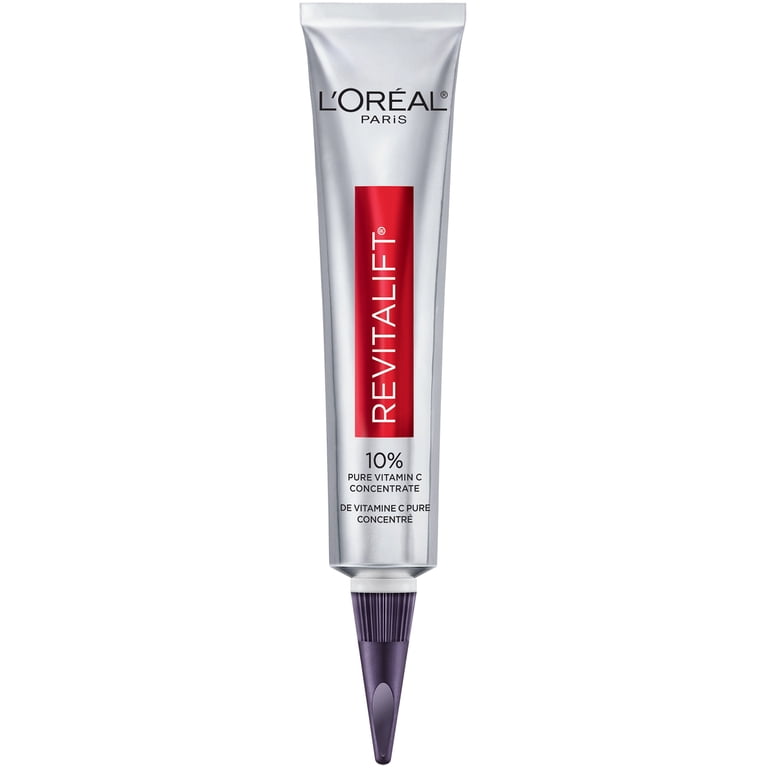
L'Oréal Paris Revitalift 10% Pure Vitamin C Face Serum
A 10% pure L-ascorbic acid serum in an opaque tube, under $30. Right form, right packaging — more than most drugstore vitamin C manages.
Key facts
L'Oréal Paris Revitalift 10% Pure Vitamin C Face Serum at a glance.
L-ascorbic acid 10%
Key active
Lightweight serum
Texture
Dull, uneven skin tone on a budget
Best for
$20–$27
Approximate price
Fragrance free
Fragrance
1 oz
Size
$24.99
Price
Serum
Type
What is it?
Top things to know about L'Oréal Paris Revitalift 10% Pure Vitamin C Face Serum
- L'Oréal Paris Revitalift 10% Pure Vitamin C Face Serum is a thin, fragrance-free serum in an opaque tube, under $30. It is for dull and uneven tone, not a moisturizer and not an acne product. L'Oréal also sells a similarly named 12% version, so read the label, not the brand name.
- The active is pure L-ascorbic acid at 10%, listed third — plain vitamin C, the form with decades of research behind it, not the gentler derivative pricier serums use quietly. Hyaluronic acid and glycerin hold water; a silicone base gives slip. It works at a low pH, so on sensitive skin it can sting for a minute.
You get the real molecule at a drugstore counter — pure L-ascorbic acid rather than a gentler derivative, in an opaque tube. Read the label, because a similarly named 12% version sits beside it. Start every other day, since a low pH stings. Replace it once it yellows.
— Dr. Schwarz
Skin fit
Is it right for your skin?
Sun Damage
Ultraviolet light creates free radicals in skin — unstable molecules that damage collagen and switch pigment cells on. Vitamin C gives up an electron to neutralize them first. Under sunscreen in the morning, it covers some of what the sunscreen lets through.
Hyperpigmentation
Vitamin C also slows tyrosinase, the enzyme that starts pigment production, so marks fade gradually and new ones form more slowly. Ten percent of the real acid does more than a bigger number of a derivative.
Sensitive Skin
L-ascorbic acid only stays stable at a low pH, and low pH stings. That is the price of the best-evidenced form. Start every other morning on dry skin, and if it still burns after two weeks, switch to a derivative such as THD ascorbate.
Texture
What it feels like on skin.
Serum
Thin and runny — it leaves the tube faster than you expect, so squeeze lightly. It sinks in quickly, but the silicone base slips and can be awkward to layer over. Let it dry fully before sunscreen. Fragrance-free. It can sting for a minute, and it yellows within a couple of months of opening — the L-ascorbic acid oxidizing, and potency falling with it.
Alternatives
If this isn’t the right product for you
Timeless Vitamin C
The same 10% L-ascorbic acid, with vitamin E and ferulic acid, in glass with an airtight pump. It costs more.
Paula's Choice BOOST C15 Super Booster
A higher 15% dose with vitamin E and ferulic acid, in opaque air-restricting packaging, at a higher price.
Vanicream Vitamin C Serum
Much gentler if L-ascorbic acid stings, but it is 5% THD ascorbate — a derivative, low dose, thinner evidence.
Ingredients · Interactive
What’s in it, and where each ingredient works.
Full ingredient list · 12 ingredients, in label order. Click one.
A silicone that smooths the surface and adds to the protective film.
A small humectant. It moves into the outer layer of skin and holds water there.
How to use it
How to use it.
How to apply it
- How muchThree or four drops for the whole face.
- CarefulStart every other morning if you are new to pure vitamin C. A minute of stinging is common. Lasting burning is not.
What to pair it with
- LayeringLet it absorb fully before the next product. Going over a wet layer makes it pill.
What to expect
- What to expectBrightness in four to six weeks, more even tone over three months. Keep it capped and out of light, and replace it once it yellows.
Questions
Common questions.
Is L'Oréal Paris Revitalift 10% Pure Vitamin C Face Serum real vitamin C?
Yes. 10% L-ascorbic acid, the best-studied form.
Will L'Oréal Paris Revitalift 10% Pure Vitamin C Face Serum sting?
It can. L-ascorbic acid works at a low pH.
Why is L'Oréal Paris Revitalift 10% Pure Vitamin C Face Serum in a tube, not a dropper bottle?
The opaque tube limits air and light, which keeps vitamin C stable.
Is L'Oréal Paris Revitalift 10% Pure Vitamin C Face Serum fragrance-free?
Yes.
Which Revitalift vitamin C is L'Oréal Paris Revitalift 10% Pure Vitamin C Face Serum?
The 10% pure version. L'Oréal sells more than one, so check the label.
References
Sources.
- 1. Topical L-ascorbic acid: percutaneous absorption studies. (https://doi.org/10.1046/j.1524-4725.2001.00264.x) — Backs the claim that real L-ascorbic acid is superior to derivatives: this study found ascorbic acid derivatives (magnesium ascorbyl phosphate, ascorbyl-6-palmitate, dehydroascorbic acid) did not raise skin ascorbate levels, that L-ascorbic acid must be formulated below pH 3.5 to penetrate, and that ~20% is the maximum useful concentration. Link
- 2. Topical Vitamin C and the Skin: Mechanisms of Action and Clinical Applications. (https://pmc.ncbi.nlm.nih.gov/articles/PMC5605218) — Supports that L-ascorbic acid is an unstable molecule prone to oxidation (explaining yellowing and the need for protective/opaque packaging), that derivatives are used because pure L-ascorbic acid is hard to stabilize, and that biologically effective topical concentrations are about 10-20%. Link
- 3. Vitamins and the skin: Vitamin C in dermatology. (https://doi.org/10.1016/j.clindermatol.2026.02.007) — Supports the claim that L-ascorbic acid is intrinsically unstable (oxidizes/degrades) requiring pH adjustment and packaging strategies, and that although derivatives are more stable they have more limited skin penetration than pure L-ascorbic acid. Link
- 4. The Roles of Vitamin C in Skin Health. (https://doi.org/10.3390/nu9080866) — Backs the underlying scientific rationale for a topical vitamin C serum: normal skin contains high vitamin C that supports collagen synthesis and antioxidant protection against UV-induced photodamage. Link