PRODUCT REVIEW
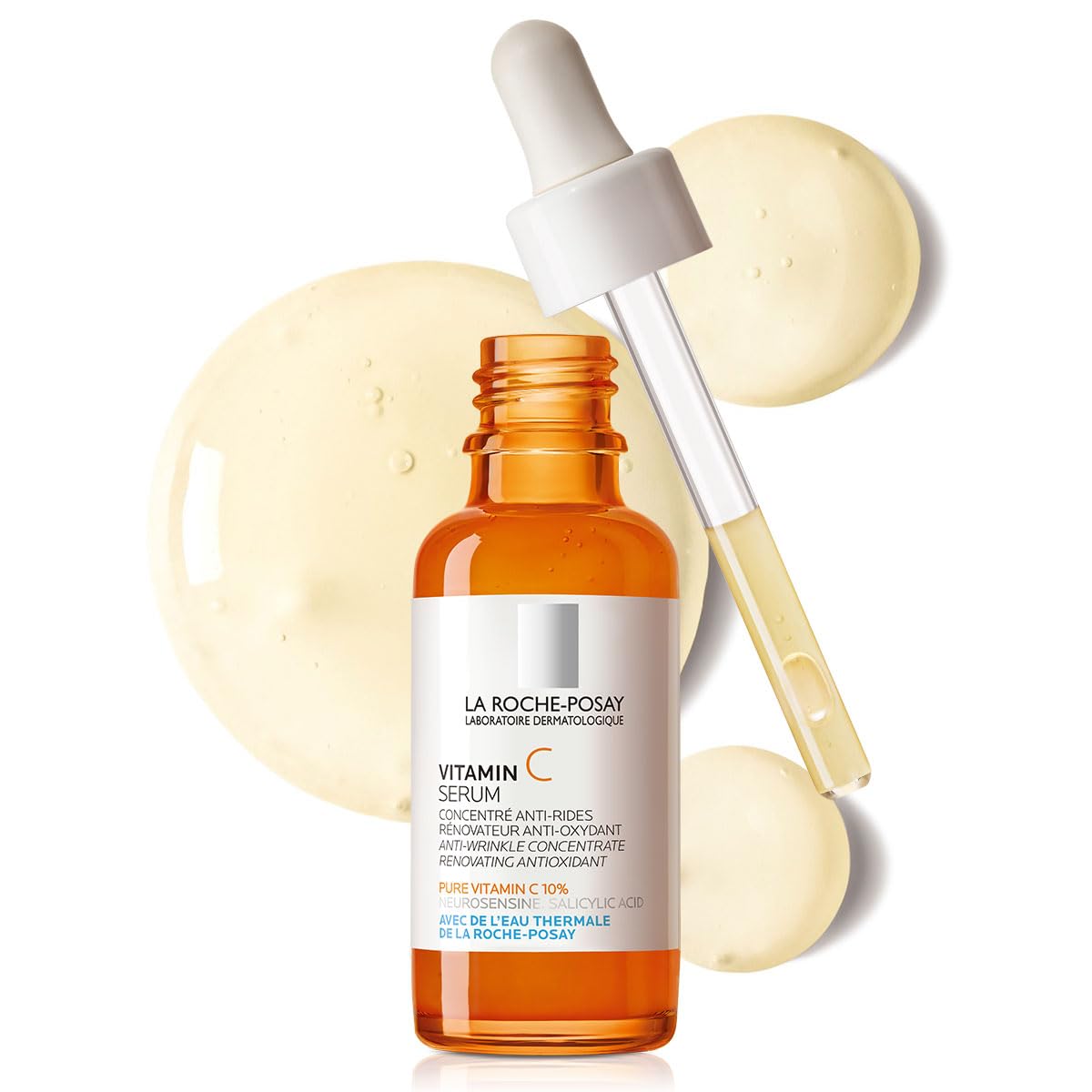
La Roche-Posay Pure Vitamin C Face Serum
A pure L-ascorbic acid serum with salicylic acid added. Effective, and very likely to sting.
Key facts
La Roche-Posay Pure Vitamin C Face Serum at a glance.
L-ascorbic acid 10–12% + salicylic acid
Key active
Lightweight, fast-absorbing serum
Texture
Dull skin with rough texture — if you can tolerate it
Best for
$40–$45
Approximate price
1.01 oz
Size
$44.99
Price
Serum
Type
What is it?
Top things to know about La Roche-Posay Pure Vitamin C Face Serum
- La Roche-Posay Pure Vitamin C Face Serum is a light, fast-absorbing serum, about $40 to $45. It treats dullness and rough texture rather than moisturizing, and it uses pure vitamin C, not a derivative.
- L-ascorbic acid sits at 10% or 12% — listings disagree, so check the box — alongside salicylic acid, vitamin E, hyaluronic acid and a soothing agent the brand calls neurosensine. There is denatured alcohol and fragrance too. Two acids at a low pH is a lot for one face, which is why it stings.
This stacks two acids on one face. L-ascorbic acid needs a pH below 3.5 and salicylic acid is acidic too, which is why stinging is the most consistent complaint. Patch test before you commit, and if your skin is reactive at all, buy a plain vitamin C serum instead.
— Dr. Schwarz
Skin fit
Is it right for your skin?
Sun Damage
Ultraviolet light throws off free radicals, unstable molecules that tear at collagen. Vitamin C neutralizes them, and the enzymes that build collagen need it too. This serum uses the pure form at a real concentration, which is the version with the evidence behind it.
Hyperpigmentation
Vitamin C slows tyrosinase, the enzyme that starts melanin production, so patches of excess pigment fade slowly and tone evens out. The salicylic acid clears the dull surface layer at the same time, which is why skin looks brighter before the pigment has moved much.
Oily Skin
Salicylic acid dissolves in oil. Water-soluble acids work on the surface; this one gets inside a pore full of sebum and clears it from within. That is the half of the serum aimed at rough texture and pores that look enlarged.
Comedonal Acne
Blackheads and whiteheads are plugs of dead cells and oil, and the salicylic acid loosens them from inside the pore. A retinoid stops the plug forming better. This is a texture serum with an acid, not an acne treatment.
Texture
What it feels like on skin.
Serum
A light, slightly slippery serum that absorbs in under a minute and leaves a smooth finish. It sits fine under sunscreen and makeup. The stinging is the story. It is the most consistent complaint, and the reason is clear — L-ascorbic acid only works below about pH 3.5, and salicylic acid is acidic too. On many faces that is a warm prickling that fades in minutes. On some it never fades. It is scented and contains denatured alcohol. Like every pure vitamin C, it oxidizes. Pale yellow is normal; brown means it is spent, however much is left in the bottle.
Alternatives
If this isn’t the right product for you
Timeless Vitamin C
10% L-ascorbic acid with vitamin E and ferulic acid, fragrance-free, no second acid and no drying alcohol. Much easier to tolerate.
Paula's Choice BOOST C15 Super Booster
15% L-ascorbic acid with vitamin E and ferulic acid, fragrance-free, plus bisabolol, panthenol and licorice to soften the low pH.
Vanicream Vitamin C Serum
5% THD ascorbate at skin-friendly pH, no fragrance. A low dose of a derivative, but very gentle.
Ingredients · Interactive
What’s in it, and where each ingredient works.
Full ingredient list · 29 ingredients, in label order. Click one.
The base the other ingredients are dissolved in. Most of it evaporates soon after the product goes on.
A small humectant. It moves into the outer layer of skin and holds water there.
A silicone that smooths the surface and adds to the protective film.
Vitamin E, an antioxidant. Here it mainly keeps the oils in the product from going rancid.
A form of hyaluronic acid. Its molecule is large, so it stays on the surface and holds water there.
A thickener that keeps the texture even.
Binds minerals in the water so the preservative works better and the formula stays stable.
How to use it
How to use it.
How to apply it
- How muchA few drops for the whole face. Keep it off the eye area and the corners of the nose.
- CarefulTwo acids at a low pH. Patch test on the jaw for a few days, and at first do not pair it with a retinoid, an exfoliating acid or benzoyl peroxide. Both actives make skin more sun-sensitive, so morning sunscreen is part of the treatment.
What to expect
- What to expectA warm sting for a few minutes is common and usually settles within two weeks. Skin looks smoother in days — that is the salicylic acid. Tone and dark marks take two to three months. If it still burns after two weeks, this is not your serum.
Questions
Common questions.
Why does La Roche-Posay Pure Vitamin C Face Serum sting so much?
Two acids at a low pH.
Is La Roche-Posay Pure Vitamin C Face Serum really for sensitive skin?
Hard to square with the sting. Patch test.
Is La Roche-Posay Pure Vitamin C Face Serum 10% or 12%?
Listings differ. Check the box.
Is La Roche-Posay Pure Vitamin C Face Serum fragrance-free?
No. It contains added fragrance.
Do I need sunscreen with La Roche-Posay Pure Vitamin C Face Serum?
Yes. Both actives make daily SPF important.
References
Sources.
- 1. Topical Vitamin C and the Skin: Mechanisms of Action and Clinical Applications (https://pmc.ncbi.nlm.nih.gov/articles/PMC5605218) — Confirms L-ascorbic acid is the most biologically active and best-studied form of vitamin C, that it must be formulated below pH 3.5 to penetrate skin, and that it boosts collagen synthesis and reduces pigmentation. Link
- 2. The Roles of Vitamin C in Skin Health (https://www.mdpi.com/2072-6643/9/8/866) — Supports the claim that vitamin C drives collagen synthesis, acting as a cofactor for the prolyl/lysyl hydroxylases that stabilize collagen and providing antioxidant protection in skin. Link
- 3. Topical L-ascorbic acid: percutaneous absorption studies (https://doi.org/10.1046/j.1524-4725.2001.00264.x) — Original percutaneous-absorption study establishing that L-ascorbic acid must be formulated at pH below 3.5 to enter the skin and that vitamin C derivatives do not raise skin ascorbic acid levels. Link
- 4. Salicylic acid (https://dermnetnz.org/topics/salicylic-acid) — Supports that salicylic acid is a keratolytic that slows shedding of cells inside follicles, prevents pore clogging, and dissolves comedones (surface texture and pores). Link
- 5. Management of Acne Vulgaris: A Review (https://jamanetwork.com/journals/jama/fullarticle/2786495) — Authoritative review confirming acne is an inflammatory disease of the pilosebaceous unit (the pore structure that salicylic acid targets) and reviewing topical acne therapies. Link