PRODUCT REVIEW
Farmacy 10% Vitamin C Serum
10% pure L-ascorbic acid in a waterless base, with ferulic acid and alpha-arbutin. Sound chemistry, weak packaging.
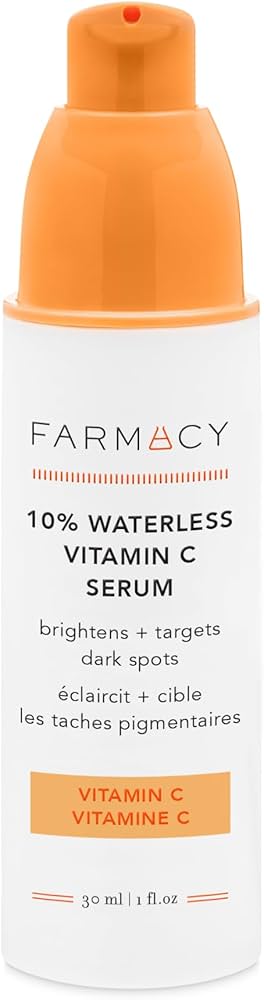
Key facts
Farmacy 10% Vitamin C Serum at a glance.
L-ascorbic acid 10%
Key active
Lightweight serum
Texture
Brightening and dark spots
Best for
$48–$52
Approximate price
1.01 oz
Size
$52.00
Price
Serum
Type
What is it?
Top things to know about Farmacy 10% Vitamin C Serum
- Farmacy 10% Vitamin C Serum is a lightweight serum sold for around $50. It is a brightening antioxidant step, not a treatment for lines or acne, and it is not sun protection. The lactic and citric acid low on the list set pH; they are not exfoliants.
- It is built on 10 percent L-ascorbic acid — pure vitamin C — in a waterless base of propanediol and pentylene glycol. Ferulic acid adds antioxidant capacity and helps stabilize the vitamin C; alpha-arbutin adds a separate route to fading dark spots. The waterless base is why it feels tacky.
Farmacy 10% Vitamin C Serum has the right recipe — L-ascorbic acid with ferulic acid in a waterless base, because water breaks vitamin C down. The bottle is the problem: reviewers report leaks, and 10% is the bottom of the useful range. Replace it when it browns. For more potency, buy a 15 to 20%.
— Dr. Schwarz
Skin fit
Is it right for your skin?
Hyperpigmentation
Dark spots are pigment cells that kept working after the trigger stopped. Farmacy 10% Vitamin C Serum comes at them twice: vitamin C slows tyrosinase, the enzyme melanin is built with, and alpha-arbutin blocks the same enzyme another way. Two evidenced routes in one bottle is unusual.
Post-Inflammatory Hyperpigmentation
The brown mark a spot leaves is pigment dropped into the skin while it was inflamed. It fades slowly, and a tyrosinase blocker stops fresh pigment being added meanwhile. Reasonable if you are patient — nothing lightens an old mark quickly.
Sun Damage
UV light creates free radicals that break down collagen; an antioxidant worn in the morning mops up some of them. Research found vitamin C, vitamin E and ferulic acid together protect better than vitamin C alone. Farmacy 10% Vitamin C Serum has two of the three.
Texture
What it feels like on skin.
Serum
A thin, slightly syrupy serum that spreads easily and dries with a faint tack. That tack is the waterless base, not added stickiness. It does not sting the way an acid does, but 10 percent L-ascorbic acid can tingle on freshly washed skin. Give it a minute and it layers under moisturizer and sunscreen without pilling. The bottle is the weak point. Reviewers report it degrading or leaking, worth knowing before you pack it.
Alternatives
If this isn’t the right product for you
Timeless Skin Care 20% Vitamin C + E Ferulic Acid Serum
20% L-ascorbic acid with vitamin E and ferulic acid, in an airtight glass pump, for about $28. More active, less money.
Paula's Choice BOOST C15 Super Booster
15% L-ascorbic acid with vitamin E and ferulic acid, concentration printed on the ingredient panel. The opaque, air-restricting packaging is a step up.
Timeless Vitamin C
The same 10% L-ascorbic acid with E and ferulic acid, in glass with an airtight pump, for less.
Ingredients · Interactive
What’s in it, and where each ingredient works.
Full ingredient list · 12 ingredients, in label order. Click one.
A small humectant. It moves into the outer layer of skin and holds water there.
How to use it
How to use it.
How to apply it
- How muchThree or four drops on clean, dry skin. Damp skin makes the tingle worse without improving the result.
- TipKeep the cap tight and out of the window. Air and light turn vitamin C brown; a waterless base slows that, it does not stop it.
What to pair it with
- LayeringBefore moisturizer and before sunscreen. It is not sun protection.
What to expect
- What to expectNothing for the first month. Pigment fades over eight to twelve weeks. If the liquid turns dark amber, it has lost potency — replace it.
Questions
Common questions.
Why is Farmacy 10% Vitamin C Serum waterless?
Vitamin C degrades in water. Waterless keeps it more stable.
Is Farmacy 10% Vitamin C Serum strong enough?
It works, but it is the low end. Stronger options exist.
Does Farmacy 10% Vitamin C Serum still oxidize?
Yes, it can darken. Replace it when it does.
What is the main drawback of Farmacy 10% Vitamin C Serum?
Reviewers report the packaging leaking or degrading.
Do I need sunscreen with Farmacy 10% Vitamin C Serum?
Yes. Vitamin C does not replace SPF.
References
Sources.
- 1. Ferulic acid stabilizes a solution of vitamins C and E and doubles its photoprotection of skin (https://pubmed.ncbi.nlm.nih.gov/16185284/) — This is the Duke (Pinnell lab) work underpinning the C E Ferulic concept: adding ferulic acid to 15% L-ascorbic acid + 1% alpha-tocopherol improved chemical stability of the vitamins and roughly doubled photoprotection, backing the claim that C + E + ferulic acid together are more protective than vitamin C alone and that ferulic acid stabilizes the vitamin C. Link
- 2. A topical antioxidant solution containing vitamins C and E stabilized by ferulic acid provides protection for human skin against damage caused by ultraviolet irradiation (https://pubmed.ncbi.nlm.nih.gov/18603326/) — Duke in vivo human study showing the C+E+ferulic acid (CEFer) formulation provides significant UV photoprotection, corroborating that the vitamin C / vitamin E / ferulic acid combination is a real, evidence-based recipe. Link
- 3. Topical L-ascorbic acid: percutaneous absorption studies (https://pubmed.ncbi.nlm.nih.gov/11207686/) — Pinnell et al. show L-ascorbic acid must be formulated at pH below 3.5 to penetrate skin and that delivery is critically dependent on formulation characteristics, supporting that real (unmodified) L-ascorbic acid needs careful formulation to work and remain effective. Link
- 4. Management of periorbital hyperpigmentation: An overview of nature-based agents and alternative approaches (https://pubmed.ncbi.nlm.nih.gov/32472659/) — Review identifying alpha-arbutin among topical depigmenting agents that modulate the melanin/tyrosinase pathway and showing significant benefit, supporting alpha-arbutin as an independently evidenced brightening mechanism for dark spots. Link