PRODUCT REVIEW
Dermalogica Dynamic Skin Retinol Serum
A "3.5% Retinoid Complex" that hides the actual dose — perfumed with seven essential oils, for $99.
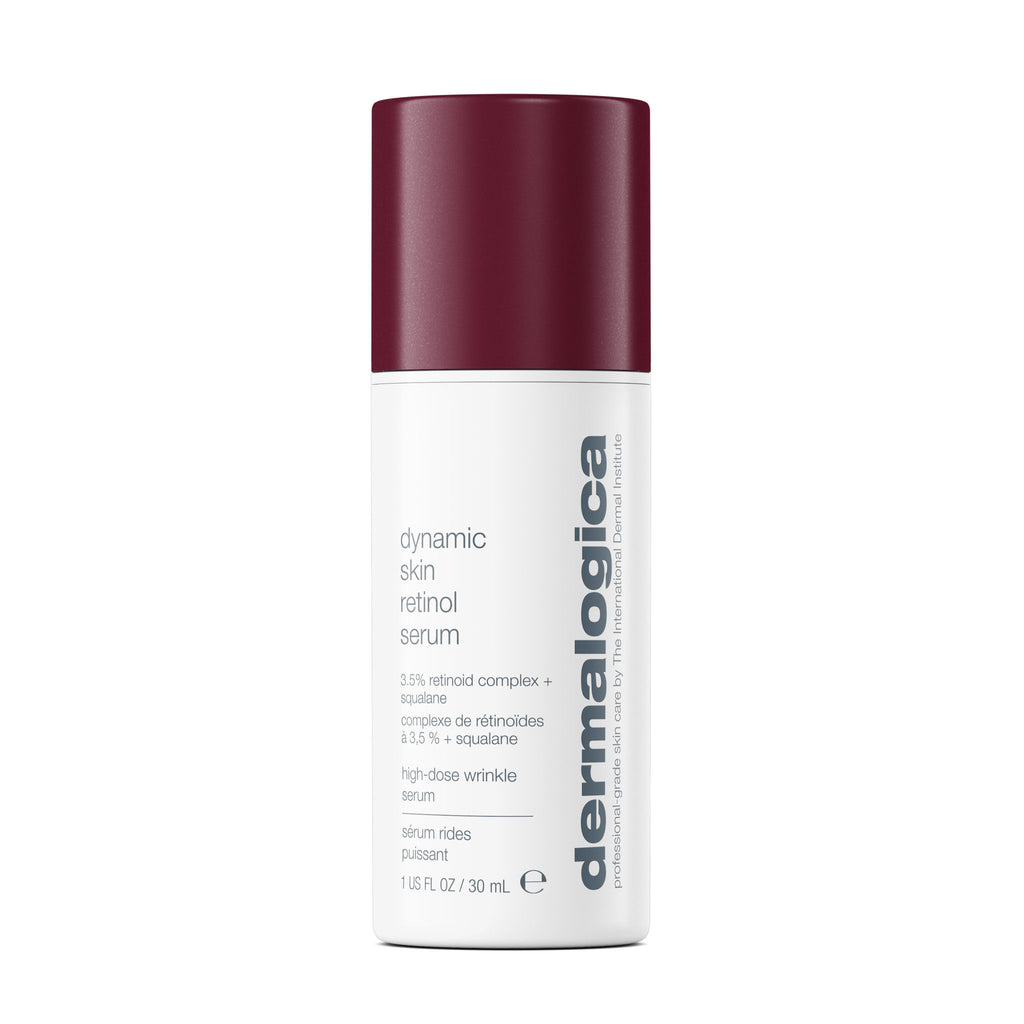
Key facts
Dermalogica Dynamic Skin Retinol Serum at a glance.
HPR + retinol (split undisclosed)
Key active
Light serum
Texture
$90–$99
Approximate price
1 oz
Size
$99.00
Price
Retinoid
Type
What is it?
Top things to know about Dermalogica Dynamic Skin Retinol Serum
- Dermalogica Dynamic Skin Retinol Serum is a lightweight night serum sold through spas, salons and the brand's own site for about $99. It targets fine lines and uneven tone, and does little for dryness.
- It is built on what Dermalogica calls a 3.5% Retinoid Complex: hydroxypinacolone retinoate, which acts on the receptor without a conversion step, plus plain retinol, in a base of squalane and glycerin. The brand will not say how much of each. Seven essential oils sit further down the list, and they are where the herbal smell comes from.
Two retinoids paired sensibly, then perfumed with seven essential oils. Retinoids weaken the barrier and essential oils are common contact allergens, so that pairing invites irritation for nothing. The 3.5% complex is a blend figure you cannot compare with anything. Buy a retinol that prints its dose and skips the perfume.
— Dr. Schwarz
Skin fit
Is it right for your skin?
Sun Damage
Most of what people call aging on the face is UV damage to the collagen underneath. Retinoids are the best-evidenced topical answer, because they switch on the genes that build new collagen. This serum delivers two, though it will not say at what strength.
Comedonal Acne
Blackheads and small closed bumps form when dead cells stick together inside the pore instead of shedding. Retinoids loosen that plug, which is why they treat acne as well as aging. A serum this light suits skin that does not want a cream on top.
Hyperpigmentation
Retinoids speed the trip skin cells make to the surface, so pigment sheds sooner. Slow work, measured in months, and it only holds if sunscreen goes on every morning.
Texture
What it feels like on skin.
Serum
A light serum on a squalane base. It spreads thin and sinks in fast. It has a clear herbal smell from the seven essential oils. In a retinoid, that smell marks the ingredient class to be wary of, not a sign of quality. It layers cleanly under moisturizer and does not pill. No sting on application, which says nothing about how skin will feel two weeks in.
Alternatives
If this isn’t the right product for you
Good Molecules Gentle Retinol Cream
Fragrance-free and essential-oil-free, with retinol 0.11% and bakuchiol 0.30% both disclosed to two decimal places, for about $10.
Peach & Lily Retinal For All Renewing Serum
0.1% retinaldehyde stated plainly, fragrance-free, with ceramides. No plant oils.
Murad Retinol Youth Renewal Serum
Also undisclosed, also perfumed, and it adds a Red 4 dye that does nothing for skin. Around $92.
Ingredients · Interactive
What’s in it, and where each ingredient works.
Full ingredient list · 43 ingredients, in label order. Click one.
The base the other ingredients are dissolved in. Most of it evaporates soon after the product goes on.
A small humectant. It moves into the outer layer of skin and holds water there.
Vitamin E, an antioxidant. Here it mainly keeps the oils in the product from going rancid.
One of the main fats between skin cells in the outer layer. It helps refill gaps in the barrier.
A light oil made from coconut oil and glycerin. It smooths and softens the surface.
Helps the preservative work and softens the feel of the product.
How to use it
How to use it.
How to apply it
- How muchA pea-sized amount for the whole face, on dry skin. Damp skin makes a retinoid go in faster and sting more.
- CarefulRetinoids thin the outer layer while skin adjusts, so you burn more easily. Sunscreen every morning, keep it off the immediate eye area, and do not stack it with acids. The seven essential oils are a leading cause of contact allergy, so stop if you get a rash, not just dryness.
What to pair it with
- LayeringIf it stings, moisturizer first, then the serum, then more moisturizer. The buffer slows it without stopping it.
What to expect
- What to expectDryness and light flaking for the first few weeks. Tone and texture change over about twelve weeks. With the dose undisclosed, there is no predicting how strong the first month feels.
Questions
Common questions.
How much retinoid is in Dermalogica Dynamic Skin Retinol Serum?
Not disclosed. "3.5%" is a blend figure.
Is Dermalogica Dynamic Skin Retinol Serum fragrance-free?
No. Several essential oils.
What is the HPR in Dermalogica Dynamic Skin Retinol Serum?
A retinoid that binds receptors without converting.
Is Dermalogica Dynamic Skin Retinol Serum good for sensitive skin?
The essential oils make it risky.
Is Dermalogica Dynamic Skin Retinol Serum worth the price?
You pay a premium for an undisclosed dose.
References
Sources.
- 1. High Stability and Low Irritation of Retinol Propionate and Hydroxypinacolone Retinoate Supramolecular Nanoparticles with Effective Anti-Wrinkle Efficacy (https://pmc.ncbi.nlm.nih.gov/articles/PMC10051651/) — Supports the claim that HPR acts directly in the retinoic-acid family without needing conversion (unlike retinol) and that combining HPR with a retinol derivative is an effective, low-irritation formulation. Link
- 2. Metabolism of Topical Retinaldehyde (https://karger.com/drm/article-abstract/199/Suppl.%201/13/117737/Metabolism-of-Topical-Retinaldehyde) — Supports the claim that retinol/retinaldehyde must be metabolically converted (oxidized by keratinocytes) into active retinoic acid in the skin. Link
- 3. Prospective, randomized, double-blind assessment of topical bakuchiol and retinol for facial photoageing (https://academic.oup.com/bjd/article-abstract/180/2/289/6601687) — Supports the claim that irritation is expected with real retinoids: retinol users reported more facial skin scaling and stinging than the comparator. Link
- 4. Efficacy and Tolerability of Topical 0.1% Stabilized Bioactive Retinol for Photoaging: A Vehicle-Controlled Integrated Analysis (https://jddonline.com/articles/efficacy-and-tolerability-of-topical-01-stabilized-bioactive-retinol-for-photoaging-a-vehicle-controlled-integrated-analysis-S1545961624P0209X) — Supports the claim that a real retinoid improves photoaging while irritation such as erythema and skin scaling/peeling is common but typically mild and transient in the first weeks. Link