PRODUCT REVIEW
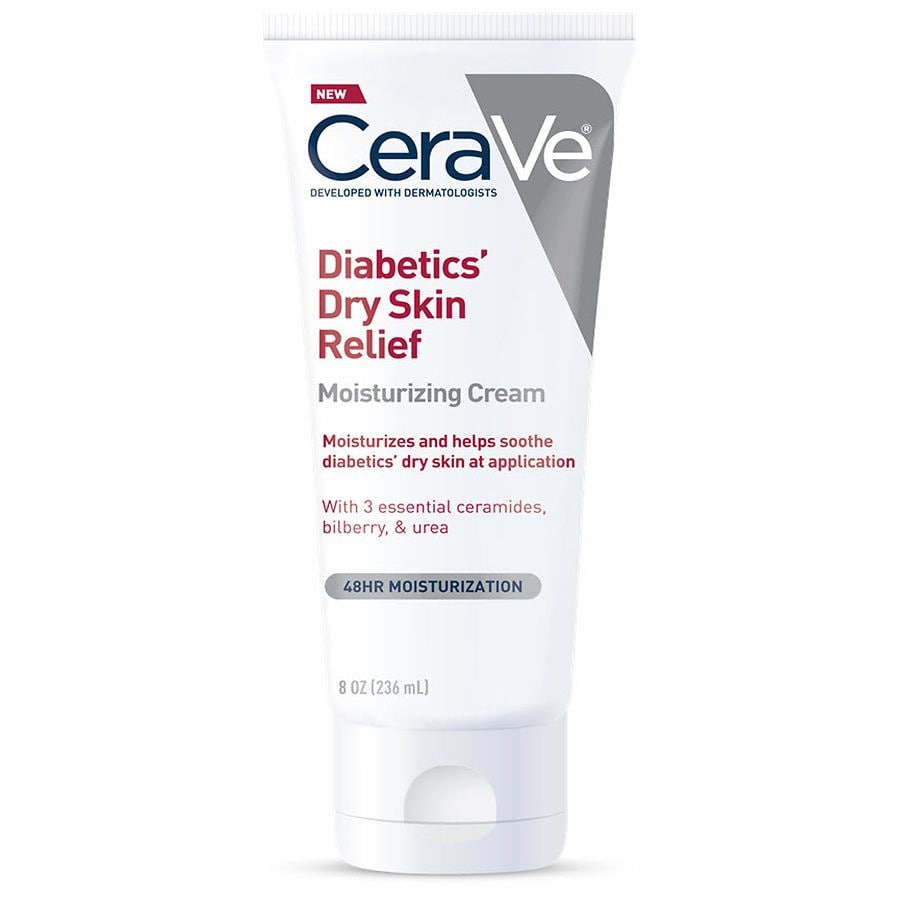
CeraVe Diabetics' Dry Skin Relief
Sold on urea. It contains none — and no petrolatum, which makes it arguably weaker than the $12 CeraVe tub beside it.
Key facts
CeraVe Diabetics' Dry Skin Relief at a glance.
Hydroxyethyl urea (a humectant — not urea)
Key active
Cream
Texture
Dry skin, if you already own it
Best for
$13–$17
Approximate price
Fragrance free
Fragrance
8 oz
Size
$11.99
Price
Moisturizer
Type
What is it?
Top things to know about CeraVe Diabetics' Dry Skin Relief
- CeraVe Diabetics' Dry Skin Relief is a fragrance-free cream for dry skin, sold in an 8 oz tube for about $12 to $17. It is a plain moisturizer, not a treatment. Nothing in it touches the nerve damage, poor circulation or slow healing that make diabetic skin risky.
- Glycerin pulls water into the outer layer; three ceramides replace the fats that hold it together. Hydroxyethyl urea is a second humectant — not urea, despite the name, and it does not loosen dead skin. No petrolatum, so it sinks in without a greasy film.
An ordinary ceramide cream with a label aimed at a market. Nothing in it touches the nerve damage or poor circulation that make diabetic skin risky, and its hydroxyethyl urea holds water without shifting dead skin. Keeping skin from cracking matters, and the plain CeraVe cream does that with petrolatum.
— Dr. Schwarz
Skin fit
Is it right for your skin?
Dry Skin
Dry skin has lost water and the fats that keep water in. Glycerin pulls water into the outer layer, three ceramides replace the fats. Apply it to damp skin — there is no petrolatum here to seal in what is already there.
Damaged Skin Barrier
A worn barrier leaks water and lets irritants in. Ceramide NP, AP and EOP are the three fats it is short of, and cholesterol sits alongside them. No acid, no active pushing against skin while it recovers.
Sensitive Skin
Nothing here is a common stinger, and it is fragrance-free. If you react to almost everything, Vanicream is the plainer choice.
Texture
What it feels like on skin.
Cream
A medium-weight cream. It spreads easily and sinks in within about a minute. With no petrolatum it leaves no greasy film — pleasant on the hands and under clothes, less protective on skin that is already cracked. It is fragrance-free and does not sting. The tube keeps fingers out of the pot.
Alternatives
If this isn’t the right product for you
CeraVe Moisturizing Cream
The $12 tub beside it, same ceramides, less per ounce.
Vanicream Moisturizing Cream
Cheap, fragrance-free, free of the common allergens. A better everyday choice for dry, fragile skin.
AmLactin Intensive Healing 15%
15% ammonium lactate in a ceramide base, for thickened, scaly skin. If you have diabetes, keep it off cracked skin and away from between the toes, and ask your care team first.
Ingredients · Interactive
What’s in it, and where each ingredient works.
Full ingredient list · 30 ingredients, in label order. Click one.
A small humectant. It moves into the outer layer of skin and holds water there.
A fatty alcohol that softens skin and thickens the product. Despite the name, it is not drying.
A silicone that smooths the surface and adds to the protective film.
An emulsifier that also helps the product spread and feel smooth.
One of the main fats between skin cells in the outer layer. It helps refill gaps in the barrier.
A second skin ceramide. It works with the others to rebuild the barrier.
A long-chain ceramide that helps the barrier fats stack into tight, orderly layers.
A thickener that gives the product its texture.
An emulsifier that helps hold the ceramides in the formula.
A barrier fat that works alongside ceramides. The barrier needs both to repair well.
The preservative. It stops bacteria and mold from growing in the product.
A thickener that keeps the texture even.
Helps the preservative work and softens the feel of the product.
How to use it
How to use it.
How to apply it
- How muchA thin, even layer over every dry area, rubbed in until it disappears.
- CarefulIf you have diabetes, check your feet daily and do not pack cream between the toes. Trapped moisture softens skin and invites infection. Broken skin is a job for your care team, not a moisturizer.
What to expect
- What to expectTightness and rough patches ease within a few days. It will not thin thickened, scaly skin — that needs real urea or lactic acid, and neither is here.
Questions
Common questions.
Does CeraVe Diabetics' Dry Skin Relief contain urea?
No. It contains hydroxyethyl urea, a humectant that does not exfoliate.
Is CeraVe Diabetics' Dry Skin Relief better than regular CeraVe cream?
Not clearly. It has no petrolatum, so it may be less protective.
Is CeraVe Diabetics' Dry Skin Relief fragrance-free?
Yes.
Is CeraVe Diabetics' Dry Skin Relief specially made for diabetics?
No. "For diabetics" is a marketing label, not a formula.
Should people with diabetes use CeraVe Diabetics' Dry Skin Relief?
It is fine as a moisturizer. It does not replace foot care.
References
Sources.
- 1. Importance of treatment of skin xerosis in diabetes (https://pubmed.ncbi.nlm.nih.gov/21492247/) — Backs the claim that moisturizing is a genuine part of diabetic skin care: a 1-month emollient study in 40 diabetic patients normalized skin hydration, reduced scaling/pruritus, and improved skin barrier function, limiting skin complications. Link
- 2. A Comprehensive Overview of Skin Complications in Diabetes and Their Prevention (https://www.cureus.com/articles/156402-a-comprehensive-overview-of-skin-complications-in-diabetes-and-their-prevention) — Backs the claim that dry/cracked skin matters in diabetes and that moisturizing is part of care: reviews how dry skin and skin-barrier defects are common in diabetes and that emollients and urea-based creams are used for skin and foot care to prevent complications. Link
- 3. The Skin Barrier and Moisturization: Function, Disruption, and Mechanisms of Repair (https://pubmed.ncbi.nlm.nih.gov/37717558/) — Backs the claim that a ceramide moisturizer base helps the skin barrier: explains that occlusives, humectants and emollients repair the physical barrier, that humectants draw water into the epidermis, and that barrier support increases ceramide content and lowers transepidermal water loss. Link
- 4. Effects of water activity and low molecular weight humectants on skin permeability and hydration dynamics - a double-blind, randomized and controlled study (https://doi.org/10.1111/ics.12136) — Backs the claim that the active is a humectant that hydrates skin: a randomized controlled study showing low-molecular-weight humectants (urea and glycerol) promote stratum corneum hydration, supporting the mechanism by which the humectant hydroxyethyl urea moisturizes. Link