PRODUCT REVIEW
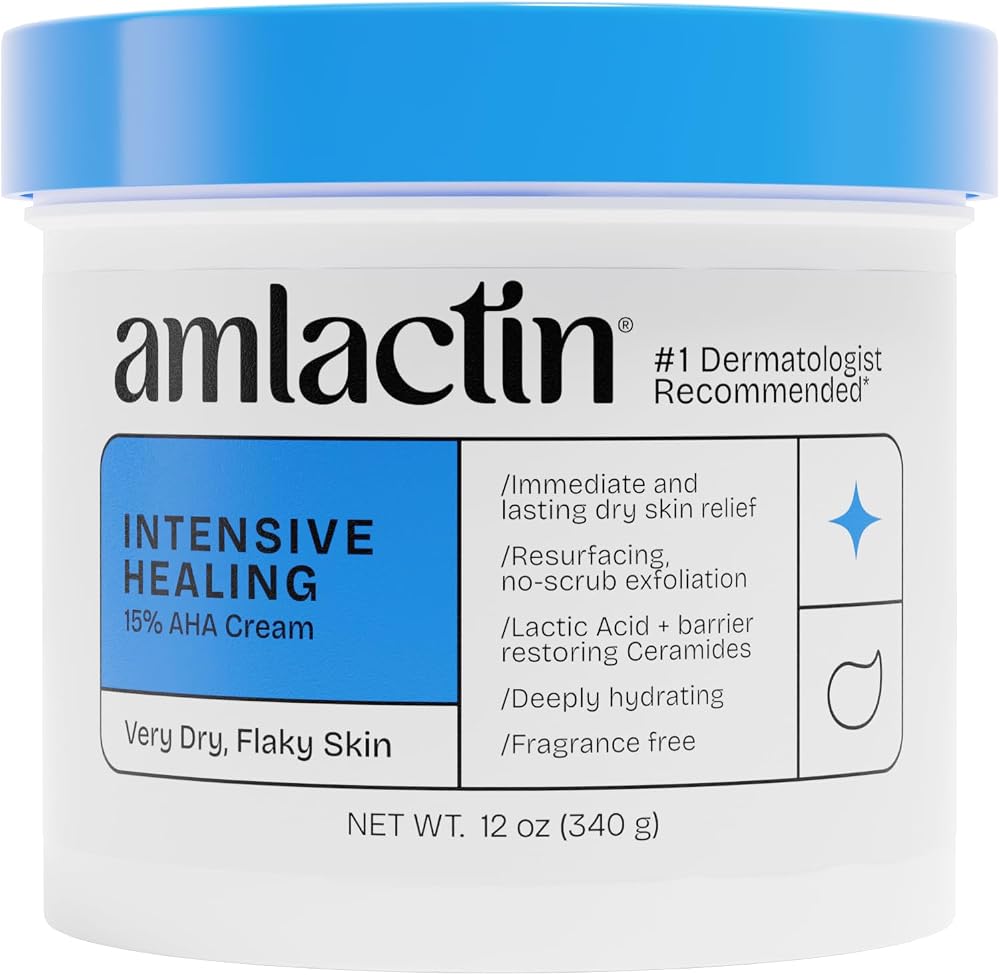
AmLactin Intensive Healing 15%
15% ammonium lactate in a ceramide base — AmLactin's best-formulated product.
Key facts
AmLactin Intensive Healing 15% at a glance.
Ammonium lactate 15%
Key active
Lotion or cream
Texture
Very dry, rough, scaly skin; stubborn keratosis pilaris
Best for
$14–$20
Approximate price
Fragrance free
Fragrance
7.9 oz
Size
$15.97
Price
Moisturizer
Type
What is it?
Top things to know about AmLactin Intensive Healing 15%
- AmLactin Intensive Healing 15% is a body moisturizer with a strong acid in it, about $14 to $20 for 7.9 oz. It comes as both a Lotion and a Cream under the same name, so check the pack. Body only, not a face cream, and sold as a cosmetic, so no agency has reviewed whether it works.
- The active is ammonium lactate at 15%, lactic acid buffered with ammonia. Lactic acid is an alpha hydroxy acid, so it loosens the glue between dead surface cells, and it is a humectant, so it holds water in. The base adds three ceramides, cholesterol and phytosphingosine — the fat classes that make up that glue.
The step up when 12% is no longer enough. Stronger ammonium lactate loosens dead cells faster, and the ceramides and cholesterol replace the barrier fats it costs you. Expect stinging on cracked skin the first week. Keep it below the neck.
— Dr. Schwarz
Skin fit
Is it right for your skin?
Keratosis Pilaris
The bumps on the backs of arms and thighs are plugs of dead cells caught in hair follicles. Nothing dissolves them permanently, because the follicle keeps making them. This loosens the plugs faster than they build up, so skin smooths while you use it and roughens again weeks after you stop.
Dry Skin
Very dry skin is rough because dead cells pile up instead of shedding, and the pile holds almost no water. Lactic acid loosens the pile and pulls water into what is left, with mineral oil and petrolatum sealing the surface.
Psoriasis
Psoriasis plaques carry thick scale because skin cells are made and shed far too fast. An alpha hydroxy acid thins that scale and lets whatever you apply next reach the plaque. Intact, scaly skin only — on a cracked plaque, a 15% acid will burn.
Texture
What it feels like on skin.
Cream
A thick white cream, heavier than a body lotion but not greasy. One pack covers arms and legs. It sinks in within a couple of minutes, leaving a soft finish and a light seal from the mineral oil and petrolatum. Faint sour smell from the lactic acid, gone within minutes, and no added fragrance. Expect stinging in the first week, worst where skin is cracked.
Alternatives
If this isn’t the right product for you
AmLactin Daily Nourish Lotion 12%
The same active at a lower strength in a simpler base. The step down if 15% leaves skin red or sore. Body only.
Vanicream Moisturizing Cream
Fragrance-free and acid-free at $13–$15, with petrolatum sealing water in. For days between, and skin too cracked for an acid.
Eucerin UreaRepair Plus
Urea is well evidenced for very dry skin, but this is Eucerin's European line, sold by gray-market importers, and "Plus" covers both 5% and 10%.
Ingredients · Interactive
What’s in it, and where each ingredient works.
Full ingredient list · 22 ingredients, in label order. Click one.
A small humectant. It moves into the outer layer of skin and holds water there.
Forms a thin film on top of the skin that slows water loss while the barrier recovers.
A silicone that smooths the surface and adds to the protective film.
An emulsifier that helps hold the ceramides in the formula.
One of the main fats between skin cells in the outer layer. It helps refill gaps in the barrier.
A second skin ceramide. It works with the others to rebuild the barrier.
A long-chain ceramide that helps the barrier fats stack into tight, orderly layers.
A building block skin uses to make its own ceramides.
A barrier fat that works alongside ceramides. The barrier needs both to repair well.
A thickener that keeps the texture even.
A thickener that gives the product its texture.
How to use it
How to use it.
How to apply it
- How muchA thin layer over the rough area. A thicker layer only stings more.
- CarefulStart every other day for two weeks if your skin is reactive. An AHA thins the dead surface layer, so you burn more easily — use sunscreen and cover treated skin in daylight, and for a week after you stop. Not on cracked, broken or freshly shaved skin.
- WhereArms, thighs, elbows, knees, shins. Not the face, the groin, or near the eyes.
What to expect
- What to expectStinging the first few times, then less. Rough skin smooths in one to two weeks. Bumps flatten over four to six weeks and return within a month of stopping.
Questions
Common questions.
What is AmLactin Intensive Healing 15% best for?
Very dry, rough, scaly skin and stubborn keratosis pilaris.
Can I use AmLactin Intensive Healing 15% on my face?
No. 15% is a body strength.
Should I get AmLactin Intensive Healing 15% lotion or cream?
Both exist under one name. Pick by preference and check the label.
Does AmLactin Intensive Healing 15% cure keratosis pilaris?
No. It manages it well; the bumps return when you stop.
Do I need sunscreen while using AmLactin Intensive Healing 15%?
Yes. AHAs make you burn more easily, during use and about a week after.
References
Sources.
- 1. Ammonium Lactate Lotion, 12% - DailyMed drug label (https://dailymed.nlm.nih.gov/dailymed/drugInfo.cfm?setid=8bb09bb3-5bbc-489d-96c1-ae97cb58381e) — FDA drug label for 12% ammonium lactate (neutralized lactic acid) confirms it is an acidic preparation (lotion pH 4.5-5.5) indicated for dry, scaly skin (xerosis), and explicitly warns that stinging or burning may occur on application, especially to abraded or shaved skin. Link
- 2. Clinical evaluation of 40% urea and 12% ammonium lactate in the treatment of xerosis (https://pubmed.ncbi.nlm.nih.gov/11978141/) — Randomized double-blind clinical trial showing 12% ammonium lactate improves xerosis measures (skin dryness, roughness, scaling and desquamation), supporting that ammonium lactate exfoliates and hydrates dry skin. Link
- 3. The skin barrier: An extraordinary interface with an exceptional lipid organization (https://pubmed.ncbi.nlm.nih.gov/37666282/) — Peer-reviewed review (Prog Lipid Res, 2023) stating the main lipid classes of the stratum corneum barrier are ceramides, cholesterol and free fatty acids, supporting the claim that ceramides and cholesterol are the actual lipid classes making up the skin barrier. Link