Picosecond Laser

A pico laser is the better choice for blue, green and yellow tattoo ink, and for acne scars. Its pulses are far shorter, so they shatter pigment instead of only heating it. A Q-switched laser matches it on black ink and usually costs less. The gap between the two is much smaller than the marketing suggests.
| The difference | Picosecond Laser | Q-switched |
|---|---|---|
| Downtime | Depends on the setting used | Redness, darkening, pinpoint bruising |
| Cost | Priced at a premium | Usually cheaper |
Mainly heat Pigment soaks up the energy, heats fast and cracks apart.
Side by side
Picosecond Laser
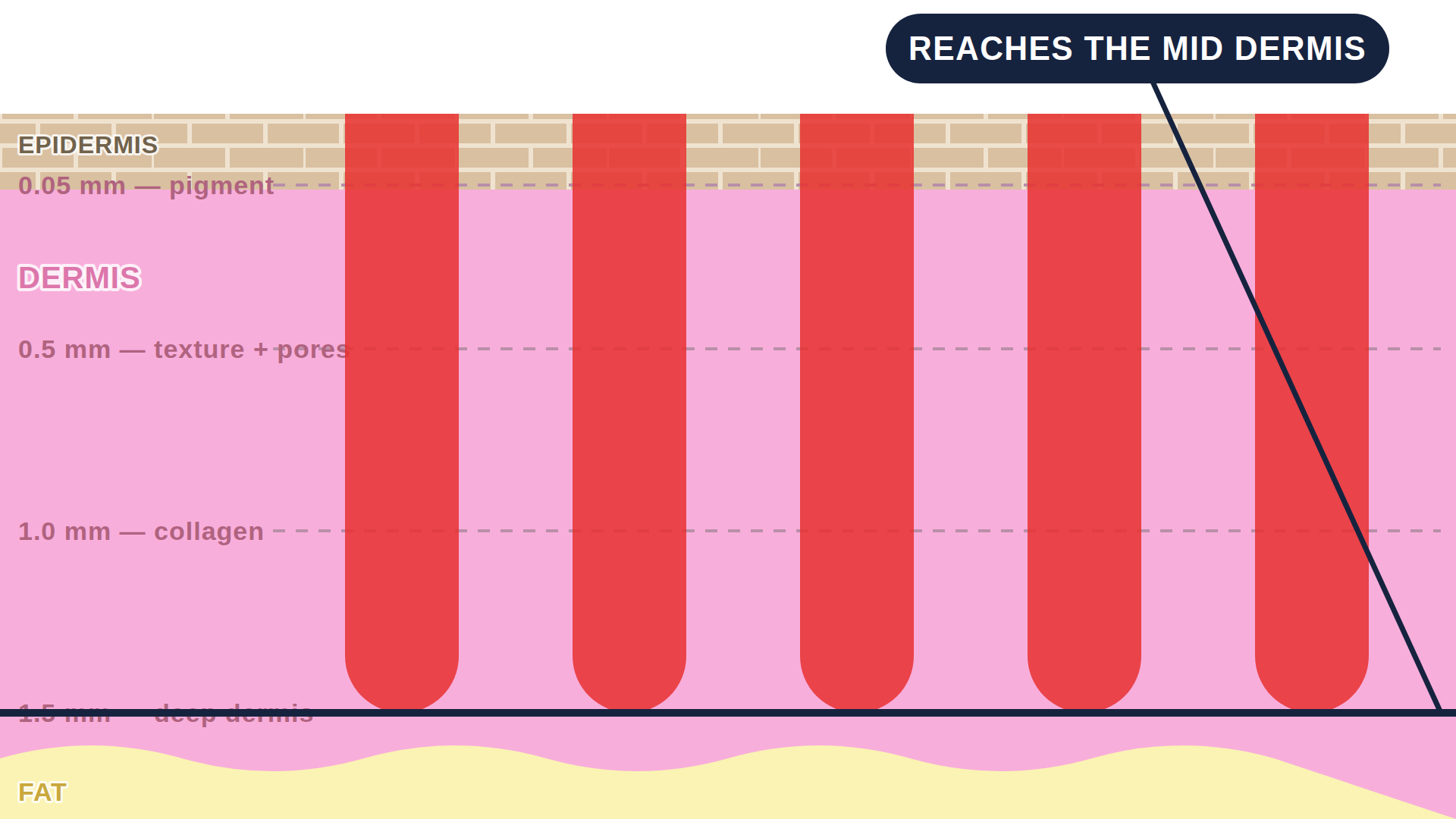
Heat plus mechanical shock
The pulse is short enough to shatter pigment, not just heat it.
Q-switched
Mainly heat
Pigment soaks up the energy, heats fast and cracks apart.
Picosecond Laser
Better for blue, green and yellow ink
In a randomised trial, about 33% of pico-treated tattoos reached 75% clearance. About 14% did with the older laser.
Q-switched
Equal to pico for black ink
The two performed about the same on plain black.
Picosecond Laser
The stronger option
A head-to-head trial against a common fractional laser favoured pico.
Q-switched
Not what it is built for
It is not aimed at scar texture.
Picosecond Laser
No proven advantage
For everyday brown pigment, no clear edge has been shown.
Q-switched
Long track record
This is routine work for the older machine.
Picosecond Laser
Not shown to help
A review that pooled several studies found no real benefit.
Q-switched
Also not a first-line answer
Melasma is not what it is best at either.
Picosecond Laser
Depends on the setting used
One setting usually settles within a day. Others often leave pinpoint bruising you can still see at 24 hours.
Q-switched
Redness, darkening, pinpoint bruising
Much the same as pico.
Picosecond Laser
Often fewer, for the right colours
The gain is in coloured ink, not black.
Q-switched
More, especially for coloured ink
Picosecond Laser
Priced at a premium
There is evidence behind the premium for coloured ink and for acne scars. There is not for black ink or sun spots.
Q-switched
Usually cheaper
Proven, and the routine choice for black ink and everyday pigment work.
Picosecond Laser
There is no home pico laser
A home wand puts a fraction of the power into the surface of the skin. It cannot fire a pulse anywhere near that short.
Q-switched
There is no home tattoo laser either
Wands sold for fading marks act on the surface. Tattoo ink sits below it, out of reach.
Picosecond Laser
Q-switched
Picosecond Laser
Some machines have both a picosecond and a nanosecond mode. The operator picks which one to use. So "I had a pico laser" does not always mean every pulse was a pico pulse. Ask which mode was used, and at what setting.
Picosecond Laser
No picosecond device is cleared to treat melasma. Clearance is the FDA paperwork that lets a device be sold for a named use. It is a separate question from what the trials found, and on melasma the trials found no significant benefit.
Q-switched

Breaks pigment into fragments small enough for the body to carry away, using very short pulses that put less heat into the skin than older lasers. It is one of the safer device options for stubborn deep marks, but the evidence in dark marks after inflammation is still thin. Test patch first, and expect a course rather than one session.

A newer laser that delivers very short pulses at low energy, aimed at the deeper pigment creams struggle with. The melasma studies so far are small and cautiously encouraging. Like every device used here it is an addition to creams and sun protection rather than a shortcut past them, and results still fade without them.

Delivers its energy in much shorter pulses, which breaks up pigment with less heat spilling into the skin around it. That lower heat is the reason it is often chosen for medium and deeper skin tones, where a darker mark afterwards is the main worry. It costs more than the older lasers and the results in sun spots are broadly similar.

A pigment-targeted laser used for stubborn brown circles that have not moved with creams or peels. Results vary a good deal, several sessions are needed, and eye shields are essential. The same caution applies as with peels: aggressive settings on eyelid skin can leave darker marks than the ones being treated, and that risk is higher on deeper skin tones.

Strong evidence, and the only method that removes ink completely and predictably. Limited to small tattoos, and it trades the tattoo for a surgical scar. Sometimes used for a small stubborn remnant at the end of a laser course.

Moderate evidence for acne scars and texture, with or without radiofrequency. Cheaper per session, no wavelength to match, and does nothing at all for tattoo ink. Often chosen over fractional laser modes on deeper skin tones.
Common questions