Fractional laser
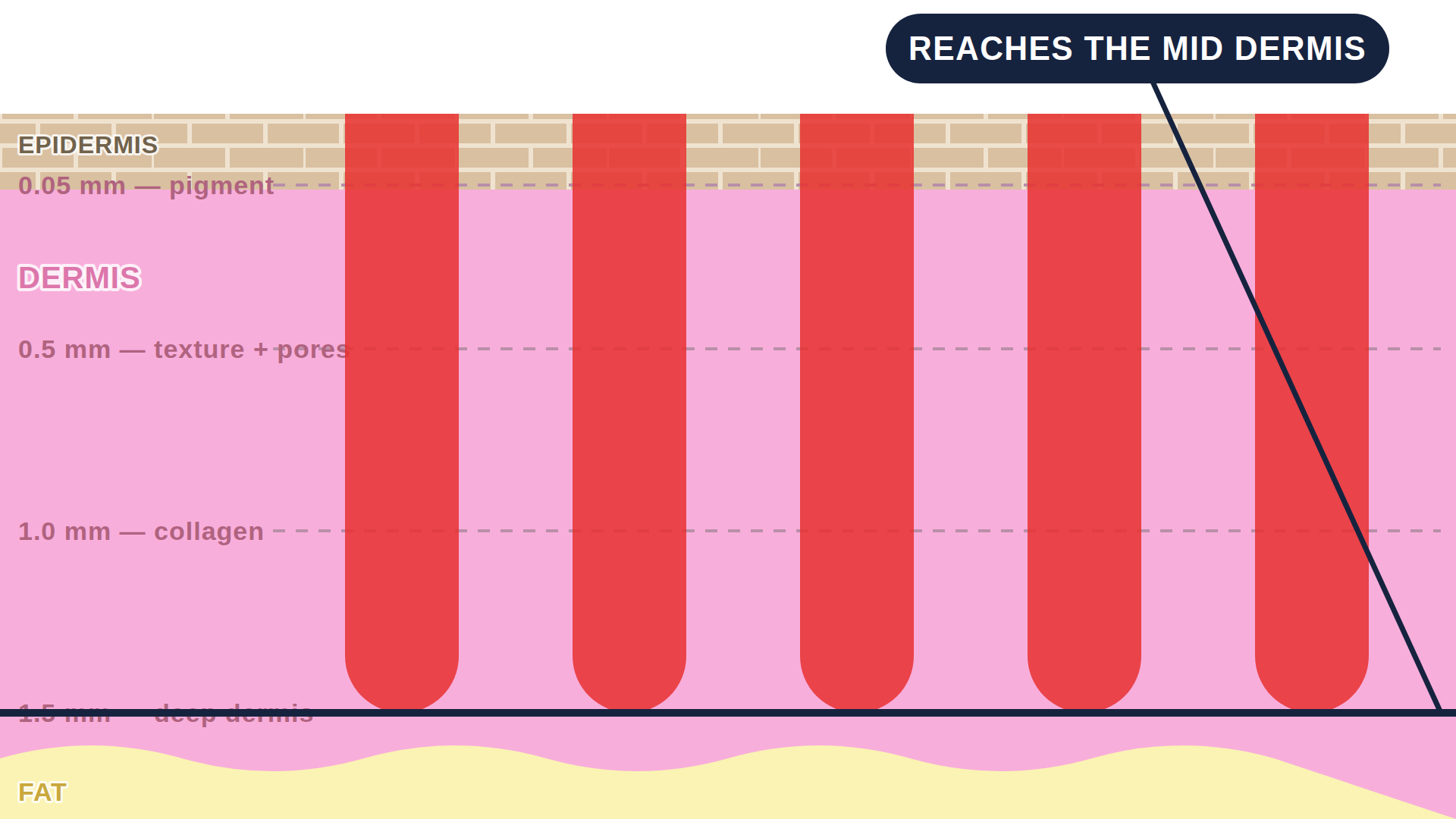
Makes tiny columns of injury It treats a fraction of the surface and leaves the skin in between untouched. That untouched skin is what heals the rest. New collagen fills in over weeks.
A fractional laser is the stronger choice for texture, acne scars and wrinkles. It makes thousands of microscopic columns of controlled injury, and the skin rebuilds itself over the following weeks. A pico laser is the better choice for tattoos and pigment. It fires pulses so short that they shatter ink and pigment without heating much around them, so most people look normal again within a day. When the two have been compared for acne scars, the fractional laser did more, and it also asked more of the person having it.
| The difference | Fractional laser | Picosecond Laser |
|---|---|---|
| What it does to the skin | Makes tiny columns of injury | Shatters pigment |
| What it is best for | Scars, texture, lines | Tattoos and brown spots |
| What it feels like | Hot, with numbing cream first | Quick snaps |
| Downtime | Days, not hours | About a day |
| Cost | Priced per session, higher per visit | Priced per session, more sessions |
Makes tiny columns of injury It treats a fraction of the surface and leaves the skin in between untouched. That untouched skin is what heals the rest. New collagen fills in over weeks.

Side by side
Fractional laser
Makes tiny columns of injury
It treats a fraction of the surface and leaves the skin in between untouched. That untouched skin is what heals the rest. New collagen fills in over weeks.
Picosecond Laser
Shatters pigment
The pulse is measured in trillionths of a second. It breaks pigment into dust more by shock than by heat. Your body then clears the pieces away.
Fractional laser
Scars, texture, lines
Acne scars, rough or crepey texture, fine lines, sun damage and surgical scars.
Picosecond Laser
Tattoos and brown spots
Tattoo removal, sun spots, freckles, and some cases of melasma. Also used for mild texture.

Breaks pigment into fragments small enough for the body to carry away, using very short pulses that put less heat into the skin than older lasers. It is one of the safer device options for stubborn deep marks, but the evidence in dark marks after inflammation is still thin. Test patch first, and expect a course rather than one session.

A newer laser that delivers very short pulses at low energy, aimed at the deeper pigment creams struggle with. The melasma studies so far are small and cautiously encouraging. Like every device used here it is an addition to creams and sun protection rather than a shortcut past them, and results still fade without them.

Delivers its energy in much shorter pulses, which breaks up pigment with less heat spilling into the skin around it. That lower heat is the reason it is often chosen for medium and deeper skin tones, where a darker mark afterwards is the main worry. It costs more than the older lasers and the results in sun spots are broadly similar.

A pigment-targeted laser used for stubborn brown circles that have not moved with creams or peels. Results vary a good deal, several sessions are needed, and eye shields are essential. The same caution applies as with peels: aggressive settings on eyelid skin can leave darker marks than the ones being treated, and that risk is higher on deeper skin tones.
Fractional laser
It will not erase a tattoo
It also does not lift loose skin.
Picosecond Laser
It will not rebuild deep scars
A pico laser can soften a shallow scar. It does not do much for a deep, boxcar acne scar on its own.

Strong evidence, and the only method that removes ink completely and predictably. Limited to small tattoos, and it trades the tattoo for a surgical scar. Sometimes used for a small stubborn remnant at the end of a laser course.

Moderate evidence for acne scars and texture, with or without radiofrequency. Cheaper per session, no wavelength to match, and does nothing at all for tattoo ink. Often chosen over fractional laser modes on deeper skin tones.
Fractional laser
Hot, with numbing cream first
Like a hot rubber band snapped over and over. Numbing cream is standard, and stronger settings may need more than that. Afterwards it feels sunburnt.
Picosecond Laser
Quick snaps
Sharper but much faster, and over in minutes for a small area. Numbing cream is often enough.
Fractional laser
Days, not hours
A gentler non-ablative treatment means a few days of pink, swelling and flaking. A stronger ablative one means about a week of raw, oozing, peeling skin, then weeks of redness fading.
Picosecond Laser
About a day
Redness and swelling for a few hours to a day. Treated spots may darken and flake off over the next week.
Fractional laser
One strong, or three to five gentle
A single strong ablative treatment can do the job. Gentler devices are a course, spaced four to six weeks apart.
Picosecond Laser
Several, and more for a tattoo
Pigment often takes three to six visits. A tattoo can take far more, spaced six to eight weeks apart.
Fractional laser
Years, for scars and texture
New collagen is real change. Ageing carries on around it.
Picosecond Laser
Permanent for the ink
Removed tattoo ink does not come back. Sun spots and melasma can return with sun exposure.
Fractional laser
Dark marks and, rarely, scarring
Post-inflammatory hyperpigmentation is the common problem, and it is more likely on deeper skin tones. Infection and scarring are uncommon but real, and more likely with the ablative settings.
Picosecond Laser
Dark or pale patches
Blistering, temporary dark marks, and loss of colour in the treated spot. Tattoo ink can also turn a different colour instead of fading.
Fractional laser
Priced per session, higher per visit
An ablative course may be one expensive appointment. Ask what a full plan costs, not one visit.
Picosecond Laser
Priced per session, more sessions
Each visit costs less than strong resurfacing, but you will need several. The total is what matters.
Fractional laser
A slower version of the same idea
At-home fractional devices exist and use the same principle at a fraction of the power. They reach the very top of the skin only. A retinoid cream is the honest at-home comparison for texture and fine lines, and it is slower but works.
Picosecond Laser
There is no home version
Home tattoo removal creams and wands do not shatter pigment. Nothing sold for home use puts out a picosecond pulse.
Fractional laser
Picosecond Laser
Fractional laser
Many pico devices can also be run in a fractional mode. A lens splits the beam into a grid of high-energy points, which lets a pigment laser do a little resurfacing too.
Fractional laser
A fractional resurfacing laser has the better record for atrophic acne scars. Those are the sunken, pitted ones, and they need the skin rebuilt from below.
Common questions