BBL (Broadband Light)

A BBL handpiece resting flat on the cheek. The flat glass window is what tells you this is a light treatment rather than a laser — it treats a wide patch at once instead of a narrow beam.
Both treatments target colour in the skin, but they suit different jobs. BBL is broadband light — a flash of many wavelengths at once — and it works best on redness and diffuse brown patchiness. A picosecond laser fires one wavelength in pulses measured in trillionths of a second, and it works best on tattoo ink, defined spots and acne scars. In darker skin, the laser is usually the safer choice, because broadband light carries more risk of burns and pigment change.
| The difference | BBL (Broadband Light) | Picosecond Laser |
|---|---|---|
| Cost | Judge it by the course, not the visit | Judge it by the course, not the visit |
A BBL handpiece resting flat on the cheek. The flat glass window is what tells you this is a light treatment rather than a laser — it treats a wide patch at once instead of a narrow beam.

The Pico handpiece delivers its energy in extremely short pulses. That is what breaks pigment apart with less heat than an older laser.
Side by side
BBL (Broadband Light)
A flash lamp passed over the skin
A handheld lamp fires a broad band of wavelengths across the surface. It is a form of intense pulsed light, not a laser.
Picosecond Laser
A laser with an ultra-short pulse
A laser fires one wavelength. Each pulse lasts trillionths of a second.

Breaks pigment into fragments small enough for the body to carry away, using very short pulses that put less heat into the skin than older lasers. It is one of the safer device options for stubborn deep marks, but the evidence in dark marks after inflammation is still thin. Test patch first, and expect a course rather than one session.

A newer laser that delivers very short pulses at low energy, aimed at the deeper pigment creams struggle with. The melasma studies so far are small and cautiously encouraging. Like every device used here it is an addition to creams and sun protection rather than a shortcut past them, and results still fade without them.

Delivers its energy in much shorter pulses, which breaks up pigment with less heat spilling into the skin around it. That lower heat is the reason it is often chosen for medium and deeper skin tones, where a darker mark afterwards is the main worry. It costs more than the older lasers and the results in sun spots are broadly similar.

A pigment-targeted laser used for stubborn brown circles that have not moved with creams or peels. Results vary a good deal, several sessions are needed, and eye shields are essential. The same caution applies as with peels: aggressive settings on eyelid skin can leave darker marks than the ones being treated, and that risk is higher on deeper skin tones.
BBL (Broadband Light)
Redness, flushing, freckling and spots fade
It suits broad, diffuse colour spread over an area.
Picosecond Laser
Ink, defined spots and scars improve
It suits well-bounded targets, and it changes texture.
BBL (Broadband Light)
Light absorbed by colour, turned to heat
Pigment and blood vessels soak up the light and heat up.
Picosecond Laser
Heat plus a mechanical shock
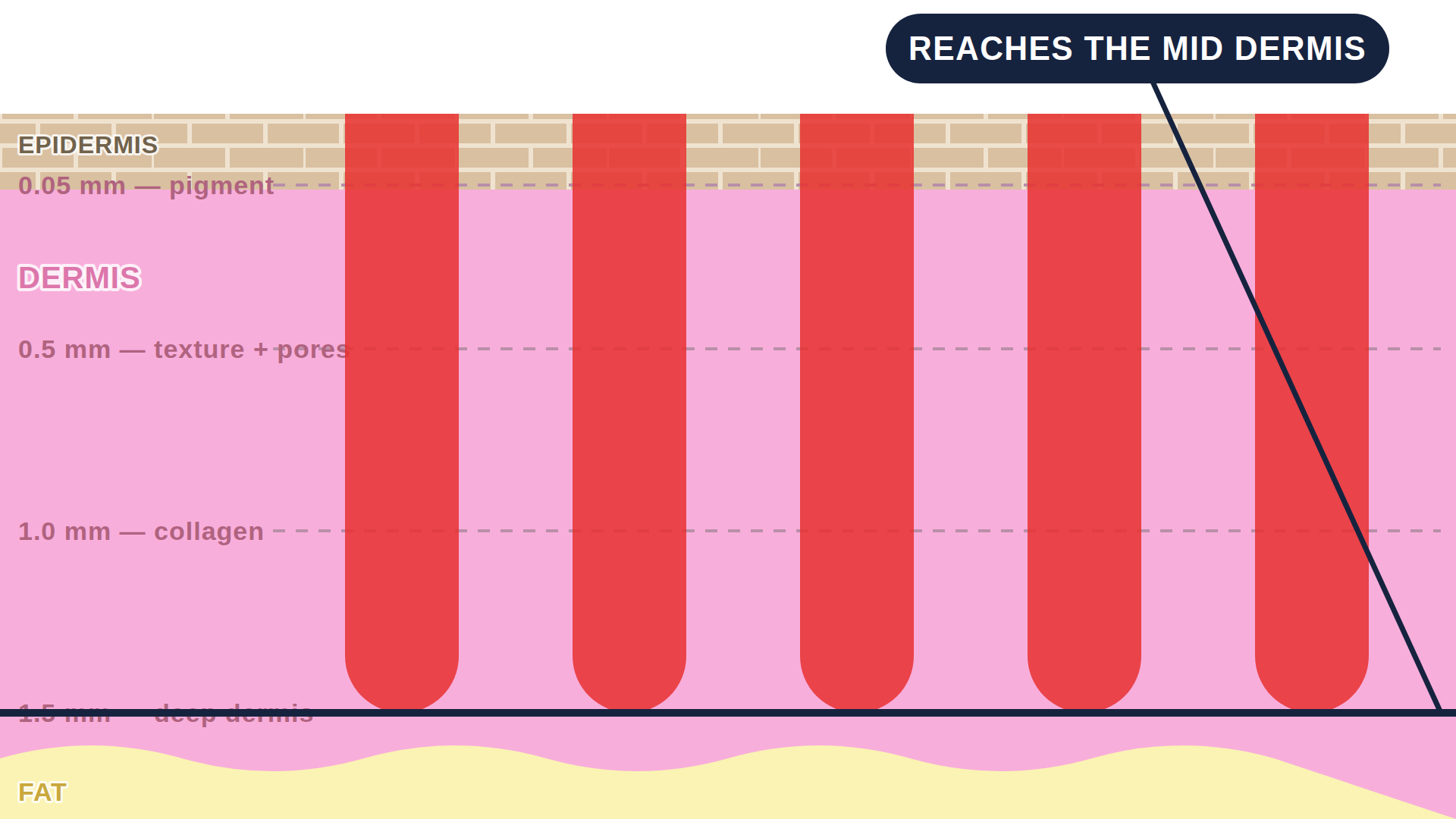
The pulse is so short that it shatters the target rather than only heating it. With a lens attached it can also make tiny cavities in the skin that trigger repair.
BBL (Broadband Light)
It will not clear a tattoo
Broad-spectrum light is not aimed at ink.
Picosecond Laser
Not better than older lasers on brown
For general brown pigment, picosecond has not been shown to beat older lasers. A review of the studies found no clear benefit for melasma either.

Strong evidence, and the only method that removes ink completely and predictably. Limited to small tattoos, and it trades the tattoo for a surgical scar. Sometimes used for a small stubborn remnant at the end of a laser course.

Moderate evidence for acne scars and texture, with or without radiofrequency. Cheaper per session, no wavelength to match, and does nothing at all for tattoo ink. Often chosen over fractional laser modes on deeper skin tones.
BBL (Broadband Light)
Redness for hours, spots flake for days
Treated spots darken like coffee grounds and lift over about a week.
Picosecond Laser
Depends on the device
Some devices settle within a day. Others often leave pinpoint bruising that is still visible at 24 hours.
BBL (Broadband Light)
Usually a series, then maintenance
Picosecond Laser
A few for spots, ten or more for a tattoo
Clinics often quote ten to twelve sessions for a tattoo, and sometimes twenty. The published review reports a range of one to ten.
BBL (Broadband Light)
Judge it by the course, not the visit
The usual shape is a short series, then maintenance. Price the whole series.
Picosecond Laser
Judge it by the course, not the visit
A tattoo is the expensive case, because the course is long.
BBL (Broadband Light)
No real home version
Home IPL gadgets exist, but they are sold for hair removal. They put a fraction of a clinic lamp's power into the skin.
Picosecond Laser
No real home version
There is no home picosecond laser. A handheld gadget cannot produce that pulse length or power. Fading creams work on the surface over weeks. Nothing you can buy shatters pigment.
BBL (Broadband Light)
Picosecond Laser
Picosecond Laser
The same caution applies to picosecond lasers, for a different reason. Any treatment that targets pigment can also provoke it. The laser is still the gentler option here, but it is not risk-free.
Picosecond Laser
Picosecond laser clearances vary by device. Between them they cover tattoo removal, benign pigmented lesions, acne scars and wrinkles. Picosecond lasers are not cleared for melasma. Pico Genesis is a protocol run on Cutera's enlighten laser.
The 755 nm picosecond devices generally settle faster than 532/1064 nm devices, which more often leave pinpoint bruising at 24 hours.
Clearance tells you what was reviewed, not what works. It is not a finding that one device beat another.
BBL (Broadband Light)
Common questions