Vivace

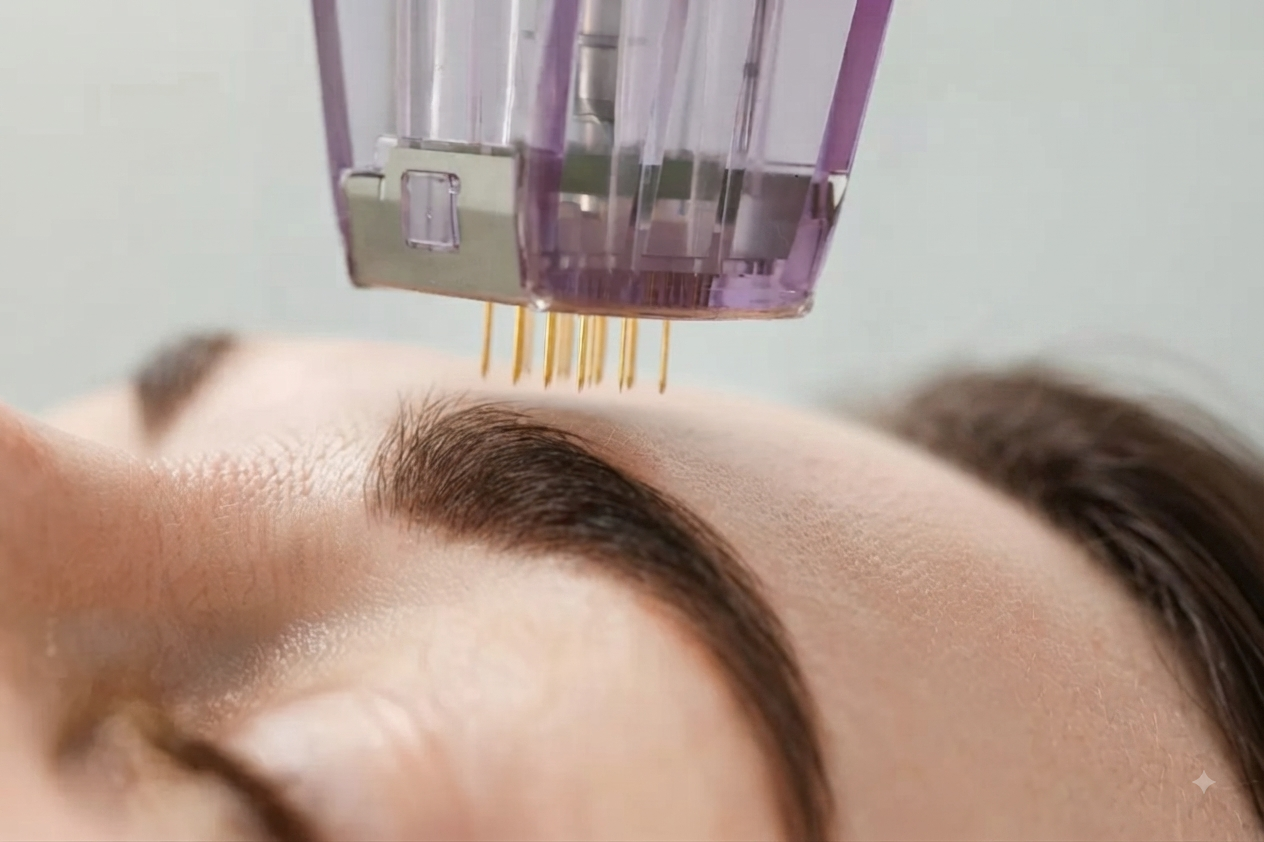
The Vivace tip on the forehead. The needles are gold-plated and insulated, releasing their heat at the tip rather than along the whole shaft.
Both machines press fine needles into the skin and heat it with radiofrequency. Vivace works from 0.5 to 3.5 mm deep. Morpheus8 goes deeper, up to 7 mm on its larger tips. Neither machine has a published trial of its own.
| The difference | Vivace | Morpheus8 |
|---|---|---|
| What you actually do | Needles plus RF, 0.5 to 3.5 mm deep | Needles plus RF, up to 7 mm deep |
| How deep it goes | 0.5 to 3.5 mm, in 0.1 mm steps | Up to 4 mm, and 7 mm on the bigger tips |
| Sessions | No session count from the maker | 1 to 6 treatments, usually 3 to 5 |
| What the evidence shows | No published trial of Vivace itself | No randomised trial of Morpheus8 |
| The downside | Not measured for this device alone | Not measured for this device alone |
The Vivace tip on the forehead. The needles are gold-plated and insulated, releasing their heat at the tip rather than along the whole shaft.
The Morpheus8 tip up close. The gold pins are what carry the radiofrequency energy below the surface — the needles are the delivery route, not the treatment itself.
Side by side
Vivace
Needles plus RF, 0.5 to 3.5 mm deep
A motor drives 36 gold-plated needles into the skin. Radiofrequency comes out of the needle tips. An LED module and a serum are sold as part of the treatment.
Morpheus8
Needles plus RF, up to 7 mm deep
Tips carry 12, 24 or 40 pins. A Burst mode fires at several depths in one needle insertion. No study of Burst mode on its own was found.
Vivace
0.5 to 3.5 mm, in 0.1 mm steps
Depth is a machine setting, not something a regulator reviews.
Morpheus8
Up to 4 mm, and 7 mm on the bigger tips
The 12-pin tip reaches 4 mm. The bigger tips reach 7 mm, so it can be set into the fat layer in a way Vivace cannot. The marketing figure of 8 mm is 7 mm of needle plus a claimed 1 mm of heat spread.
Vivace
No session count from the maker
The maker does not publish one.
Morpheus8
1 to 6 treatments, usually 3 to 5
The operator manual says every 3 to 6 weeks.
Vivace
No published trial of Vivace itself
No trial of the Vivace protocol, its LED module or its serum was found.
Morpheus8
No randomised trial of Morpheus8
None was found for this device either.
Vivace
Not measured for this device alone
Morpheus8
Not measured for this device alone
Vivace
No real home version
Home rollers and pens have no radiofrequency, so the heating this machine works by is missing. A roller also drags sideways instead of going straight in and out, so it tears more than it punctures.
Morpheus8
No real home version
The gap is wider here, because this device is set several millimetres down. Home needles are a fraction of that length and blunt quickly, and a blunt needle does more damage than a sharp one. Home radiofrequency wands never reach the depth a clinic device works at.
Vivace
Morpheus8
Vivace
Vivace and Virtue RF are made by the same company. Clinic pages often present them as rivals.
Morpheus8
"Safe for all skin types" is an overstatement for Morpheus8 at high energy. Above 62 mJ per pin, its applicator is limited to Fitzpatrick skin types I to IV. Vivace's wrinkle use covers Fitzpatrick I to V.
Vivace
Ask for the complete Vivace course quote, identifying the treatment area, numbing and planned visits.
Morpheus8
Ask for the equivalent Morpheus8 course quote. Include follow-up and proposed maintenance rather than comparing one introductory session.
Common questions
Who makes them. Vivace is made by ShenB in Korea and sold in the US by Aesthetics Biomedical; Virtue RF comes from the same company. Morpheus8 is made by InMode and is the rebuilt Fractora platform, first cleared in 2011.
Vivace's clearance names a cosmetic use and Morpheus8's does not. Vivace (K193070, 2021) is cleared "for electrocoagulation and hemostasis and the percutaneous treatment of facial wrinkles... when using the 1MHz setting," for Fitzpatrick skin types I to V. The clearance states plainly that the 2 MHz setting "has not been evaluated" for wrinkles. Morpheus8's clearances name electrocoagulation and hemostasis (K192695, 2019), then coagulation or contraction of soft tissue (K231790, 2023).
Electrocoagulation and hemostasis is surgical language, not a cosmetic claim. It means sealing tissue and stopping bleeding. Most devices in this class carry that wording.
A clearance is not a finding that a device works. A 510(k) clearance means the FDA judged the device substantially equivalent to one already on the market. So the FDA reviewed a wrinkle use for Vivace at 1 MHz and accepted it, and no regulator has reviewed any cosmetic claim for Morpheus8. That is not proof that Vivace works better.
Treating acne scars, laxity or texture with either machine is off-label. Off-label use is legal and routine.
Only a handful of devices in this class carry cosmetic wording. Vivace, Virtue RF, Profound and Profound Matrix do. Potenza, Secret RF, Genius, Sylfirm X, Scarlet, Agnes, PiXel8-RF and Morpheus8 do not.
RF microneedling can cause serious injury. The FDA has received reports of burns, scarring, loss of fat, nerve damage and disfigurement. Some injuries have needed surgery or other medical treatment. A few days of expected redness is not the full risk picture.
Choose a licensed medical professional trained on the device. Discuss the risks and other treatment options before deciding. RF microneedling should not be done at home.