BodyTite

BodyTite treats the fat layer of large body areas, alongside liposuction. A thin tube goes under the skin through a small entry point, and radiofrequency energy runs between that tube and an electrode on the surface. Morpheus8 treats skin quality: texture, acne scarring and laxity. Insulated needles are pressed through the skin, and the heat comes out of the last half-millimetre of each one.
| The difference | BodyTite | Morpheus8 |
|---|---|---|
| What it is best at | The fat layer of large body areas | Texture, acne scarring and laxity |
| Downtime | Not documented in the published research | A few days of redness |
Side by side
BodyTite
A minimally invasive body procedure
A thin tube goes in through a small entry point. Published reports describe it under local anaesthetic, on large areas such as the abdomen, flanks, arms and thighs, paired with liposuction.
Morpheus8
An in-office needle treatment
Numbing cream goes on first. Then a handpiece presses a grid of needles through the skin. The numbing cream is standard and usually included in the price.
BodyTite
Heats the fibrous layer under the skin
Current runs between the tube under your skin and an electrode on the surface. That heat firms up the fibrous network underneath. The machine watches the temperature and adjusts the energy on its own, cutting off at 69 to 70 °C inside and 38 to 40 °C at the skin surface.
Morpheus8
Small heated zones in the true skin
Current passes between the pins in the tip. That makes a grid of small heated zones in the dermis, the living layer under the surface. The pins are insulated except for the last 0.5 mm, so the energy leaves at the needle tip rather than at the skin surface.
BodyTite
Into the fat layer, wherever it is passed
No tube length or width is published.
Morpheus8
Selectable, from 0.5 mm to 7 mm
Tips reach from a fixed 0.5 mm up to 7 mm. The "8 mm" often quoted is a marketing figure: 7 mm of needle plus 1 mm of heat around it.
BodyTite
The fat layer of large body areas
It is one part of a procedure that also removes fat by suction. It is not a fat-reduction treatment on its own — liposuction is what removes the fat.
Morpheus8
Texture, acne scarring and laxity
Remodelling the skin itself. Acne scars are the best-evidenced use of this type of device.
BodyTite
Not documented in the published research
No published trial gives a recovery figure, so we do not quote one. But it is still a procedure. There is an entry point, an anaesthetic, and usually liposuction alongside it.
Morpheus8
A few days of redness
Nearly everyone gets redness, and some get swelling. One neck study described three to four days. Those figures come from studies of radiofrequency microneedling on other companies' machines.
BodyTite
No published session figure
Morpheus8
Usually three to five, a few weeks apart
The manual says 1 to 6 treatments, typically 3 to 5, every 3 to 6 weeks. Published trials cluster at three sessions. That is convention, not a tested course length.
BodyTite
There is no home version of this
BodyTite works from inside the fat layer, through an entry point made by a clinician. Nothing sold for home use goes under the skin.
Morpheus8
Home rollers and pens are a different thing
Home microneedling devices have no radiofrequency at all, so the heat that does the work here is missing. The needles are also shorter and blunt quickly.
BodyTite
Morpheus8
Morpheus8
Most Morpheus8 research was done on other machines. There is a real body of work on radiofrequency microneedling, but it mostly used other companies' devices. Anyone shown "the studies" for Morpheus8 is usually being shown work done with somebody else's kit. The longest properly measured follow-up is six months.
Morpheus8
Morpheus8's own clearances read the same way. Electrocoagulation and hemostasis in December 2019 (K192695), then coagulation or contraction of soft tissue in July 2023 (K231790). Above 62 mJ per pin, Morpheus8 is limited on-label to skin types I to IV.
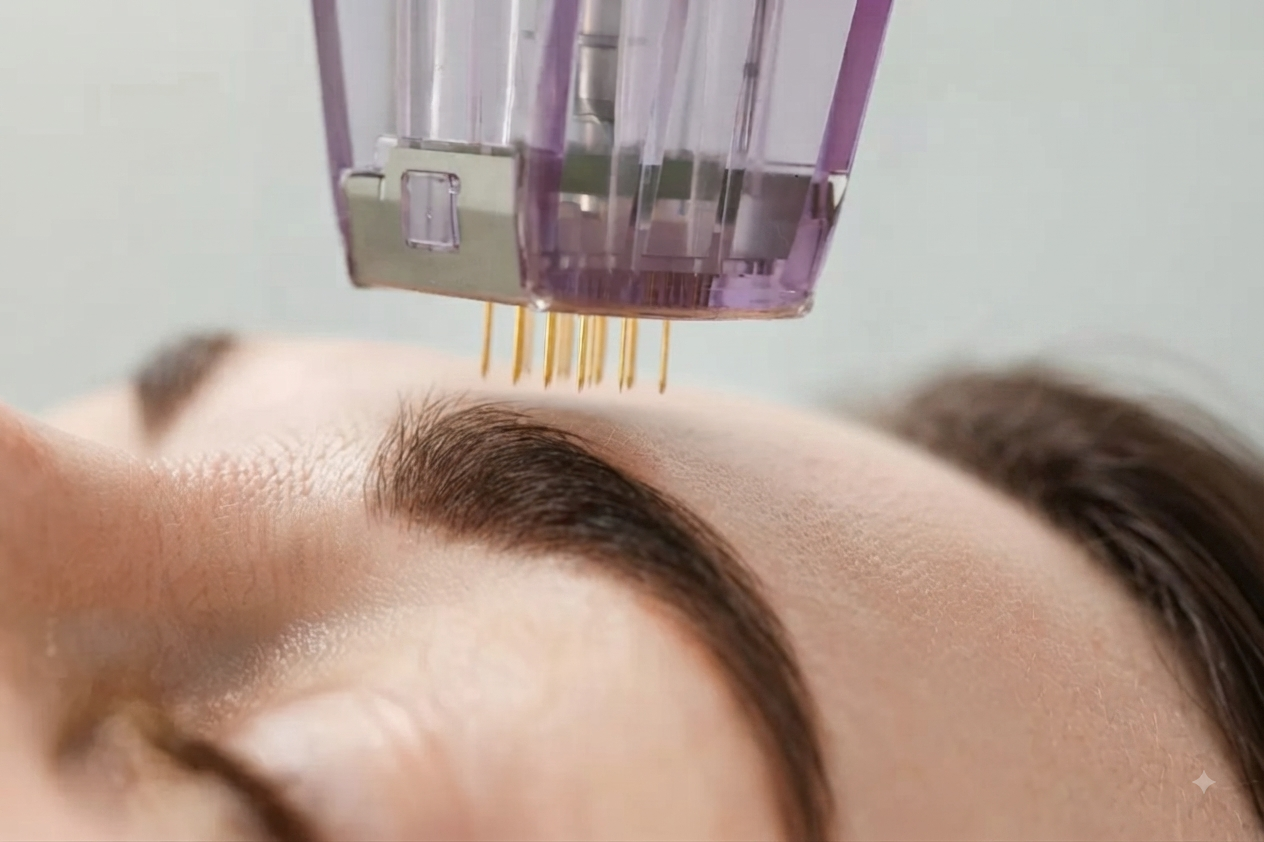
The Morpheus8 tip up close. The gold pins are what carry the radiofrequency energy below the surface — the needles are the delivery route, not the treatment itself.
Common questions
Fat loss is one of the more reported problems with radiofrequency microneedling. In the FDA's post-market database, 26 of 224 reported events between 2013 and 2025 were fat loss. That is a share of reports, not your risk. The database is voluntary and has no denominator, so it cannot be turned into a per-patient chance of anything.
One controlled study found no fat loss at all. A 2024 study measured the fat layer under the chin by ultrasound after needle radiofrequency and found it unchanged.
This matters because both devices work close to fat. BodyTite works in the fat layer on purpose, and Morpheus8's deeper tips reach just under the skin. A device that can affect fat on purpose can also do it by accident. There is no published rate for this, and no set treatment for it.
Both devices are made by InMode.
Neither clearance names a cosmetic use. BodyTite is not the name on any FDA clearance. It is a handpiece under InMode's general "InMode RF System" clearances. Those are worded as electrocoagulation and hemostasis — surgical language for sealing tissue and stopping bleeding — and since July 2024 as coagulation or contraction of soft tissue. Liposuction, lipolysis, fat reduction, body contouring and skin tightening appear in none of them.
InMode's real cosmetic claims belong to other applicators. The BodyFX, WMbody and EmBodyFX applicators are cleared for "temporary reduction in the appearance of cellulite" (K131362, 2013; K183450, 2019). The Evolve Transform applicator is cleared for "non-invasive lipolysis" and reduction in circumference of the abdomen (K231495, 2023) — the abdomen and nowhere else. A clinic saying "InMode is FDA cleared for fat and cellulite" is describing those applicators, not these two.
Clearance was never proof of benefit. A 510(k) is mostly a finding that a device is much like an earlier one, and off-label use is legal and routine in aesthetics.
RF microneedling can cause serious injury. The FDA has received reports of burns, scarring, loss of fat, nerve damage and disfigurement. Some injuries have needed surgery or other medical treatment. A few days of expected redness is not the full risk picture.
Choose a licensed medical professional trained on the device. Discuss the risks and other treatment options before deciding. RF microneedling should not be done at home.