Virtue RF
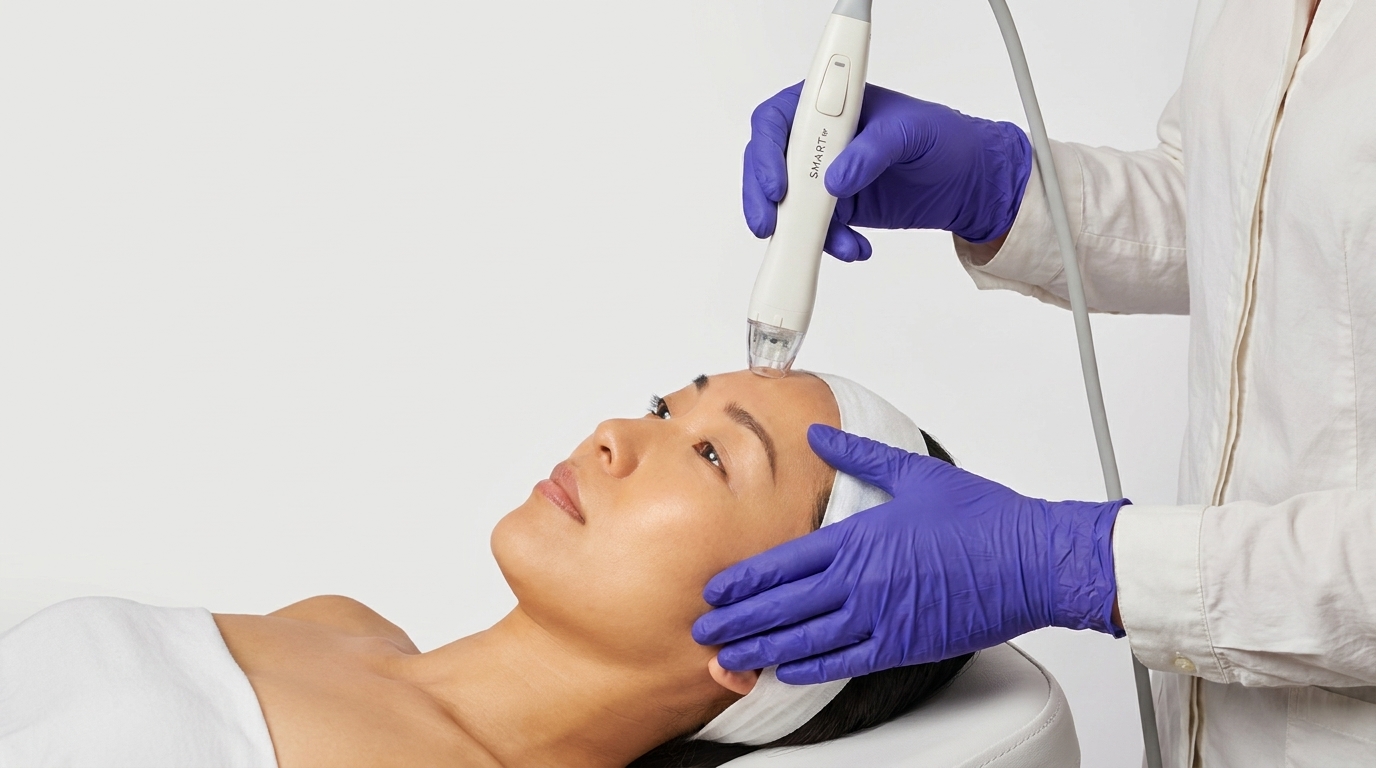
The Virtue RF handpiece is placed and held rather than dragged. It is motorised, so the needle entry is quicker and more even than a hand-pressed pass.
Both of these are radiofrequency microneedling devices: fine needles carry heat into the skin. Virtue RF is the one with a cosmetic use — facial wrinkles — written into its FDA paperwork, and that covers one of its three handpieces. Morpheus8 is the one that reaches deeper, up to 7 mm. Neither brand has a published trial of its own, so both are sold on research run with other machines.
| The difference | Virtue RF | Morpheus8 |
|---|---|---|
| What it is best at | Facial wrinkles | Depth |
| Cost | No published price | No published price |
The Virtue RF handpiece is placed and held rather than dragged. It is motorised, so the needle entry is quicker and more even than a hand-pressed pass.
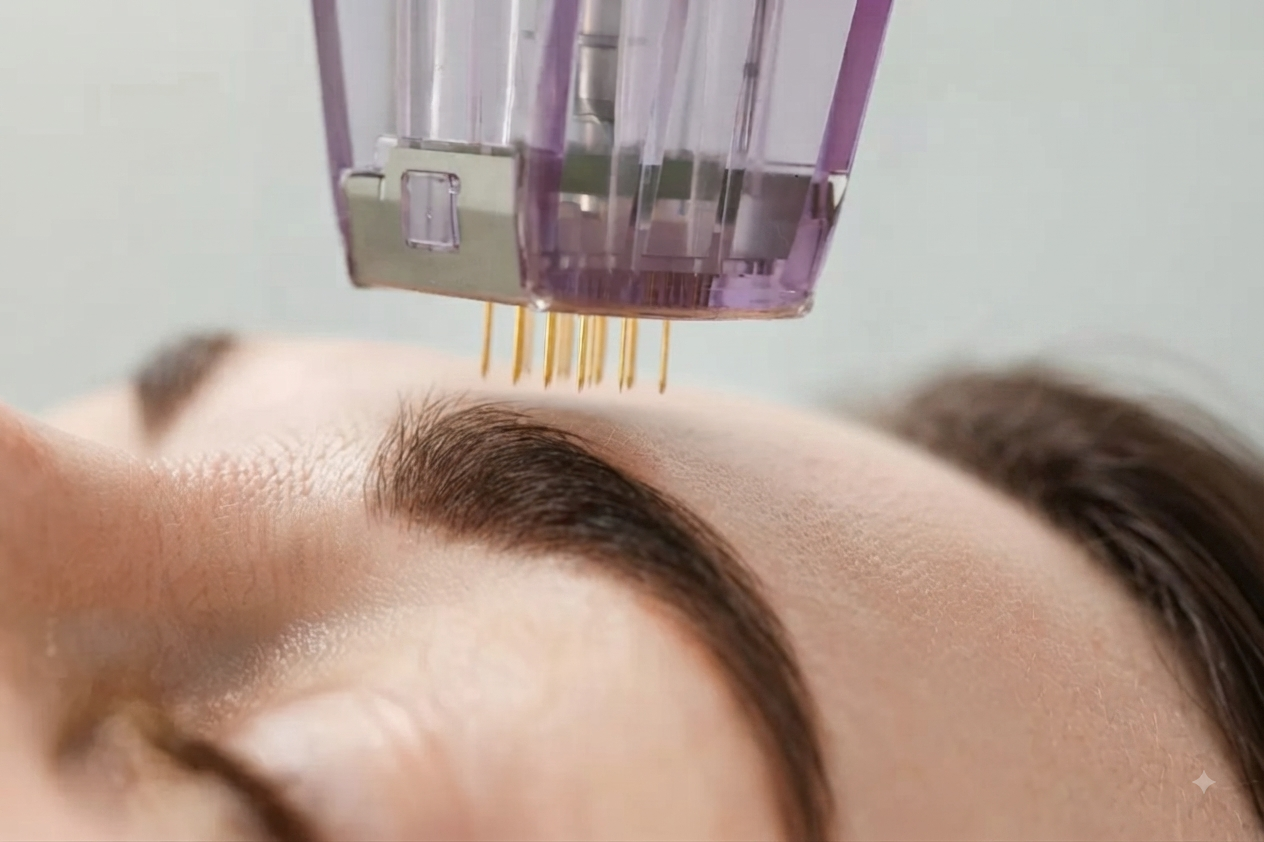
The Morpheus8 tip up close. The gold pins are what carry the radiofrequency energy below the surface — the needles are the delivery route, not the treatment itself.
Side by side
Virtue RF
Three handpieces on one platform
Smart RF and Deep RF are bipolar. Exact RF is monopolar, with a single needle for small, targeted areas. Needle arrays come as single, 12-needle or 36-needle.
Morpheus8
One applicator, several tips
Tips come with 12, 24 or 40 pins, plus a fixed-depth T tip.
Virtue RF
Bipolar and monopolar, at 0.5, 1 or 2 MHz
The single-needle Exact RF handpiece is the monopolar one.
Morpheus8
Bipolar only, at 1 MHz
The pins are insulated except for the last 0.5 mm. So the heat lands in the dermis rather than at the entry point.
Virtue RF
No published depth range
There is no official depth range for Virtue RF. Any depth figure you are quoted comes from the maker or the clinic.
Morpheus8
Up to 7 mm, depending on the tip
The manual gives 1 to 4 mm on Prime, 1 to 7 mm on the standard tip and 2 to 7 mm on Body. The widely quoted 8 mm is a marketing figure: 7 mm of pin plus a 1 mm heat profile.
Virtue RF
Facial wrinkles
This is the one use with a reviewed indication behind it. No trial naming Virtue RF was found, so the brand rests on the general radiofrequency microneedling research.
Morpheus8
Depth
It is the applicator most often chosen when the plan involves working below the dermis. For the class as a whole, the best-evidenced use is atrophic acne scars — the dented kind.
Virtue RF
No brand-specific safety data
What you are told about the risks does not come from this device. It comes from the wider group of radiofrequency microneedling machines.
Morpheus8
A skin-tone limit at higher energy
Above 62 mJ per pin, Morpheus8 is limited to skin types I to IV.
Virtue RF
No published price
Neither the maker nor the US distributor publishes what a session costs.
Morpheus8
No published price
The maker does not publish what a session costs either.
Virtue RF
There is no home version
Home radiofrequency wands press against the skin surface. They have no needles to carry energy under it, and Virtue RF's whole effect depends on heat landing inside the dermis.
Morpheus8
There is no home version
The point of Morpheus8 is depth, several millimetres down. A device you can buy puts a fraction of the power into the surface and never gets near that.
Virtue RF
Morpheus8
Virtue RF
Virtue RF is built by ShenB in Korea, the same maker as Vivace, and sold in the US by Cartessa, which distributes it rather than builds it. Morpheus8 is made by InMode and runs on InMode's radiofrequency consoles.
Both devices reached the US market through a 510(k) clearance, which means each was judged much like a device already on sale. A clearance is not a finding of benefit. Their cleared wording is still very different.
Virtue RF's clearance (K211562, 23 November 2021) covers electrocoagulation and hemostasis — surgical wording for sealing tissue and stopping bleeding — and, for the Smart RF handpiece at 1 MHz, "the percutaneous treatment of facial wrinkles." The wrinkle claim belongs to that one handpiece at that one frequency, with no skin type limit attached. The Deep RF and Exact RF handpieces carry no wrinkle claim.
Morpheus8
Morpheus8's clearances name no cosmetic use. They cover electrocoagulation and hemostasis, and since 2023, coagulation or contraction of soft tissue. Above 62 mJ per pin, on-label use is limited to skin types I to IV. The summaries give a depth of 4.0 mm on the 12-pin tip and 7.0 mm on the 24- and 40-pin tips.
Acne scars, laxity, cellulite, stretch marks and under-eyes appear in neither clearance. Treating them with either device is off-label, which is legal and routine. Depth is not something the FDA clears either.
Common questions
The problems are known, but how often they happen is not. Reports collected by the FDA describe texture changes, pigment changes, fat loss, inflammation, burns and pain.
Those reports cannot give you a risk. Reporting is voluntary, and nobody counts how many people were treated. The reports tell you which problems occur, not how likely they are.
Fat loss is the one that marketing does not mention. The evidence is mixed. A 2024 study measured the fat layer under the chin by ultrasound and found no significant change.
RF microneedling can cause serious injury. The FDA has received reports of burns, scarring, loss of fat, nerve damage and disfigurement. Some injuries have needed surgery or other medical treatment. A few days of expected redness is not the full risk picture.
Choose a licensed medical professional trained on the device. Discuss the risks and other treatment options before deciding. RF microneedling should not be done at home.