Sylfirm X

The Sylfirm X handpiece is held against the skin for each placement. It can run in two modes, one for pigment and vessels and one for firming.
Sylfirm X is the shallower of the two. Both devices put tiny needles into the skin and send radiofrequency energy out of the needle tips, and Sylfirm X can be set as fine as 0.3 mm. Morpheus8 is the deeper one. Its larger tips reach 7 mm, so it is used on the jawline, under the chin and on the body. Neither device has a published trial of its own.
| The difference | Sylfirm X | Morpheus8 |
|---|---|---|
| What it is | Bipolar RF microneedling, 2 MHz | Bipolar RF microneedling, 1 MHz |
| Downtime | Not measured for this device | Not measured for this device |
The Sylfirm X handpiece is held against the skin for each placement. It can run in two modes, one for pigment and vessels and one for firming.
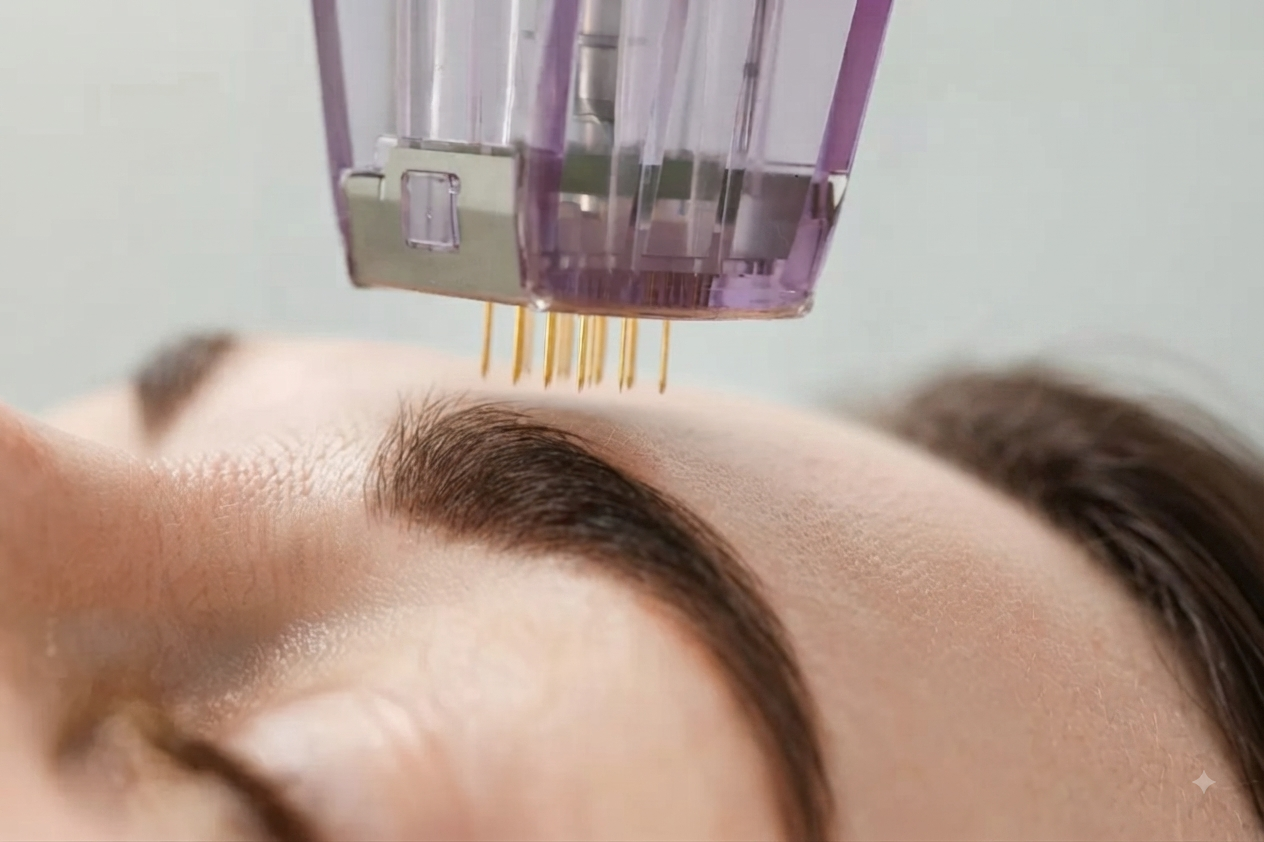
The Morpheus8 tip up close. The gold pins are what carry the radiofrequency energy below the surface — the needles are the delivery route, not the treatment itself.
Side by side
Sylfirm X
Bipolar RF microneedling, 2 MHz
A Korean-made device with two energy modes, one continuous and one pulsed. Tips come with 25 or 18 electrodes. The claim that the pulsed mode suits redness and pigment is a marketing claim, not a tested one.
Morpheus8
Bipolar RF microneedling, 1 MHz
A rebuilt version of an older device called Fractora. It runs 12-, 24- and 40-pin tips. It can release energy at several depths in one pass as the needle pulls back out.
Sylfirm X
0.3 to 4.0 mm, in 0.1 mm steps
The 0.3 mm setting is the shallowest in this device class. Pigment sits in and just under the top layer of skin. That shallow end is what this device is sold on.
Morpheus8
Up to 4.0 mm or 7.0 mm, by tip
The 12-pin tip reaches 4.0 mm. The 24- and 40-pin tips reach 7.0 mm. The deep end is what Morpheus8 is sold on.
Sylfirm X
Not insulated, says the maker
A bare needle shaft carries current at the surface as well as deeper down. That is the reason a mark can be left at each entry point.
Morpheus8
Insulated except the last 0.5 mm
The pins are coated along the shaft, so the energy lands mostly at the tip.
Sylfirm X
No Sylfirm X trial was found
The melasma research clinics point to used other machines. It should not be credited to this device.
Morpheus8
No randomised trial was found
Sylfirm X
Not measured for this device
Morpheus8
Not measured for this device
Sylfirm X
Home wands are far weaker
A home radiofrequency wand puts a fraction of the power into the skin surface. It has no needles, so nothing carries energy down to the depth this device works at.
Morpheus8
Home rollers are a different thing
A home derma roller has needles but no radiofrequency, so nothing heats the skin under the surface. Its needles are shorter and blunt quickly, and a blunt needle does more damage.
Sylfirm X
Morpheus8
Sylfirm X
Sylfirm X's two modes are documented. What they treat is not. The paperwork records both modes. It does not record the claim that the pulsed mode suits redness, melasma and other pigment problems.
No trial of Sylfirm X itself has been published. The melasma research on this treatment did not use this machine. The one study that named a device used a different one, and it found no clear effect.
Sylfirm X
Sylfirm X is made by VIOL in Korea and sold in the US by Benev. Its pulsed setting runs 120 to 240 milliseconds and its continuous mode 120 to 300 milliseconds. Its 510(k) predicate devices are CELFIRM and Scarlet SRF, both from the same manufacturer, so these machines are more closely related than the marketing suggests. The FDA summary does not state whether the needles are insulated.
Morpheus8
Morpheus8 is InMode's device, built on the Fractora platform first cleared in 2011. Its operator manual describes energy released at 7, 5 and 3 mm as the needle retracts, and states that the pins are coated except for the distal 0.5 mm.
Sylfirm X
Ask how many Sylfirm X visits the plan includes and which concern is being treated. Get the full course price.
Morpheus8
Ask for Morpheus8 pricing for the same concern and area, including numbing and follow-up. Compare the full plans rather than an advertised starting price.
Common questions
RF microneedling can cause serious injury. The FDA has received reports of burns, scarring, loss of fat, nerve damage and disfigurement. Some injuries have needed surgery or other medical treatment. A few days of expected redness is not the full risk picture.
Choose a licensed medical professional trained on the device. Discuss the risks and other treatment options before deciding. RF microneedling should not be done at home.