SkinPen

The SkinPen up close. The disposable cartridge on the front holds the needles, and it is changed for every patient.
SkinPen is needles alone. Morpheus8 adds radiofrequency heat. So this is not a different treatment, it is the same idea taken deeper. What really changes is depth, downtime and cost. SkinPen suits acne scars, rough texture and early fine lines; Morpheus8 is the one aimed at mild sagging too.
| The difference | SkinPen | Morpheus8 |
|---|---|---|
| Cost | The cheaper of the two | Considerably more expensive |
The SkinPen up close. The disposable cartridge on the front holds the needles, and it is changed for every patient.
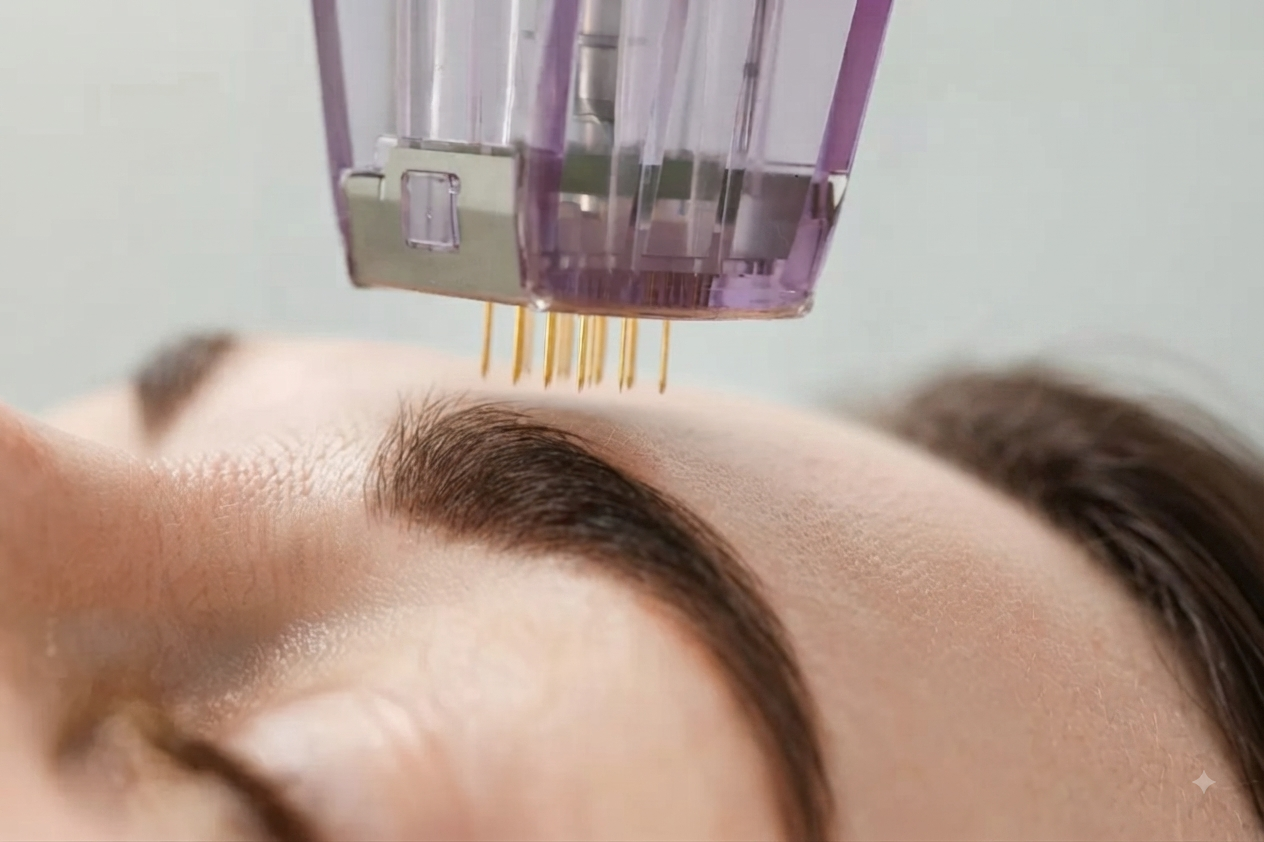
The Morpheus8 tip up close. The gold pins are what carry the radiofrequency energy below the surface — the needles are the delivery route, not the treatment itself.
Side by side
SkinPen
A pen of fine needles, no energy
Thousands of tiny channels set off the skin's normal healing response. New collagen and elastin form. Nothing is heated.
Morpheus8
The same needles, plus heat
Insulated needles carry radiofrequency into the deeper skin. The pins are coated except for the last 0.5 mm, so the heat lands below the surface. It is a channel plus a small controlled burn at the bottom.
SkinPen
0 to 2.5 mm, adjustable
Treatment is done at depths up to 2.5 mm.
Morpheus8
0.5 to 7 mm, depending on the tip
Tips run from 0.5 mm fixed up to 7 mm. The "8" in the name is 7 mm of needle plus about 1 mm of surrounding heat.
SkinPen
Scars, texture, fine lines, pores
Dented acne scars, rough texture, fine lines and the look of large pores all improve.
Morpheus8
Scars, texture, plus mild sagging
The same concerns, plus mild to moderate loose skin. Acne scars are the best-evidenced use of RF microneedling. One split-face trial found it about as effective as fractional CO2 laser, with less downtime and fewer pigment problems.
SkinPen
Not for sagging or contouring
It does not tighten loose skin. It does not reach or heat fat, so it does not reshape anything.
Morpheus8
Not proven to last for years
The longest measured follow-up is 6 months. Claims of one to three years have no published source.
SkinPen
3 to 6 sessions, about 4 weeks apart
That is normal clinic practice.
Morpheus8
1 to 6 sessions, every 3 to 6 weeks
Most people need 3 to 5 sessions at mild to moderate depth settings.
SkinPen
Red for 1 to 3 days
Redness like a moderate sunburn for about 1 to 3 days. Mild swelling and pinpoint bleeding on the day are normal.
Morpheus8
Redness, swelling, a grid of dots
In one study, every patient had redness and 30% had swelling. Another put downtime at 3 to 4 days. The skin barrier is back to normal by about day 7.
SkinPen
The cheaper of the two
Needles alone cost much less than needles plus heat.
Morpheus8
Considerably more expensive
The tips are single-use, and bigger or deeper tips cost more. You pay that.
SkinPen
Rollers and home pens
A roller drags sideways instead of going straight in and out, so it tears more than it punctures. Home needles are shorter and blunt quickly. A blunt needle does more damage than a sharp one.
Morpheus8
Home RF wands
A home radiofrequency wand puts a fraction of the power into the surface of the skin. It never reaches clinic depth, and it does not put a needle through the skin. There is no home version.
SkinPen
Morpheus8
Morpheus8
Almost no published study used Morpheus8 itself. No randomised trial of the device was found. Most of the research people see when they search the name was done on other machines. The evidence for RF microneedling as a group is real, but it is not this brand's own evidence.
SkinPen
SkinPen Precision was granted through a De Novo request, DEN160029, on 1 March 2018. It was the first microneedling device authorised for marketing in the US, and it created the device category itself: 21 CFR 878.4430, product code QAI. Its current indication, K202243 of 2 April 2021, reads: "intended to be used as a treatment to improve the appearance of wrinkles of the neck for Fitzpatrick skin types II - IV and to improve the appearance of facial acne scars in adults with all Fitzpatrick skin types aged 22 years and older." Only the acne-scar half covers all skin types.
Morpheus8
Morpheus8's clearances name no cosmetic use at all. The 2019 clearance, K192695, is for "Electrocoagulation and Hemostasis." A 2023 clearance, K231790, changed the wording to "coagulation/contraction of soft tissue or hemostasis," which InMode announced in July 2024. Acne scars, wrinkles, laxity, cellulite, stretch marks and the double chin appear in none of them. Treating those with Morpheus8 is off-label, which is legal and routine. The device is a rebuilt version of InMode's older Fractora platform, cleared using Fractora3D as the comparison device. Morpheus8 is made by InMode, and the needle depths and session counts above come from InMode's device manual.
Neither authorisation is proof of benefit. A De Novo and a 510(k) are both permissions to market, not verdicts on how well something works. Depth is not something the FDA clears in the first place.
Common questions
RF microneedling can cause serious injury. The FDA has received reports of burns, scarring, loss of fat, nerve damage and disfigurement. Some injuries have needed surgery or other medical treatment. A few days of expected redness is not the full risk picture.
Choose a licensed medical professional trained on the device. Discuss the risks and other treatment options before deciding. RF microneedling should not be done at home.