Potenza

The Potenza tip combines needles with radiofrequency. It is used in stamped passes rather than dragged, so each placement is separate.
Potenza is the more adjustable machine. Your provider can change the current, the frequency and the needle depth in one visit. Morpheus8 goes deeper, up to 7 mm on its long tips. It runs one current at one frequency, and it is the machine used on the body. No study has compared the two, and both are the same treatment: needles that carry an electrical current into the skin.
| The difference | Potenza | Morpheus8 |
|---|---|---|
| What you actually do | Needles plus radiofrequency, in clinic | The same treatment, on a deeper machine |
| How the current flows | Monopolar or bipolar, the operator picks | Bipolar only |
| How deep it goes | 0.5 to 2.5 mm | 0.5 to 7 mm, depending on the tip |
| How many sessions | About 3, spaced 3 to 8 weeks apart | 3 to 5, spaced 3 to 6 weeks apart |
| How long it lasts | No controlled data past six months | No controlled data past six months |
The Potenza tip combines needles with radiofrequency. It is used in stamped passes rather than dragged, so each placement is separate.
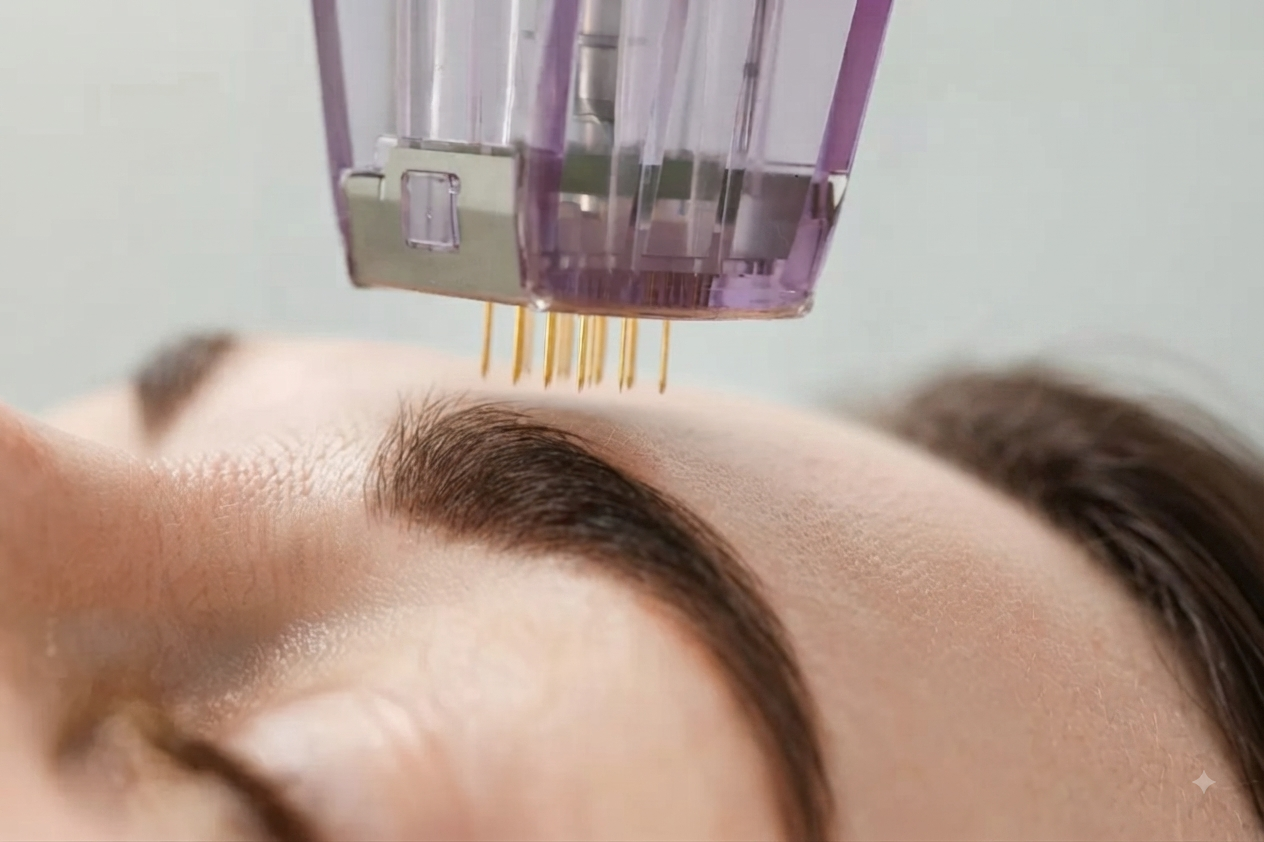
The Morpheus8 tip up close. The gold pins are what carry the radiofrequency energy below the surface — the needles are the delivery route, not the treatment itself.
Side by side
Potenza
Needles plus radiofrequency, in clinic
Your provider picks monopolar or bipolar current, and 1 MHz or 2 MHz. That is four combinations on one machine. Top power is 50 W. The newest version also adds tips that only touch the surface, with no needles.
Morpheus8
The same treatment, on a deeper machine
Bipolar current only, at 1 MHz, up to 65 W. Tips come in 12, 24 and 40 pin versions. There is also a shallow tip fixed at 0.5 mm.
Potenza
Monopolar or bipolar, the operator picks
Monopolar current travels through the tissue to a return pad placed on the body. Bipolar current stays between the pins inside the tip.
Morpheus8
Bipolar only
Current flows between the pins inside the tip, never to a return pad. The pins are insulated except for the last 0.5 mm, so the surface is spared.
Potenza
0.5 to 2.5 mm
The needles reach 2.5 mm at most, so everything Potenza does happens in the dermis.
Morpheus8
0.5 to 7 mm, depending on the tip
The 12-pin tip reaches 4.0 mm. The 24- and 40-pin tips reach 7.0 mm. The long tips go past the dermis, which is the point of using it on the body.
Potenza
About 3, spaced 3 to 8 weeks apart
No session figure comes with the device. Published protocols cluster at 3 sessions, 3 to 8 weeks apart.
Morpheus8
3 to 5, spaced 3 to 6 weeks apart
The manual says 1 to 6 sessions, usually 3 to 5, repeated every 3 to 6 weeks.
Potenza
No controlled data past six months
Nothing has been measured on this device beyond that point.
Morpheus8
No controlled data past six months
Nothing has been measured on this device beyond that point either.
Potenza
No skin-tone limit is stated anywhere
Its paperwork says nothing about skin tone at all. That is an absence, not a promise that it is safe for every skin tone.
Morpheus8
A skin-tone limit above 62 mJ per pin
Above 62 mJ per pin, Morpheus8 is limited to Fitzpatrick skin types I–IV. Clinics that advertise it as safe for all skin types are only right below that level.
Potenza
Morpheus8
Potenza
Potenza is named in two small studies. In 29 Japanese women treated for melasma, the standard melasma score barely moved. About 28% improved by a quarter or more, and 62% were satisfied. The maker employs one author and pays two others to speak.
Morpheus8
Morpheus8 has almost nothing of its own. No randomised trial has been published on the device.
Potenza
Potenza is manufactured by Jeisys in Korea. Cynosure Lutronic only distributes it in the US, and clinic pages routinely misattribute manufacture to Cynosure. Morpheus8 is manufactured by InMode.
Potenza
Ask which Potenza settings or treatment approach, area and number of visits the quote covers.
Morpheus8
Ask for a Morpheus8 plan for the same concern and area. Compare complete course totals with numbing and follow-up included.
Common questions
Neither device is cleared for a single cosmetic use. Potenza's FDA 510(k) clearance says it is "intended for use in dermatologic and general surgical procedures for electrocoagulation and hemostasis." Morpheus8's says the same, with "coagulation/contraction of soft tissue" added in a 2023 clearance. Wrinkles, acne scars, laxity, cellulite and stretch marks appear in neither.
Clearance is not evidence that a device works. It means the device was judged substantially equivalent to one already on the market. Treating cosmetic concerns with either machine is off-label, which is legal and routine.
Depth is a hardware specification, not something the FDA clears. A 2024 Potenza clearance lowered the maximum insertion depth from 4.0 mm to 2.5 mm and made the needles thicker, from 0.25 mm to 0.35 mm. InMode's widely quoted 8 mm figure for Morpheus8 is 7 mm of needle plus a claimed 1 mm of surrounding heat, and it originates in a press release rather than a clearance summary.
RF microneedling can cause serious injury. The FDA has received reports of burns, scarring, loss of fat, nerve damage and disfigurement. Some injuries have needed surgery or other medical treatment. A few days of expected redness is not the full risk picture.
Choose a licensed medical professional trained on the device. Discuss the risks and other treatment options before deciding. RF microneedling should not be done at home.