Pixel8-RF

The Pixel8-RF handpiece places fine needles through the skin and heats from their tips, so the energy lands below the surface rather than on it.
PiXel8-RF will not tell you how deep it goes. Its maker lists tip sizes and the energy frequency, but no depth range. Morpheus8 publishes both. Its tips reach from 0.5 mm to 7 mm, and the needles are coated except for the last 0.5 mm.
| The difference | Pixel8-RF | Morpheus8 |
|---|---|---|
| What it is | 25, 49 and 64-pin tips | 12, 24 and 40-pin tips |
| Cost | No published price | Around $1,861 on average, self-reported |
The Pixel8-RF handpiece places fine needles through the skin and heats from their tips, so the energy lands below the surface rather than on it.
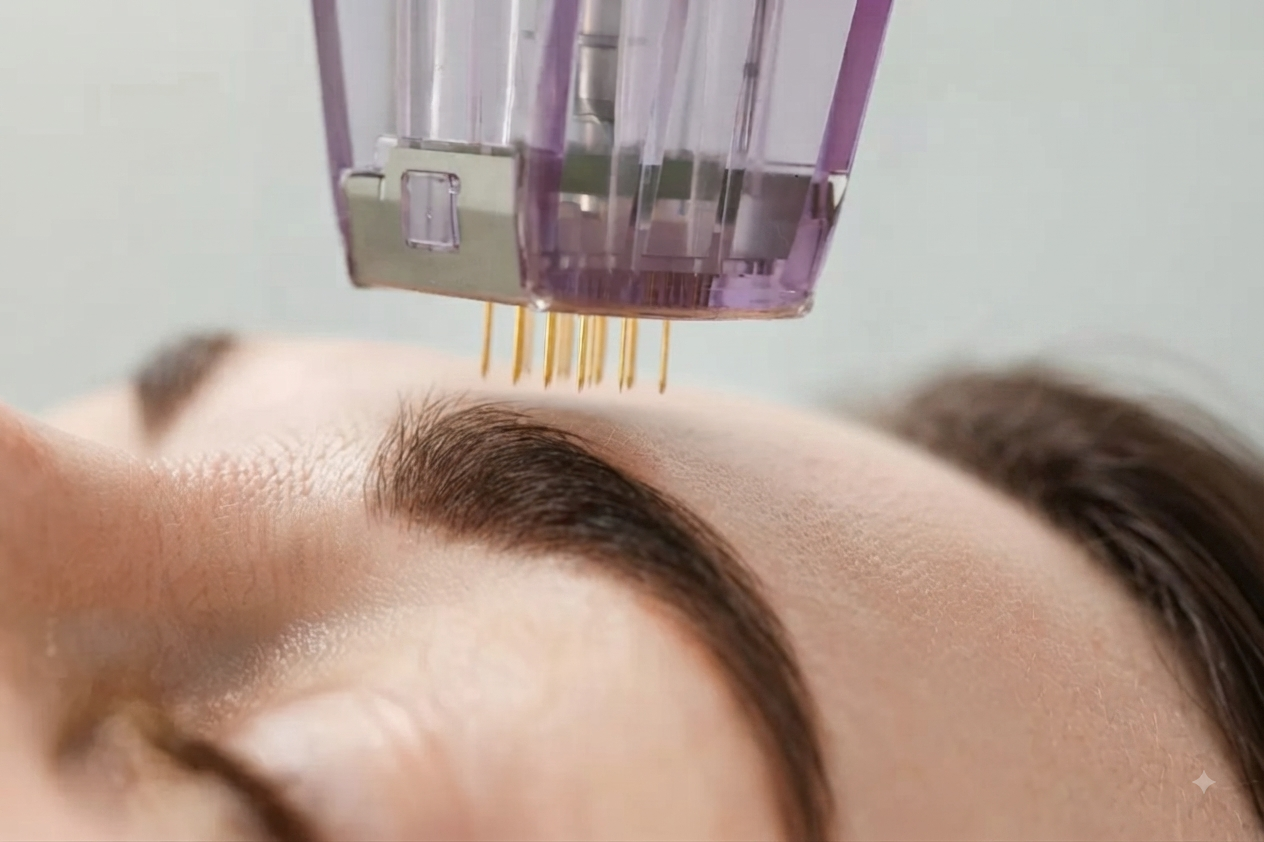
The Morpheus8 tip up close. The gold pins are what carry the radiofrequency energy below the surface — the needles are the delivery route, not the treatment itself.
Side by side
Pixel8-RF
25, 49 and 64-pin tips
This device is imported and rebadged by a US company in Alabama. The design behind it is the Korean-made Pinxel. Do not mix it up with PiXel8-Reveal, a laser, or with Alma's separate Pixel line.
Morpheus8
12, 24 and 40-pin tips
Based on an older device from the same maker.
Pixel8-RF
Bipolar radiofrequency at 4 MHz
The maker says both insulated and non-insulated tips are sold. Which one goes on your skin is not published anywhere. So ask.
Morpheus8
Bipolar radiofrequency at 1 MHz
The operator manual says the needles are coated except for the last 0.5 mm. That spares the surface of the skin.
Pixel8-RF
Not published
Pin counts are published. Depth is not. Ask the clinic to show you the depth setting on the screen, and to say what it will be set to.
Morpheus8
0.5 mm to 7 mm, depending on the tip
A fixed 0.5 mm tip for the surface, 1 to 4 mm on the 12-pin tip, and up to 7 mm on the 24 and 40-pin tips.
Pixel8-RF
No session count is published
Published protocols in this field cluster at three sessions, three to eight weeks apart.
Morpheus8
3 to 5 sessions, 3 to 6 weeks apart
The manual says 1 to 6 sessions. Most people have 3 to 5. They are spaced 3 to 6 weeks apart.
Pixel8-RF
No published price
There is no reliable published price. The single-use tip is usually the biggest cost per session, so ask how many tips a course needs.
Morpheus8
Around $1,861 on average, self-reported
That average comes from 124 patients who reported their own prices. Small single-area sessions start around $549. A full series can run past $4,000. These are self-reported figures, not audited ones, and they are a few years old.
Pixel8-RF
Reported for the class, not the badge
Reports for this class of device cover four things. They are texture changes, pigment changes, fat loss and burns.
Morpheus8
Reported for the class, not the badge
The same list applies. Neither device has a separate safety record of its own in the published literature.
Pixel8-RF
No home version
Home radiofrequency wands press on the surface of the skin. They have no needles, so nothing carries the energy down to the depth a clinic device reaches.
Morpheus8
No home version
The same applies. Home pens and rollers make punctures with no radiofrequency at all. That is a different treatment, not a weaker version of this one.
Pixel8-RF
Morpheus8
Pixel8-RF
No published trial names PiXel8-RF. Morpheus8 has no randomised trial either. The research behind this treatment was done on other machines.
Pixel8-RF
PiXel8-RF is imported and rebadged in the US by Rohrer Aesthetics of Alabama; the design it was cleared against is the Korean-made Pinxel. Morpheus8 is made by InMode, was cleared against InMode's older Fractora, and carries the FDA device name "the Morpheus8 (Fractora) Applicators". Its console is rated to a maximum of 65 watts. The self-reported price figures come from RealSelf's cost page, updated 10 May 2024.
Both carry the same standard electrosurgical clearance wording: surgical procedures for electrocoagulation and hemostasis — sealing tissue and stopping bleeding. That is PiXel8-RF's clearance in full (K233147, October 2023). Morpheus8 carries the same wording from December 2019, plus coagulation or contraction of soft tissue from July 2023.
A clearance is not evidence of benefit. It means the FDA agreed the device is much like one already sold. Wrinkles, acne scars and skin tightening appear in neither clearance, so treating those is off-label — legal and routine, but no cosmetic result was reviewed. Above 62 millijoules per pin, Morpheus8 is limited to Fitzpatrick skin types I to IV. PiXel8-RF has no skin type limit stated.
Common questions
RF microneedling can cause serious injury. The FDA has received reports of burns, scarring, loss of fat, nerve damage and disfigurement. Some injuries have needed surgery or other medical treatment. A few days of expected redness is not the full risk picture.
Choose a licensed medical professional trained on the device. Discuss the risks and other treatment options before deciding. RF microneedling should not be done at home.