Morpheus8
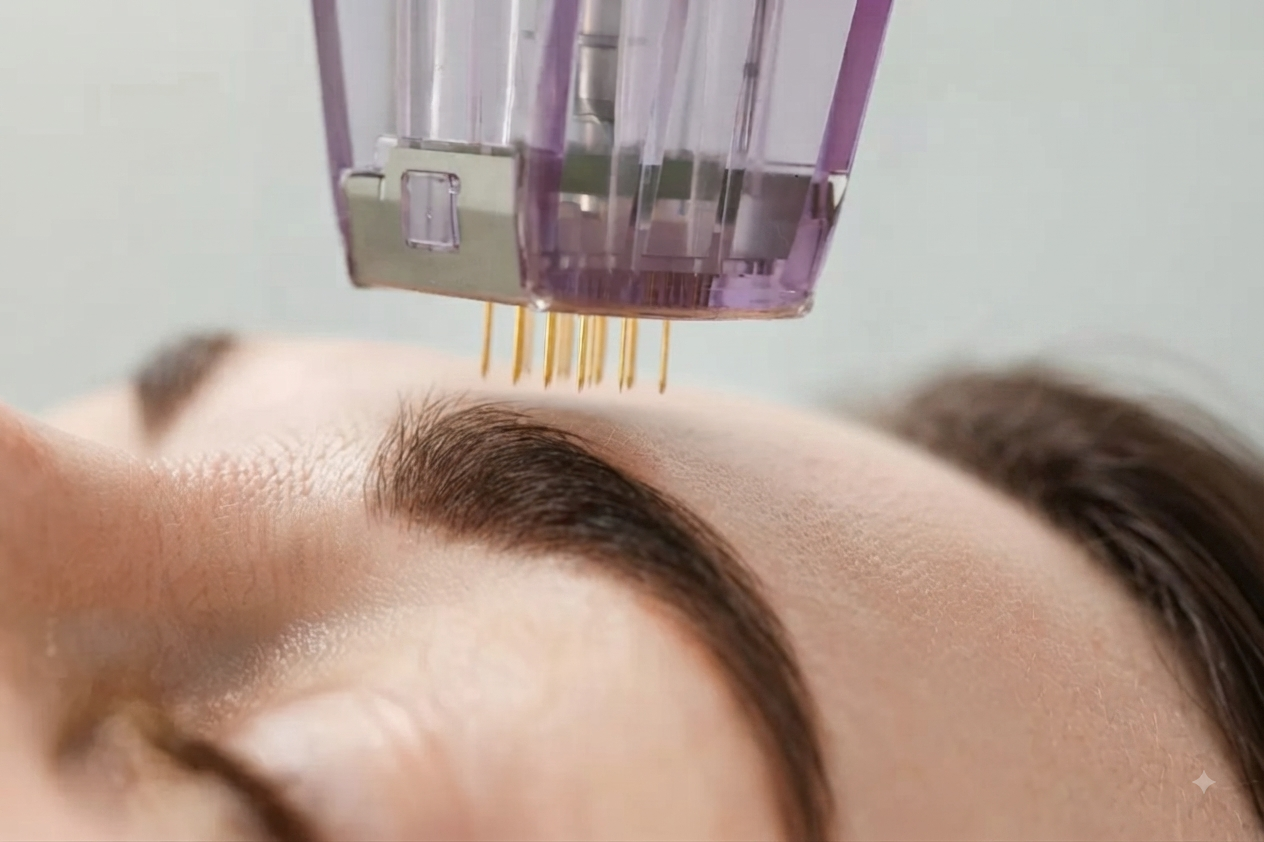
Both treatments come from the same company, but only one goes under your skin. Morpheus8 pushes a grid of fine needles through the skin and heats the tissue from the needle tips, with numbing cream. FaceTite goes beneath the skin through a small entry point, under local anaesthetic. How invasive each one is — that is the real choice here.
| The difference | Morpheus8 | FaceTite |
|---|---|---|
| What it is | Needles through skin, numbing cream | A small entry point, local anaesthetic |
| Downtime | Three to four days of redness | Not documented in published research |
| Cost | One dated figure, from consumers | No reliable published price |

Side by side
Morpheus8
Needles through skin, numbing cream
An in-office treatment. The skin stays intact.
FaceTite
A small entry point, local anaesthetic
A minimally invasive procedure. A thin tube, called a cannula, passes under the skin.
Morpheus8
Heat released at the needle tips
Radiofrequency current runs between the pins. It leaves a grid of small heat-sealed zones in the deeper skin. The pins are insulated except for the last 0.5 mm, so the heat comes out at the tip rather than at the surface.
FaceTite
Heat released under the skin
It seals the fibrous network beneath the skin. The machine tracks temperature and adjusts the energy as the tube moves.
Morpheus8
0.5 mm to 7 mm, depending on the tip
A fixed 0.5 mm resurfacing tip. 1 to 4 mm on Prime, 1 to 7 mm on the standard tip, 2 to 7 mm on Body. The 8 mm you may see quoted is a 2020 marketing number: 7 mm of needle plus 1 mm of heat spread.
FaceTite
Into the layer under the skin
Wherever the cannula travels. No cannula length or gauge is published, so none is quoted.
Morpheus8
Three to four days of redness
Redness in almost everyone, swelling in some. One neck study put it at three to four days, with the skin back to normal by about day seven.
FaceTite
Not documented in published research
No published trial gives a recovery figure for FaceTite, so none is quoted. But it involves an entry point and an anaesthetic. That is a different order of event.
Morpheus8
1 to 6, usually 3 to 5
Every 3 to 6 weeks, according to the operator's manual. Published protocols usually run three.
FaceTite
No published session figure
Nothing published says how many, so none is quoted.
Morpheus8
One dated figure, from consumers
RealSelf reports an average of $1,861, from 124 patient-reported prices. Single sessions on one small area start at $549. A full series can run over $4,000. Those prices are self-reported, US-skewed and now dated.
FaceTite
No reliable published price
None is quoted. Ask for the total course price, what the tips cost, and what is included if a second pass is needed.
Morpheus8
Home rollers and wands are not it
A home roller drags sideways instead of going straight in and out, so it tears more than it punctures. Home radiofrequency wands put a fraction of the power into the skin surface. Neither reaches the depth this device works at.
FaceTite
There is no home version
FaceTite works under the skin, through an entry point, under an anaesthetic. Nothing sold for home use goes under the skin at all.
Morpheus8
FaceTite
Morpheus8
Morpheus8's first 510(k) clearance, in December 2019 (K192695), reads electrocoagulation and hemostasis — surgical language for sealing tissue and stopping bleeding. A second, in July 2023 (K231790), reads coagulation or contraction of soft tissue. Above 62 mJ per pin the applicator is limited on-label to skin types I to IV. Depth is not something the FDA clears at all.
FaceTite
FaceTite is not the name on any FDA clearance. It is a handpiece under InMode's general RF System clearances, worded the same way: electrocoagulation and hemostasis, and since July 2024, coagulation or contraction of soft tissue.
Jowls, laxity, tightening and contouring appear in neither. Off-label treatment is legal and normal. It just means no regulator reviewed either device for the thing you are being sold. So a clinic claim of "FDA cleared for jawline tightening" is not coming from a clearance document.
The Morpheus8 tip up close. The gold pins are what carry the radiofrequency energy below the surface — the needles are the delivery route, not the treatment itself.
Common questions
RF microneedling can cause serious injury. The FDA has received reports of burns, scarring, loss of fat, nerve damage and disfigurement. Some injuries have needed surgery or other medical treatment. A few days of expected redness is not the full risk picture.
Choose a licensed medical professional trained on the device. Discuss the risks and other treatment options before deciding. RF microneedling should not be done at home.