← All comparisons
Dermapedia / CompareProcedures

Laser Facial vs Hydrafacial

A "laser facial" is not one treatment, so ask which machine the clinic means. The most common version is a carbon peel, and it has real trial support for acne. A HydraFacial is one machine that scrubs and vacuums the dead surface layer. It puts no energy into the skin, so it cannot burn you or change your skin colour.

At a glance

The differenceLaser facialHydrafacial
What it isA category, not a productOne machine, one protocol
What it is best atAcne, pigment and oilinessCongestion and surface texture
Downtime and how it feelsSnapping and heat, then hours of rednessNone, sometimes an hour or two of pink
Sessions and costA course, priced as a medical treatmentOften sold monthly

Laser facial

A category, not a product Ask which machine. A carbon or "Hollywood" peel is carbon lotion plus a 1064 nanometre laser, which shatters the carbon and the debris stuck to it. "Laser toning" is the same wavelength at low energy, used for pigment. Fractional resurfacing is a different device again, with different risks. If a clinic will not name the make, model and wavelength, that is your answer.

Hydrafacial

Hydrafacial

Side by side

The differences that matter

10 comparison points

What it is

Laser facial

A category, not a product

Ask which machine. A carbon or "Hollywood" peel is carbon lotion plus a 1064 nanometre laser, which shatters the carbon and the debris stuck to it. "Laser toning" is the same wavelength at low energy, used for pigment. Fractional resurfacing is a different device again, with different risks. If a clinic will not name the make, model and wavelength, that is your answer.

Hydrafacial

One machine, one protocol

A disposable spiral tip abrades the skin inside a film of fluid, with mild acid solution running through at the same time. Vacuum lifts away the fluid, the dead cells and the pore contents.

How deep it goes

Laser facial

Into living skin

A 1064 nanometre beam reaches well past the dead surface layer. What happens there depends on the settings and the number of passes. That depth is the point of the treatment. It is also why a laser can injure skin in ways scrubbing cannot.

Hydrafacial

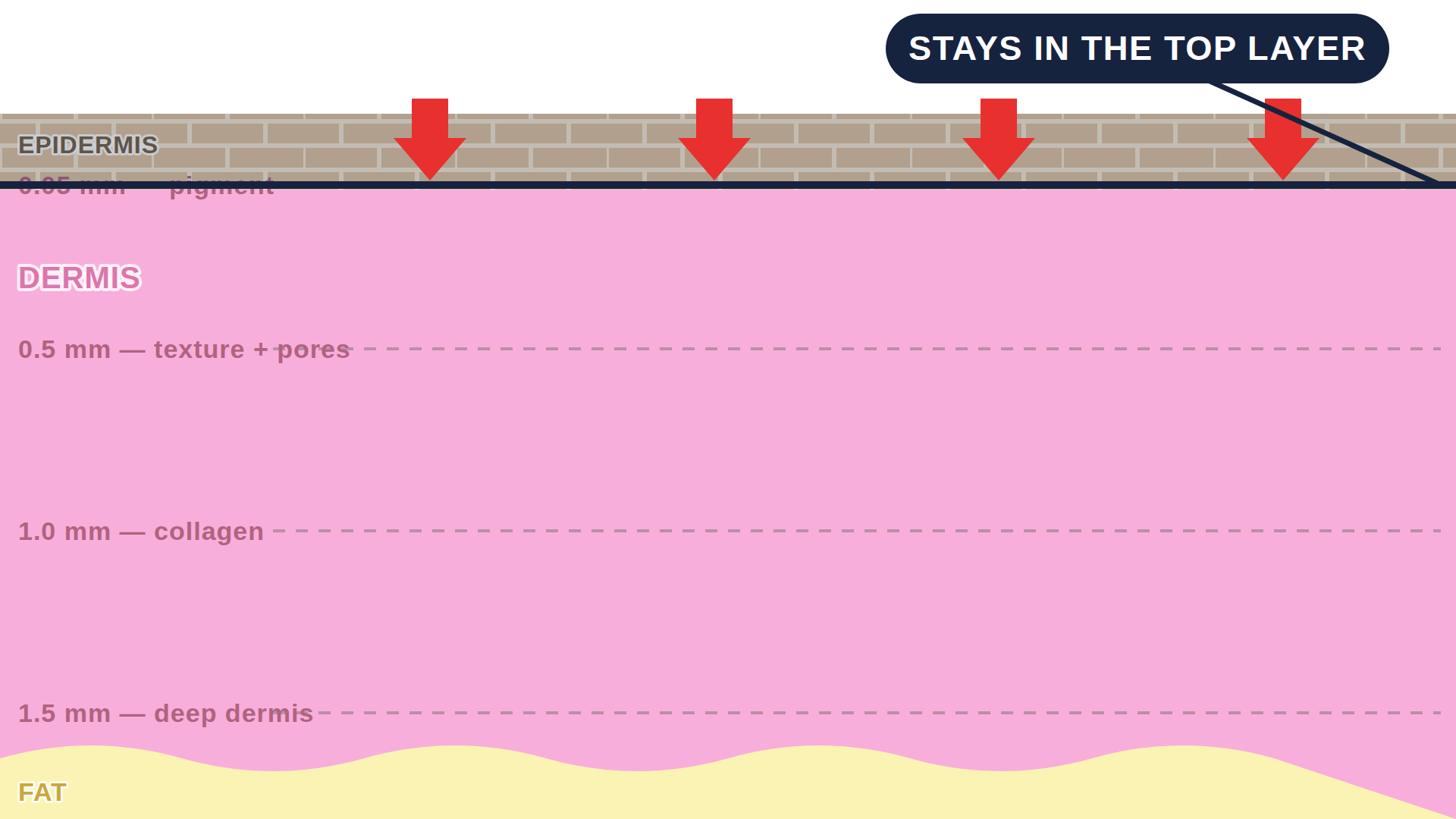
The dead surface layer only

The target is a layer about nine microns thick, roughly a tenth the width of a hair. It regrows within days. In an imaging study, it was thinner right after treatment and back to normal at two weeks, with no visible change in the collagen underneath.

What it is best at

Laser facial

Acne, pigment and oiliness

The strongest evidence here is the carbon peel for acne. In a split-face trial of 22 people, three sessions two weeks apart cut inflammatory spots by 59% on the treated side, while the untreated side rose 5%. Non-inflammatory spots fell 52%.

Hydrafacial

Congestion and surface texture

It physically empties pores and smooths the surface. In the best HydraFacial study, 20 adults with mild to moderate acne went from 20% to 65% rated clear or almost clear over 12 weeks.

Downtime and how it feels

Laser facial

Snapping and heat, then hours of redness

Usually bearable without numbing. Expect a hot snapping feeling and a smoky smell. Redness afterwards is normal. Deeper laser treatments take longer to recover from.

Hydrafacial

None, sometimes an hour or two of pink

Scratchy and mildly stinging, with tugging during extraction. How rough it feels depends on the tip chosen. The range includes tips the company names "Aggression."

Sessions and cost

Laser facial

A course, priced as a medical treatment

The acne trial used three sessions two weeks apart. Clinics commonly sell four to six. That is convention, not a tested schedule. No professional society publishes a price for this treatment.

Hydrafacial

Often sold monthly

Studies used six treatments spaced seven days to two weeks apart. Monthly is a clinic recommendation, not a trial result. One consumer database average, from 261 self-reported prices, was $209.

Who tends to be happy with it

Laser facial

  • Best for — Active acne, oiliness and large-looking pores, where the carbon peel has trial support.
  • Also for — Pigment problems, though this is where skin tone matters most.
  • The mindset — A medical treatment. Choose the operator and the machine first.

Hydrafacial

  • Best for — Congested skin and blackheads, and anyone wanting a visible change with no recovery.
  • Also for — Someone who wants to avoid heat and pigment risk entirely.
  • The mindset — Grooming, judged on how skin looks the next morning.

Energy versus no energy

Hydrafacial

A laser puts energy into living skin. A HydraFacial does not. Because a laser works at depth, it can change things scrubbing cannot reach: pigment, oil glands, the structure of a scar. For the same reason it can cause harm scrubbing cannot — burns, blisters, scarring, and colour changes that may last months or be permanent.

The skin tone question

Hydrafacial

A HydraFacial has no light and no heat. Darkening after irritation or heavy extraction stays possible in any skin.

What we still do not know

The fine print

Laser facial

The lasers used for laser facials are cleared, not approved. The Hollywood Spectra system was cleared in February 2022 as a Class II prescription laser. Its cleared uses include tattoo removal, nevus of Ota, common moles, hair removal, resurfacing for acne scars and wrinkles, melasma, mild to moderate inflammatory acne, pigmented spots, minor vascular lesions and the dark marks left after inflammation.

Hydrafacial

The HydraFacial was never reviewed for anything. It is registered as a Class I device under product code GFE, 21 CFR 878.4820, a category exempt from premarket notification. There is no clearance number and no reviewed uses. Exempt is not unregulated — registration, listing, manufacturing quality rules and the ban on false labelling all apply — but the FDA has never evaluated any claim about what this machine achieves. A clearance is a finding that a device is much like an earlier one, not proof that a treatment works.

Common questions

Questions Patients Ask

What is a laser facial, exactly?

It is a category rather than a single treatment. The term is used for a carbon or "Hollywood" peel, for low-energy pigment toning, for non-ablative fractional resurfacing, and sometimes for intense pulsed light, which is not a laser. Before booking, ask for the make, model and wavelength of the machine, because these treatments have different effects, different recoveries and different risks.

What is the Hollywood peel actually doing?

Carbon lotion is spread over the face and settles into pores, then a Q-switched Nd:YAG laser at 1064 nanometers is passed over it. The carbon gives the laser an added target, so the very short pulses are absorbed by carbon particles and the debris attached to them. Many protocols also run a longer-pulse pass that warms tissue and oil glands. Worth knowing: the word "carbon" appears nowhere in the cleared indications of the best-known machine, so a carbon peel sold for glow is off-label use of a prescription device.

Is a laser facial safe for darker skin?

It depends entirely on the device and the settings, which is why the question has to be asked device by device. A 2026 review of treatments in Fitzpatrick types IV to VI found these skin types carry a higher risk of both lightening and darkening across this family of treatments, and advised avoiding intense pulsed light devices capable of resurfacing or hair removal. The same review names the long-pulsed 1064 nm Nd:YAG as the standard choice for hair removal in darker skin. Ask what settings the provider uses for your skin type, ask how many patients with your skin tone they have treated, and consider a test patch.

Which is better for acne?

On published evidence, the carbon laser peel. A split-face randomized trial in 22 people with three sessions two weeks apart found inflammatory lesions fell 58.6 percent on the treated side while rising 5 percent on the untreated side, with biopsy findings to match. The best HydraFacial acne study is 20 people, open-label, with no control group and a company employee among the authors. No trial has compared the two treatments directly, so this is a comparison of separate evidence files rather than a measured result.

Which costs more?

A laser facial, in almost every clinic, because it is a medical treatment on an expensive prescription device. No professional society publishes a price for a carbon laser facial, and the blended "skin resurfacing" averages that circulate - $1,829 for 2023 - lump together dermabrasion, chemical peels, ablative and non-ablative laser and microdermabrasion, so they are not a price for one session of anything. For a HydraFacial the only dated figure with a stated sample is a consumer database average of $209 from 261 self-reported prices, last updated July 2023.

Is a HydraFacial FDA-cleared?

No. It is registered as a Class I device in the powered dermabrasion brush category, which is exempt from premarket notification, so there is no clearance number and no reviewed indications. That is different from the lasers used for laser facials, which are Class II devices that did go through FDA review and carry cleared indications and prescription-only status. Exempt does not mean unregulated or unsafe - registration, manufacturing standards and the ban on false labeling still apply - but it does mean no efficacy claim was ever assessed.

Can I have both?

People do, usually not on the same day. There is no study of the combination, and no schedule has been tested. The practical rule is to let skin settle between anything that heats it and anything that abrades it, and to tell each provider what else you have had done and when.
