Hydrafacial

This is one treatment with two names. HydraFacial is a brand of machine, and the name is trademarked. "Hydrofacial" is the generic spelling clinics use for the same kind of wet exfoliating facial. It is also the most common misspelling of the brand, which is spelled hydra, with an a. So you are really choosing a clinic and an operator — ask about the machine and the settings, not the logo.
| The difference | Hydrafacial | Hydrofacial |
|---|---|---|
| What is standardised | The consumables and the sequence | Nothing, formally |
| Cost | About $200, from self-reported reviews | Usually cheaper, no published figure |
Any other hydrodermabrasion machine The same idea: suction, an abrasive tip and a liquid. The fluid does three jobs. It lubricates, so the scrubbing is gentler. It carries acids. And it wets the top layer of skin.
Side by side
Hydrafacial
One company's machine and consumables
A handpiece holds a disposable spiral tip. Serum is pumped to the tip while the vacuum runs. So the swirling fluid scrubs the surface, adds liquid and sucks debris away at once. The basic version is three steps: cleanse, extract, hydrate.
Hydrofacial
Any other hydrodermabrasion machine
The same idea: suction, an abrasive tip and a liquid. The fluid does three jobs. It lubricates, so the scrubbing is gentler. It carries acids. And it wets the top layer of skin.
Hydrafacial
Dead cells and pore contents lifted off
The surface is exfoliated and pores are cleared out. Skin usually looks smoother and brighter straight afterwards.
Hydrofacial
The same, at whatever setting is used
How much you see depends on the strength of the solution, and on how hard the extraction is pushed. The clinic sets both.
Hydrafacial
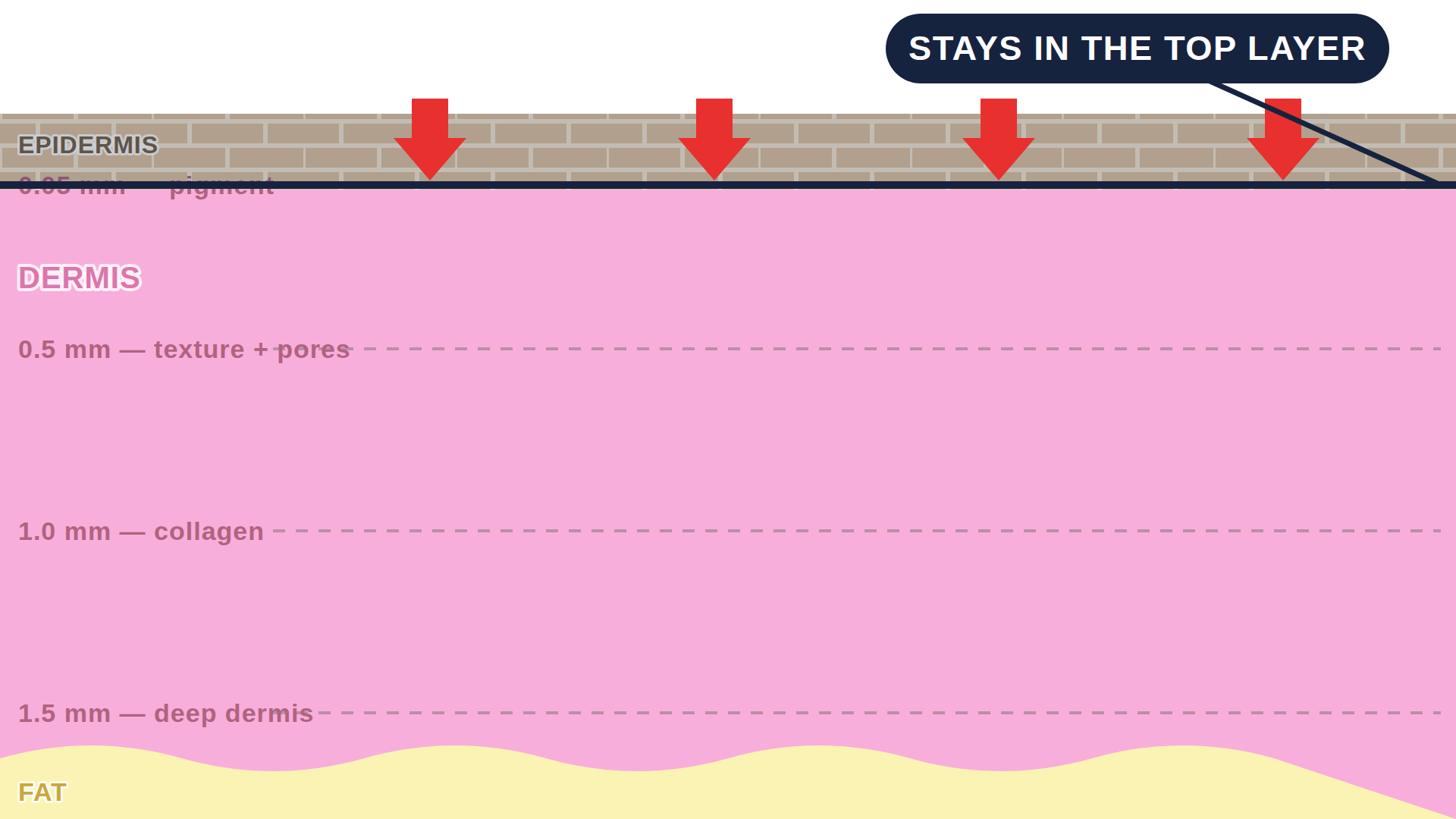
Surface work, not resurfacing
The work happens on the stratum corneum, the layer of dead cells at the very top of your skin. Do not expect it to change scars, deep lines or sagging.
Hydrofacial
The same ceiling
Changing the machine does not change how deep the treatment goes. Neither version is a peel, a laser or microneedling.

Limited evidence. The dry version of the same idea, sanding the surface instead of using liquid and suction. Slightly more abrasive, no serum step, generally cheaper.

Moderate evidence. Reaches the deeper layer and works on indented scars and texture. Real downtime and real discomfort, for a different order of result.
Hydrafacial
The consumables and the sequence
Tips are single-use and bought from the maker, and the serums are the company's own. How rough it gets is still the operator's call.
Hydrofacial
Nothing, formally
Tip design, solution strength, suction and order are set by the clinic. Two hydrofacials may share nothing but the name.
Hydrafacial
An hour or two of pink skin
Most people feel a scratchy or stinging sensation during the treatment. Afterwards the skin can feel tight and look pink for an hour or two.
Hydrofacial
The same, with more variability
Stronger suction or a stronger acid means more redness, and more chance of small round bruises. That is a settings question, not a brand one.
Hydrafacial
About $200, from self-reported reviews
RealSelf puts the average around $200. That comes from a few hundred Americans saying what they paid. Some paid over $300. It is not a survey of clinics.
Hydrofacial
Usually cheaper, no published figure
Generic hydrofacials usually cost less, because there is no branded tip or serum to buy. No reliable average has been published for them.
Hydrafacial
A pore vacuum is not this treatment
Handheld pore vacuums apply suction and nothing else. There is no abrasive tip and no fluid, so the skin is pulled at rather than exfoliated. Suction alone can leave round bruises.
Hydrofacial
The same gap, for the same reason
The generic clinic version is the cheaper option here. A home device is not. Machines that do both jobs at once are clinic machines.
Hydrafacial
Hydrofacial
Hydrafacial
HYDRAFACIAL is a registered US trademark, Registration No. 6479166, filed by Edge Systems LLC and registered on 7 September 2021. A clinic without a genuine machine cannot sell the service under that name, so it sells a "hydrofacial," an "aqua facial" or a "hydrating facial" instead.
Common questions
Most pages calling a hydrofacial a lesser treatment are written by clinics that own a HydraFacial machine. That does not make the point false. Tip quality, training and support really do differ. It does mean the argument comes from a seller.
The claim that crosses the line is the regulatory one. Clinics say a generic machine is "not FDA approved like HydraFacial is". In the way that matters, their status is the same. Neither has been reviewed by the FDA.
The FDA puts powered dermabrasion devices in Class I, under product code GFE, "powered dermabrasion brush," 21 CFR 878.4820. That category is exempt from 510(k) review, so there is no K-number to look up for either kind of machine. Exempt is not unregulated: registration, listing, quality rules and the ban on false labeling still apply.
The clearances the maker does hold are for other products: the Del Sol Blue Light Therapy System (K061470, 2006), the Del Sol Red Light Therapy System (K072399, 2008), and Edge Systems Sterile Tubing (K990748, 1999). None is the facial device. An advertised "FDA-cleared HydraFacial" describes something the FDA never reviewed.