Genius RF
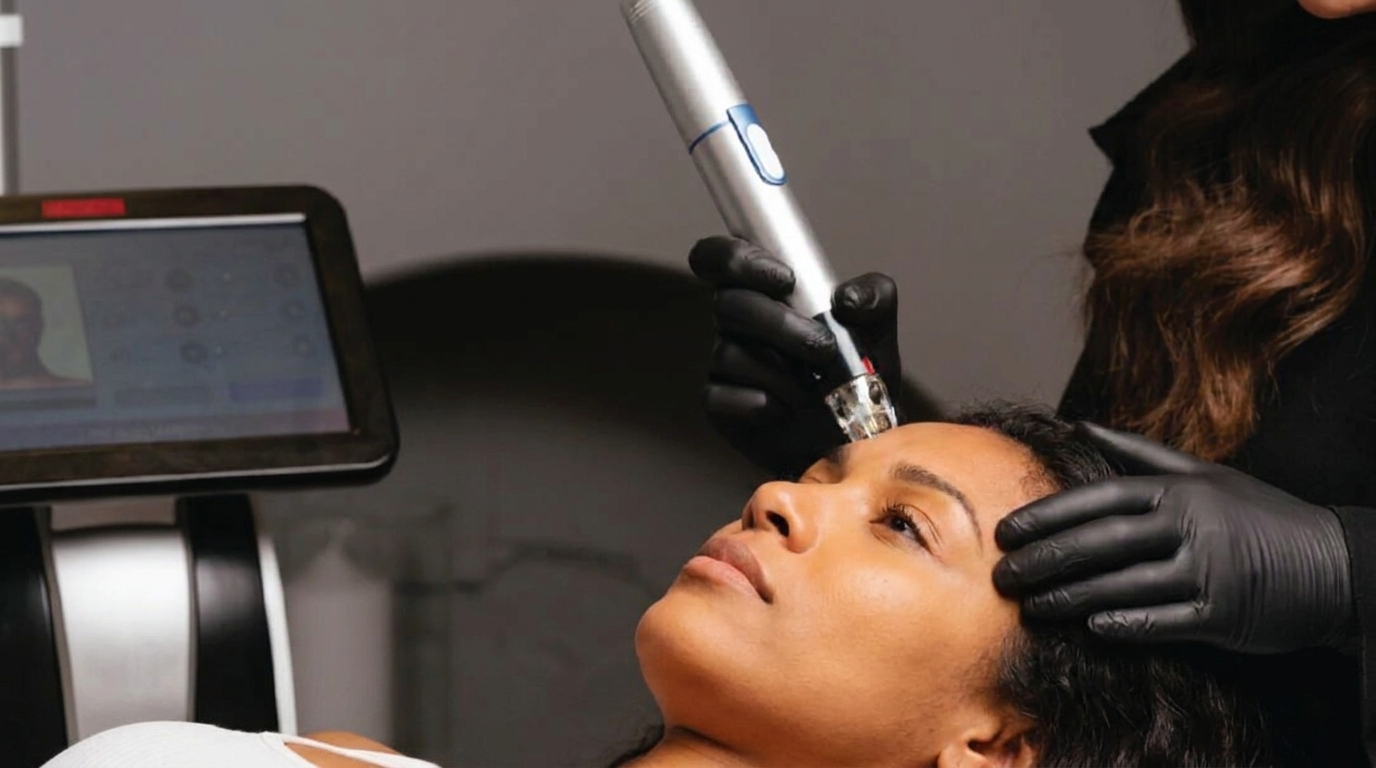
The Genius RF handpiece places needles through the skin and heats from the tip. The screen behind it shows the depth and energy being used for that pass.
Both machines drive fine needles into the skin, then heat the tissue from the inside. The clearest difference is depth: Genius reaches about 3.5 to 4 mm, while Morpheus8 tips are listed to 7 mm. Almost none of the research shown for either device was actually run on either device. Neither is cleared for wrinkles, scars or tightening.
| The difference | Genius RF | Morpheus8 |
|---|---|---|
| What it is | Insulated needles, radiofrequency | Insulated needles, radiofrequency |
The Genius RF handpiece places needles through the skin and heats from the tip. The screen behind it shows the depth and energy being used for that pass.
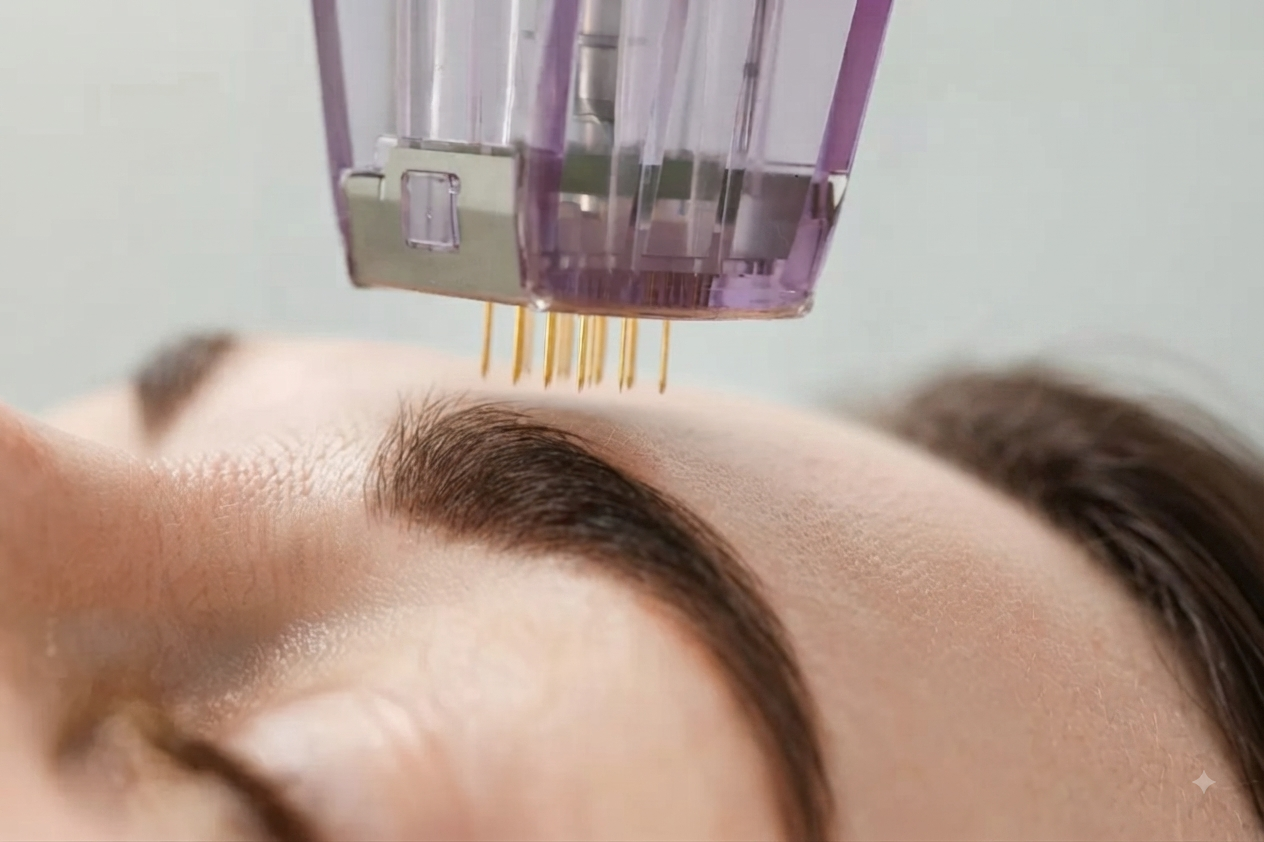
The Morpheus8 tip up close. The gold pins are what carry the radiofrequency energy below the surface — the needles are the delivery route, not the treatment itself.
Side by side
Genius RF
Insulated needles, radiofrequency
49 needles in a 7 by 7 grid on a 10 by 10 mm tip. A 2026 update lists tips of 49, 16, 14 or 25 needles.
Morpheus8
Insulated needles, radiofrequency
Tips of 12, 24 and 40 pins. Each pin is coated except for the last 0.5 mm.
Genius RF
Bipolar radiofrequency at 460 kHz
Bipolar means the current stays between electrodes inside the tip. It does not travel through the body to a return pad. The shaft is coated, so the bare tip does the work.
Morpheus8
Bipolar radiofrequency at 1 MHz
The needles are coated except for the last 0.5 mm. The console it runs on is rated to a maximum of 65 watts.
Genius RF
0.5 to 3.5 mm, 4 mm in the 2026 version
Morpheus8
Up to 7 mm on the largest tips
A fixed 0.5 mm resurfacing tip, 1 to 4 mm on the 12-pin tip, and up to 7 mm on the 24 and 40-pin tips.
Genius RF
Not stated by the maker
The maker gives no session count. Published protocols in this field cluster at three sessions, three to eight weeks apart.
Morpheus8
3 to 5 sessions, 3 to 6 weeks apart
The operator manual says 1 to 6 treatments, usually 3 to 5. Sessions are 3 to 6 weeks apart.
Genius RF
Reported for the class, not the badge
Reported problems for this class of device are texture changes, pigment changes and fat loss.
Morpheus8
Reported for the class, not the badge
The same list applies. Neither device has its own safety record in published research.
Genius RF
No home version
Home radiofrequency wands press against the surface of the skin. They have no needles, so nothing carries the energy down to the depths this machine is set to.
Morpheus8
No home version
Home microneedling pens and rollers make punctures with no radiofrequency at all. A device that only pricks the skin is a different treatment, not a weaker version of this one.
Genius RF
Morpheus8
Genius RF
Genius is marketed on real-time impedance feedback. The idea is that the device reads the electrical resistance of the tissue as the needles go in, then adjusts the energy to suit. That is the maker describing its own product. It is not confirmed in the FDA paperwork, which does not describe an automated feedback system.
Genius RF
Genius has one published study of its own. It treated 23 older patients once on the forearm for senile purpura. Collagen, elastic fibre and skin thickness "tended to improve" but did not reach statistical significance. 65% were very satisfied. It was one small trial with no comparison group.
Morpheus8
Morpheus8 has no trial of its own to point to. More broadly, the studies that built the case for radiofrequency microneedling ran on other machines. The evidence belongs to the class, not to a badge.
Genius RF
Genius is made by Lutronic and was cleared against Lutronic's older Infini. Morpheus8 is made by InMode and was cleared against InMode's older Fractora; its FDA device name is "the Morpheus8 (Fractora) Applicators".
Neither device is cleared for wrinkles, acne scars or tightening. Genius is cleared for electrocoagulation and hemostasis (K180945, December 2018) — surgical language for sealing tissue and stopping bleeding. The 2026 update (K253484, June 2026) adds one word: contraction. Morpheus8 carries the same base wording (K192695, December 2019), then coagulation or contraction of soft tissue (K231790, July 2023).
A 510(k) clearance is not a finding that a device works. It means the FDA agreed the device is much like one already on the market. Treating wrinkles or scars with either one is off-label. That is legal, routine and very common. It is worth knowing when a clinic says a treatment is "FDA cleared for" something.
Only one of the two carries a skin type limit. Above 62 millijoules per pin, Morpheus8 is limited to Fitzpatrick skin types I to IV. The Genius clearance states no skin type restriction.
Genius RF
Ask for the total Genius RF course price for your treatment area, with numbing and follow-up itemized.
Morpheus8
Ask for the total Morpheus8 course price for the same area and goal. A lower per-session quote may not mean a lower total.
Common questions
RF microneedling can cause serious injury. The FDA has received reports of burns, scarring, loss of fat, nerve damage and disfigurement. Some injuries have needed surgery or other medical treatment. A few days of expected redness is not the full risk picture.
Choose a licensed medical professional trained on the device. Discuss the risks and other treatment options before deciding. RF microneedling should not be done at home.