Endolift

Endolift works from a fibre placed under the skin. The red glow on the neck is the aiming light showing where the fibre sits.
The real difference is whether anything enters your skin. Endolift passes a thin laser fibre under the surface through a needle entry point, and heats the tissue from the inside. Ultherapy stays outside, focusing ultrasound through intact skin to a point below it. One is a small procedure with a short recovery; the other is a treatment with almost none.
| The difference | Endolift | Ultherapy |
|---|---|---|
| Downtime | Several days, up to about two weeks | Essentially none |
Endolift works from a fibre placed under the skin. The red glow on the neck is the aiming light showing where the fibre sits.
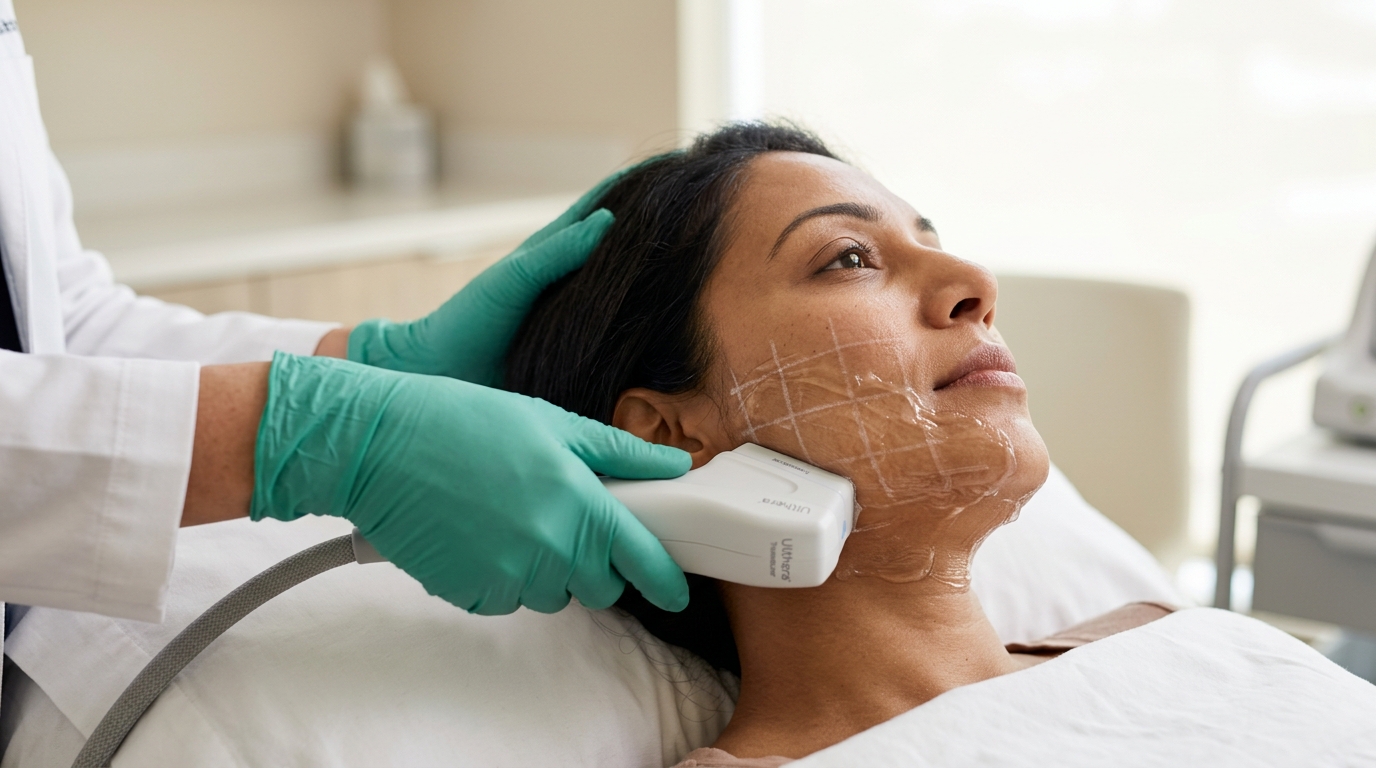
Ultherapy is guided by ultrasound. Gel is spread first so the applicator can image the layers underneath and place the energy at a set depth.
Side by side
Endolift
A procedure, under local anaesthetic
A thin fibre is threaded under the skin through a needle entry point, then drawn through the layer just beneath it.
Ultherapy
A treatment, nothing enters the skin
The device is held against the surface. No entry point, no anaesthetic.

Focused ultrasound heats a deep layer to tighten it, aimed at the jaw, neck and brow rather than at lines. The change is modest and takes three to six months to show, and it is nothing like a surgical lift. It can be uncomfortable, and results vary enough that it is worth seeing a provider's own before-and-after photographs.
Endolift
Laser light from a fibre in the tissue
The 1470 nm light is soaked up by water, and to a degree by fat, so the heat stays close to the fibre tip. That gives local heating, a small amount of fat reduction, and tightening of the fibrous bands and the underside of the skin.
Ultherapy
Ultrasound focused to a point below
It works like a magnifying glass focusing sunlight. At the focal point the tissue reaches roughly 60 to 70 degrees Celsius, making small columns of denatured collagen. The surface is spared. Healing pulls those points together over the next two to six months.
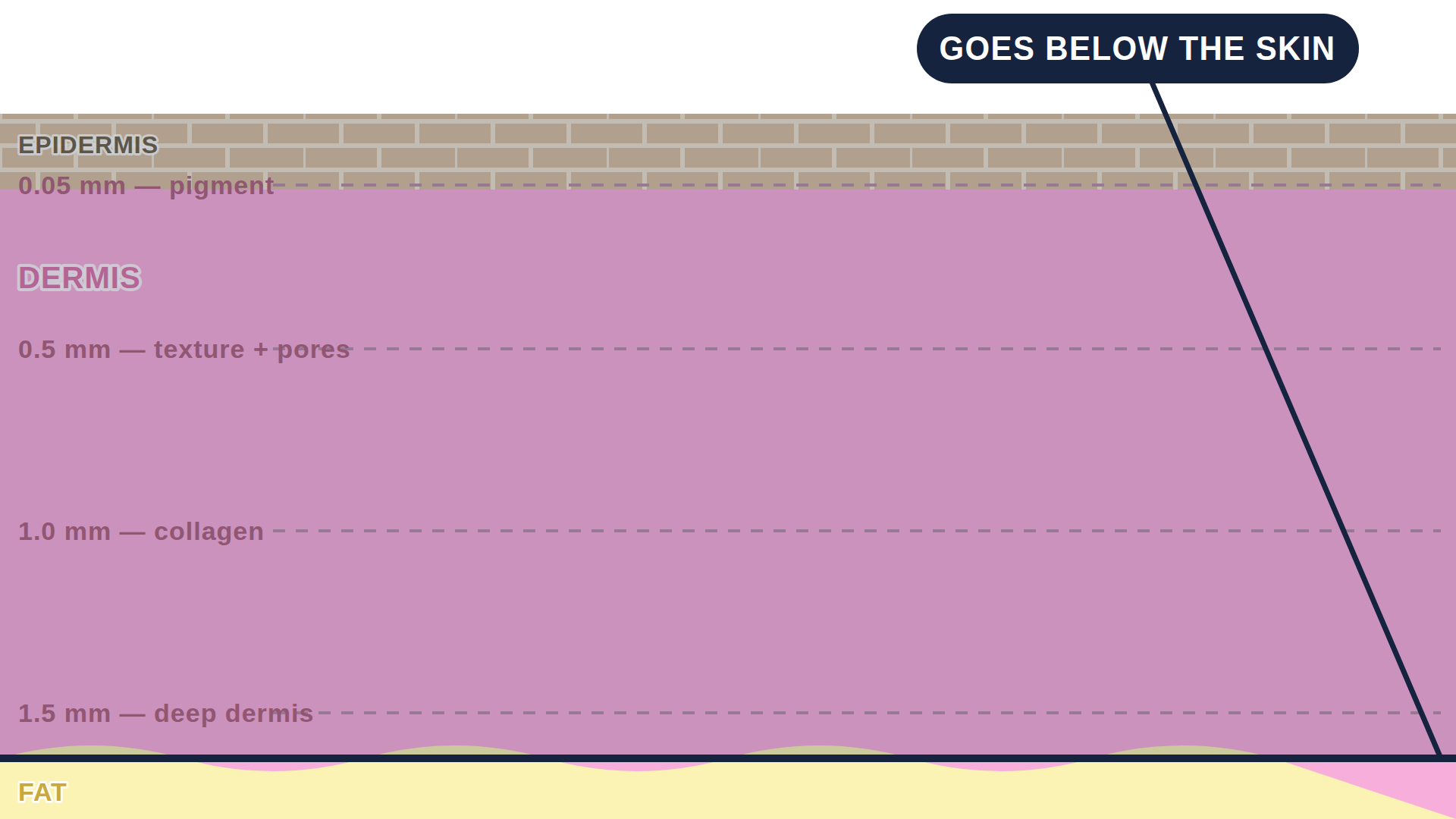
Endolift
Under the skin, where the fibre sits
The layer just beneath the skin, and the fat right under it.
Ultherapy
Up to about 4.5 mm, through the skin
Its three transducers reach the upper skin, the deep skin, and the sheet of muscle and fibrous tissue below, the SMAS.
Endolift
No published trial to point at
No clinical trial of Endolift was found in the published literature. So nothing here says how well it performs.
Ultherapy
It cannot remove fat
It cannot treat surface texture or scarring either. It makes no channel in the skin, so nothing can be delivered through one.
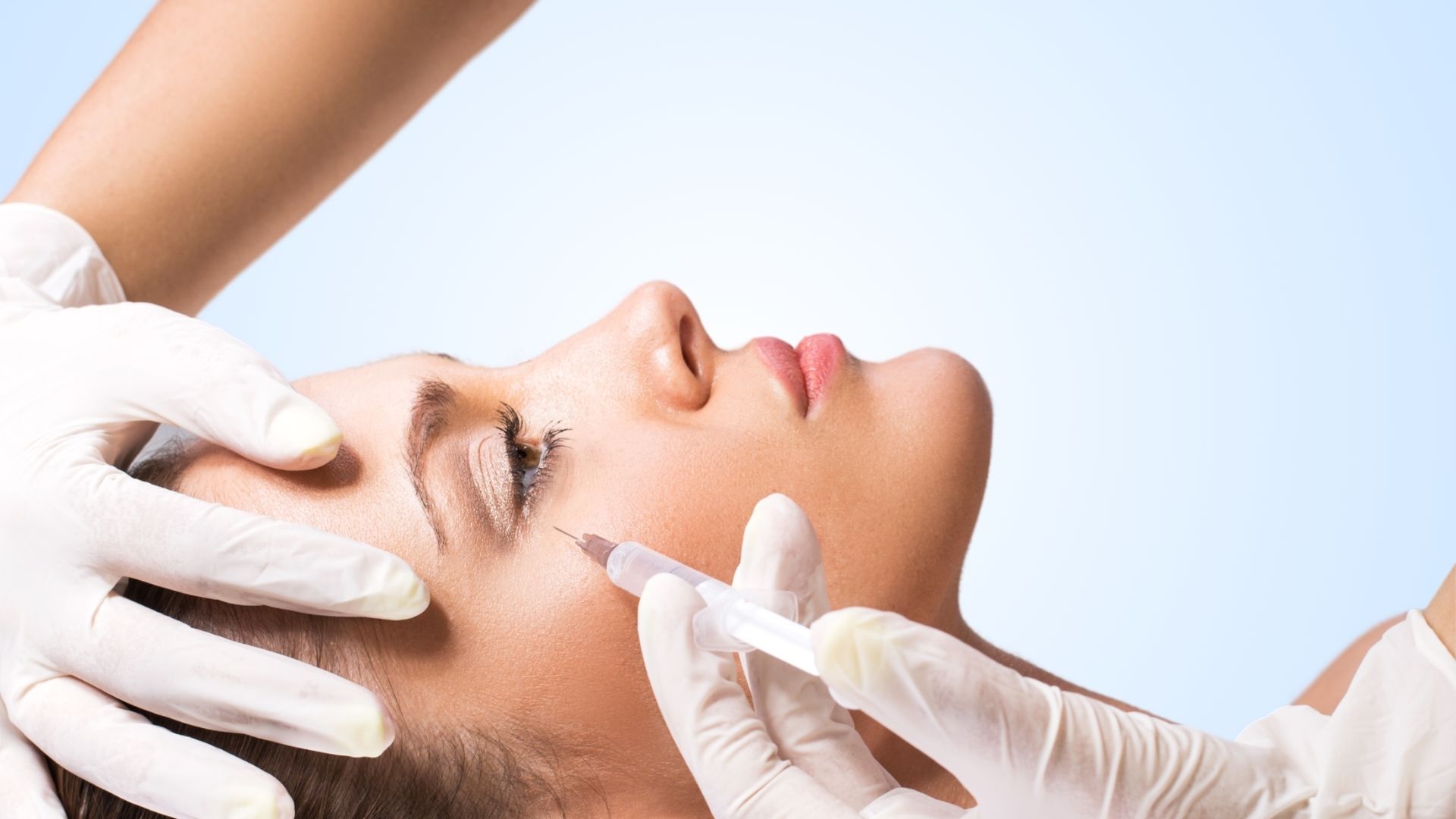
Strong evidence for lines caused by movement, and no effect on laxity. Frequently done alongside rather than instead.
Endolift
Several days, up to about two weeks
Entry-point marks, swelling and bruising.
Ultherapy
Essentially none
Redness, swelling and tenderness that pass. Sometimes bruising or short-lived numbness.
Endolift
Done under local anaesthetic
A fibre is being passed under the skin, so the area is numbed first.
Ultherapy
Pain during the treatment itself
That is the main complaint people report.
Endolift
There is no home version
Nothing you can buy places a fibre under your skin. Any device sold for home use works on the surface only.
Ultherapy
Home ultrasound and lifting wands
A home wand puts a fraction of the power into the surface. It never reaches the depth the clinic device works at. Creams sold for lifting sit on top of the skin. The layer both of these treatments aim at is several millimetres down.
Endolift
Ultherapy
Endolift
Endolift can reduce a small amount of fat. The fibre is placed in the tissue, so it works in the layer where the fat sits. A surface device does not reach it.
Ultherapy
Ultherapy leaves no wound. The energy passes through intact skin, so there is no entry mark and no route for infection. Endolift is done through the skin, with everything that implies.
Endolift
The Endolift laser is cleared for surgery, not for lifting. Eufoton holds two US clearances, K092860 in 2010 and K260489 in 2026, both under the general surgical laser product code. The 2026 clearance describes a 1470 nm diode laser running at a maximum of 15 W. Its cleared uses are vaporisation, incision, excision, ablation, cutting, hemostasis or coagulation, and laser-assisted lipolysis, across plastic and aesthetic medicine, ENT, gynaecology and neurosurgery. Skin tightening, skin laxity and lifting appear nowhere in that text, and a search of the FDA clearance database for the device name Endolift returns no matches.
Ultherapy
Ultherapy's authorisation names lifting outright. Ulthera, from Merz, was granted a De Novo request, DEN080006, on 11 September 2009. The current wording is to lift the eyebrow, lift lax submental and neck tissue, and improve lines and wrinkles of the décolleté. A February 2025 clearance, K243035, added skin laxity on the abdomen and the front and back of the arms. Its imaging is separately cleared to see up to 8 mm down. The transducer depths (10-1.5, 7-3.0 and 4-4.5) come from the transducer names used in FDA testing, not from the approved wording.
Endolift
Ask what the Endolift procedure quote includes: treatment area, anesthesia, clinician fees and aftercare.
Ultherapy
Ask which Ultherapy areas and follow-up the quote covers. Compare the whole procedure plans and the recovery time you would need to set aside.
Common questions
Ask what the device is cleared for. If a US clinic advertises FDA-cleared Endolift, ask for the number and read what it covers. The laser is cleared. The lifting use it is sold for is not.
Ask who is performing it, and where. Endolift is mostly performed outside the United States. Where it is done in the US, it is off-label use of a cleared surgical laser. Off-label treatment is legal and routine in medicine. It simply means no regulator reviewed this device for this purpose.
Ask what the entry points will be, and how many. A fibre is passed under your skin under local anaesthetic. That makes this a procedure rather than a surface treatment.