DiamondGlow

DiamondGlow does three things in one pass. It exfoliates, suctions and delivers serum.
DiamondGlow is diamond-tip microdermabrasion with a branded serum added in the same pass. It is one company's machine, with set serums, set tips and a set protocol. Microdermabrasion is the same abrasion without the serum step. No trial has compared the two.
| The difference | DiamondGlow | Microdermabrasion |
|---|---|---|
| Cost | No reliable published price | Two weak survey figures |
DiamondGlow does three things in one pass. It exfoliates, suctions and delivers serum.

Microdermabrasion sands the top layer of skin with a wand and suction.
Side by side
DiamondGlow
A wet diamond tip, plus a serum
The tip sands the skin inside a film of fluid. Suction pulls the debris and used fluid away. A named SkinMedica serum is left on skin that has just had its outer layer disturbed.
Microdermabrasion
A crystal or diamond tip, then vacuum
Crystal machines fire tiny crystals at the skin and vacuum them back. Diamond-tip machines use a grit wand and vacuum. Either way, the machine takes off dead cells and debris. You apply whatever the clinic stocks afterwards.
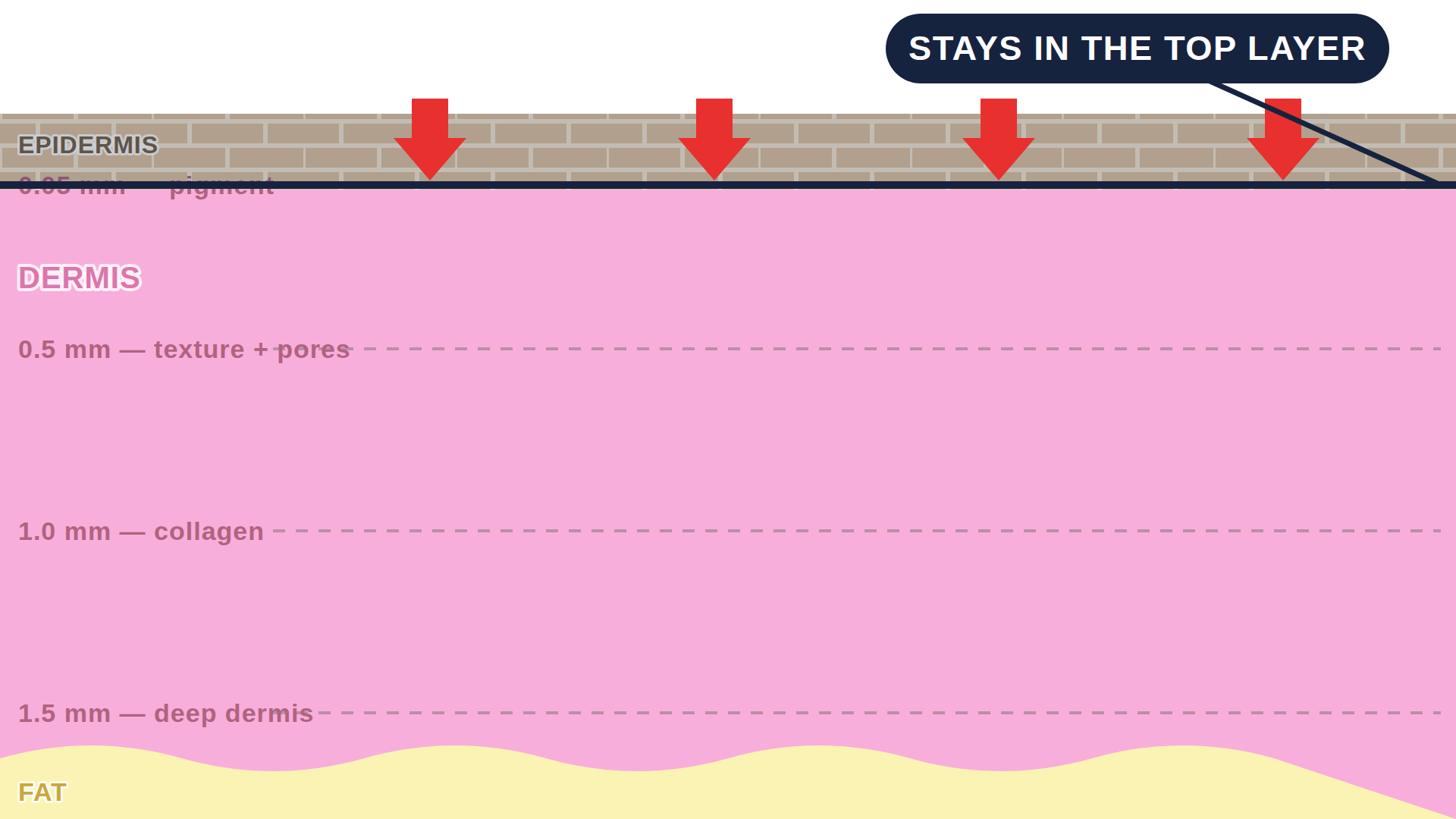
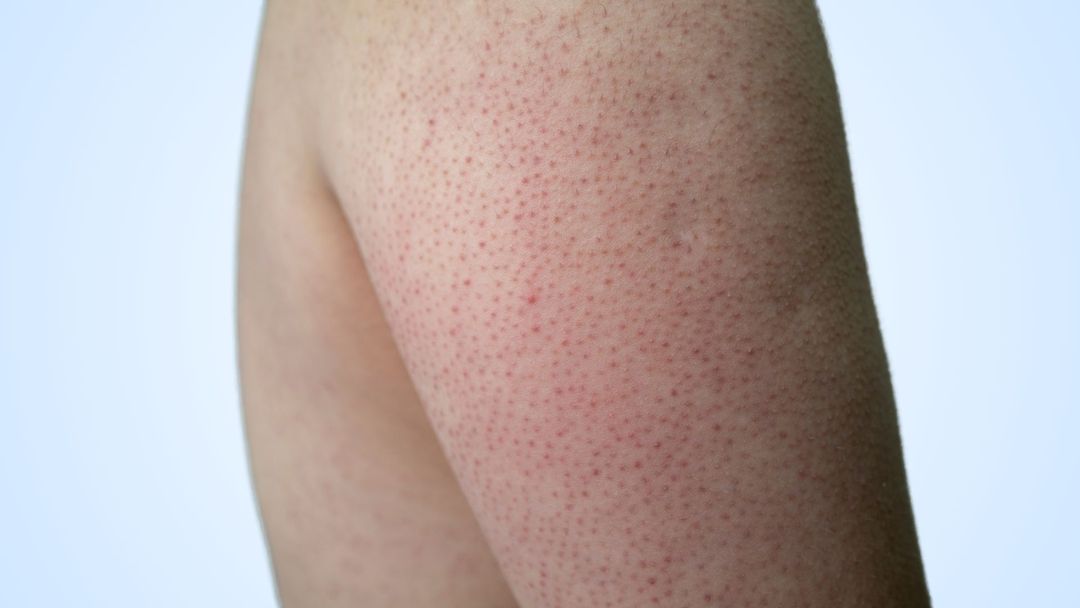
Sanding the surface has the same problem as a body scrub: the plug sits inside the follicle, below where it reaches. Any smoothness is short-lived, and it adds redness. On deeper skin tones the irritation can leave dark marks, so it is one to skip.

Sands off the very top of the skin, which is above where the pigment actually sits, so it does little for brown marks and nothing for gray ones. Repeated sessions add friction and inflammation to skin that marks easily. Money spent here is better spent on daily sunscreen and a treatment that reaches the pigment cells.

Polishes off the very top layer of skin, which makes it briefly smoother and brighter. The pigment in a sun spot is held in ridges below that layer, so it is not reached. It is often sold as a treatment for spots and it is not one, and repeated sessions can irritate skin enough to leave marks of their own.

It polishes the surface layer, and the tear that made the stretch mark is well below that. It is commonly sold as a stretch mark treatment and the published results are minimal. If a clinic is offering this as their answer, it is worth asking what else they do.

Sands off the outer dead layer, so skin feels smoother and looks brighter for a few days. It does not reach the dermis, which is where wrinkles are, so it does not change them. Pleasant, safe on most skin, and frequently sold as an anti-aging treatment when it is not one.

Polishes the very top layer of skin, which is nowhere near deep enough to reach the collagen that makes a scar. It can leave skin looking brighter for a few days. It is widely sold for acne scarring and it does not change acne scarring.
DiamondGlow
Smoother, brighter skin
In the largest study, 29 women had six treatments over 12 weeks with a growth factor serum. Raters said fine lines, smoothness and radiance all improved. But the maker ran the study and there was no control group. The same women also used the serum at home twice a day for 12 weeks. So it cannot tell you how much the machine did.
Microdermabrasion
The same surface smoothing
Microdermabrasion has a much bigger published record. One study found three passes did no better than two.
DiamondGlow
Not a drug, by the maker's own account
The maker says its serums are meant to be cosmetics. They are not drugs, and are not meant to treat disease. Its own site calls the machine a general dermabrasion device. It takes off the top layer of skin and puts serums on it.
Microdermabrasion
Limited for pigment problems and acne
A review found microdermabrasion can smooth rough texture. It can also help skin take up some medicines. It does little for dark marks or acne.

Moderate evidence. Aimed at indented scars and texture, which microdermabrasion does not touch. More downtime per session, more cost, and usually done once active acne is controlled.
DiamondGlow
Six sessions, two weeks apart
That is the schedule every published protocol used. Skin looks smoother and brighter the same day.
Microdermabrasion
About six sessions, often weekly
Weekly is the most common published gap, usually six sessions. On a generic machine, the interval is set by whoever owns it.
DiamondGlow
Stinging, then tightness and redness
The company describes a scratchy, stinging feeling during treatment. After it, skin can feel tight and look red or a little puffy. It calls serious problems uncommon. The rare ones it lists are bad irritation and allergic reactions. Two FDA injury reports are on file. One was red streaks on the neck and under one eye. One was an allergic reaction to a serum used during treatment.
Microdermabrasion
Redness for a day, plus crystal dust
Redness is usually gone within a day. Crystal versions spray loose dust near the eyes and airway, so eye protection is standard.
DiamondGlow
No reliable published price
No professional society reports a fee for it. The maker publishes no price. Clinic menu prices are set by the businesses selling the treatment.
Microdermabrasion
Two weak survey figures
One consumer survey put the average at $177. A 2020 survey of providers put it at $167. Neither tells you much about the machine you will be treated with.
DiamondGlow
No home machine does the serum step
The whole idea is a serum put onto skin at the moment it is sanded, inside a film of fluid. No home device does that. Rubbing a serum on after a scrub is not the same treatment.
Microdermabrasion
Scrubs and handheld vacuums
A home scrub or small suction wand works on the very surface. It has far less power and no controlled tip.
DiamondGlow
Microdermabrasion
DiamondGlow
There is no 510(k) for DiamondGlow, and the manufacturer does not claim one. There is none for Dermalinfusion or SilkPeel either. Allergan Aesthetics holds Class II clearances for unrelated products, and those belong to those products, not to this one.
Common questions
You are buying consistency, not a different mechanism. A known serum. A written plan. Single-use tips. Published safety information, and a company big enough to answer the phone.
A known formula is worth something. Professional serums do not have to list their ingredients for you. At many clinics you do not know what is going on your skin. The maker publishes what its serums are.
So is a service network. FDA reports in this device category include damaged power supplies and bare wiring. A maker that services its own machines is a real check on quality.
None of that means a better result. No study shows the branded machine does more for your face than a well-kept generic one in good hands. That comparison has never been run.
Tell your provider about any allergy, including to skincare ingredients. A serum goes onto skin that has just been sanded.
Say at booking if you get cold sores. Antiviral medicine is started in advance, so it has to be prescribed before the appointment.
Skip either treatment if your skin is broken, sunburned or inflamed. The maker warns against treating damaged skin.
Ask what machine is used, whether the tip is new, and what goes onto your skin. If a clinic calls the machine FDA cleared or FDA approved, that is not accurate for either device here.
Both machines are the same class of FDA device, and that class is exempt. Allergan lists DiamondGlow with the FDA as a Class I powered dermabrasion device, product code GFE, 21 CFR 878.4820, exempt from premarket review. Every generic microdermabrasion machine sits in the same place. Powered dermabrasion devices were exempted from premarket notification in 1998, and manual ones in 1994. No microdermabrasion machine has FDA-cleared indications for use.
Ownership. DiamondGlow is the rebrand of Dermalinfusion, which began as SilkPeel from Envy Medical. Allergan acquired Envy Medical in March 2019, and the platform now sits under the SkinMedica brand inside Allergan Aesthetics. The FDA listing still carries the earlier names.
General controls still apply on both sides. Those are registration, product listing, manufacturing quality rules, adverse event reporting and a ban on false labelling. Roughly 158 devices are listed under this product code, from large aesthetics companies to imported skin scrubbers and blackhead vacuums. The branded platform and the cheap imported machine have the same regulatory status.