Sculptra

Sculptra is a course of injections done in a clinic. You go home the same day, and your body slowly lays down new collagen over the following months. Fat transfer is surgery. A surgeon suctions fat from elsewhere on your body by liposuction, then grafts it into your face under anaesthetic — and nobody can tell you how much of it you will keep.
| The difference | Sculptra | Fat transfer |
|---|---|---|
| Cost | Paid per session, over a course | Priced as surgery, not as an injection |
| What the research behind each one looks like | Sculptra has two randomised trials behind its approvals. | Fat transfer has no trials of that kind. |
An operation with two healing sites Fat is suctioned from a donor site, processed, then injected into the face in small amounts. It needs a surgical setting and sedation or anaesthesia. You heal in two places: where the fat came from, and where it went.
Side by side
Sculptra
3 or 4 injection sessions
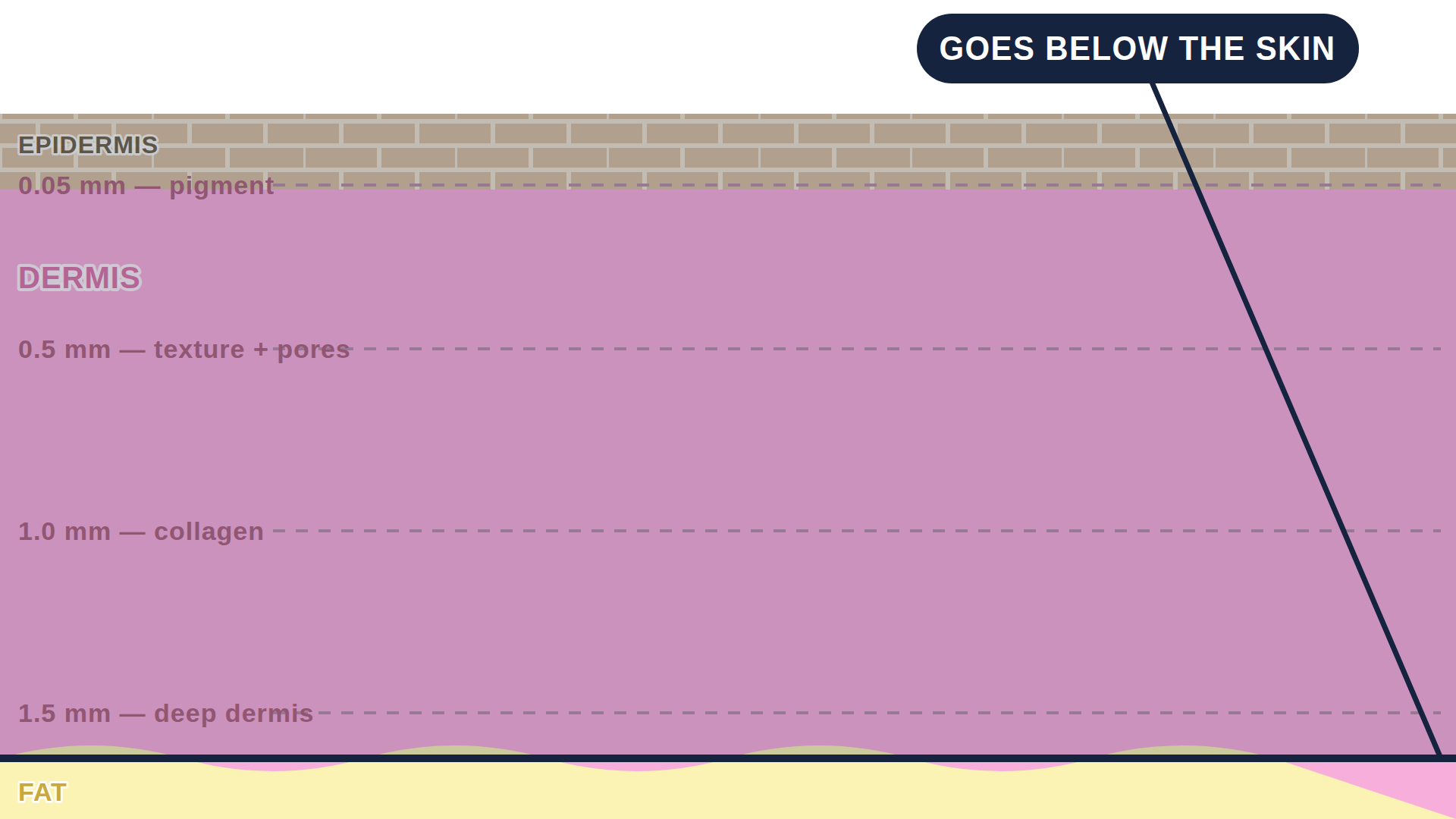
Sculptra is injected into the deep skin. It is a clinic appointment, not an operation, and most people have a course of three or four.
Fat transfer
An operation with two healing sites
Fat is suctioned from a donor site, processed, then injected into the face in small amounts. It needs a surgical setting and sedation or anaesthesia. You heal in two places: where the fat came from, and where it went.

A collagen-stimulating injectable given as a course, usually three sessions. Nothing looks different straight away; volume builds gradually over several months and lasts around two years. It suits overall thinning and flatness rather than a single line, and it cannot be dissolved, so it is a slower and less reversible decision than filler.
Sculptra
More fullness in the treated area
Nothing looks fuller on the day. The particles are a scaffold. The volume comes from collagen your body lays down around them.
Fat transfer
More fullness, from your own fat
The fat is placed in small amounts, and the fullness is there straight away. Then some of it goes.
Sculptra
Weeks to months after each session
Each session builds on the last, and there are usually three or four.
Fat transfer
Straight away, then it settles
Scans show retention falling over roughly the first three to six months, then levelling off.
Sculptra
It cannot be dissolved out
No reversal agent is approved for PLLA. Hyaluronidase breaks down hyaluronic acid fillers, but it has no target here.
Fat transfer
It cannot be dissolved out either
Grafted fat cannot be dissolved. It can be removed surgically, and it responds to your own weight changes.
Moderate evidence. The other common biostimulator. It adds volume the same day as well as building collagen, and typically lasts about 12 to 18 months rather than two years. Also not reversible.
Sculptra
Still working at one year
In the cheek trial, 71% of treated people met the responder mark at month 12, against 26% of untreated controls.
Fat transfer
About half the fat survives
Pooled across studies, retention averaged 47%. Whatever survives and grows a blood supply is long lived.
Sculptra
Bruising and swelling for days
In the cheek trial, 21% had a side effect linked to treatment. Bruising at the injection site was the most common, at 11%. About 1 in 100 developed small lumps under the skin, usually felt rather than seen.
Fat transfer
Weeks of recovery in two places
Swelling and bruising at the donor site and the face. Firm painless lumps, fat necrosis and oil cysts are described weeks to months later. Repeat sessions and frozen fat are named risk factors.
Sculptra
Injection into an artery
Filler entering an artery can block blood supply and, rarely, cause blindness. PLLA cannot be dissolved out.
Fat transfer
The same risk, and severe published cases
A review of published reports found 58 complications in 38 patients. 32 were severe or permanent, including vision loss in 7. Most followed injection into the forehead or temple.
Sculptra
Paid per session, over a course
Priced per appointment, and most people have three or four of them.
Fat transfer
Priced as surgery, not as an injection
The bill covers a surgical setting and anaesthesia as well as the graft itself.
Sculptra
No home version exists
Sculptra is placed millimetres down in the deep skin. Creams sold as collagen boosters sit on the surface, so they cannot reach that depth.
Fat transfer
No home version exists either
Fat transfer needs liposuction and a surgical setting. Nothing sold over the counter moves fat from one part of your body to another.
Sculptra
Fat transfer
Sculptra
Sculptra has two randomised trials behind its approvals. People were assigned at random, and the people scoring the results did not know who got what. Follow-up ran to about two years in each.
Fat transfer
Fat transfer has no trials of that kind. Surgery is not a device, so no maker had to run one. What it has instead is observational studies, case series and review articles.
Sculptra
Sculptra is FDA approved under premarket approval P030050, granted in August 2004 for facial fat loss in people with, or being treated for, human immunodeficiency virus. Cosmetic uses came later: 2009 for nasolabial folds and other facial wrinkles, and 2023 for fine lines and wrinkles in the cheek region. The cheek trial enrolled 149 people at 13 US sites and was sponsored by Q-Med and Galderma Research and Development.
Sculptra is supplied as freeze-dried PLLA powder, reconstituted with sterile water before injection.
Fat transfer
Fat transfer has nothing to approve. Surgery is not a device, so there is no premarket approval route and no regulatory dossier behind it.
No reversal agent is approved for PLLA. Hyaluronidase is approved for hyaluronic acid fillers only.
Common questions