Corn

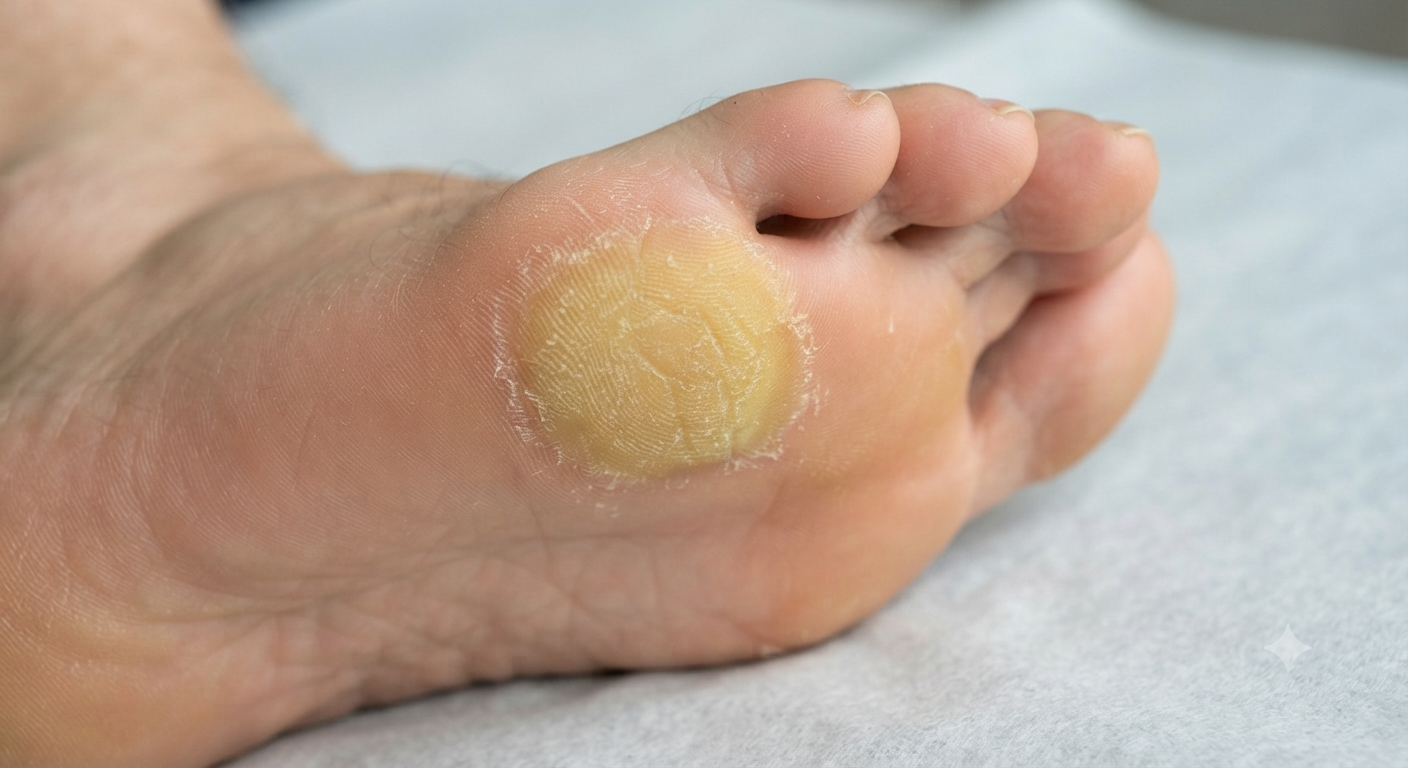
A corn on the ball of the foot. It is small and round with a hard core at the centre — that core is what presses inward and does the hurting.
A corn is small and deep. Pressure lands on one point, so the skin builds a hard core. That core presses inward like a stone in your shoe, and it hurts when you press on it. A callus is broad and flat. Pressure spreads over a wide area, so the skin thickens evenly and usually does not hurt.
| The difference | Corn | Callus |
|---|---|---|
| Does it hurt | Usually yes | Usually no |
| Should you treat it | Yes, if it hurts | Usually leave it |
A corn on the ball of the foot. It is small and round with a hard core at the centre — that core is what presses inward and does the hurting.
A callus in the same area. It is broader and flatter with no core, and the edges fade gradually into normal skin instead of stopping sharply.
Side by side
Corn
Small and round
Usually under a centimetre, with a defined edge and a hard centre you can feel.
Callus
Broad and flat
Can cover several centimetres with no clear border. It fades into normal skin.
Corn
Usually yes
The hard core presses down into the tissue underneath. It feels like standing on a pebble.
Callus
Usually no
It is a protective pad. Most people only notice a callus when it cracks.
Corn
Toes, mostly
Tops and sides of toes, between toes, and the ball of the foot. Shoes that press or rub in one spot.
Callus
Weight-bearing surfaces
Heels, the ball of the foot, palms, and fingers. Anywhere that takes repeated broad friction.
Corn
Both kinds
A hard corn sits on bony spots. A soft corn forms between toes, where sweat keeps it moist and white.
Callus
Hard
Dry, thickened, sometimes yellowish, and it may crack at the edges.
Corn
A pressure point
Narrow shoes, a seam, a bony bump, a toe that sits higher than the others, or the way you walk.
Callus
Repeated friction
Walking, standing, going barefoot, sport, tools, or an instrument.
Corn
Yes, if it hurts
Padding around it, wider shoes, and paring by a professional for quick relief.
Callus
Usually leave it
A callus is doing a job. Treat it only if it is thick enough to crack, or it feels uncomfortable. A cracked heel callus is worth treating, because deep cracks can bleed and let infection in.
Corn
Change the pressure
A wider toe box, cushioned insoles, and a pad that surrounds the corn rather than sitting on it. If the pressure stays, the corn comes back however often it is pared off.
Callus
Soften and reduce
Urea or salicylic acid cream, gentle filing after a shower, and moisturizer. Slowly, not all at once.
Corn
Weeks, if nothing changes
Callus
Ongoing
Corn
Medicated corn plasters are also worth avoiding if you have any circulation or nerve problem. The acid does not know where to stop.
Callus
Do not use a blade, a razor, or a callus shaver. You cannot judge depth by eye. The two most common results are an infection and a wound that takes weeks to heal.
Corn
Common questions
Get professional advice before self-treatment if you have diabetes, poor circulation or a weakened immune system. Seek care for severe pain, bleeding, pus, or a problem that is not improving. Do not cut the hard skin away yourself.