Sofwave
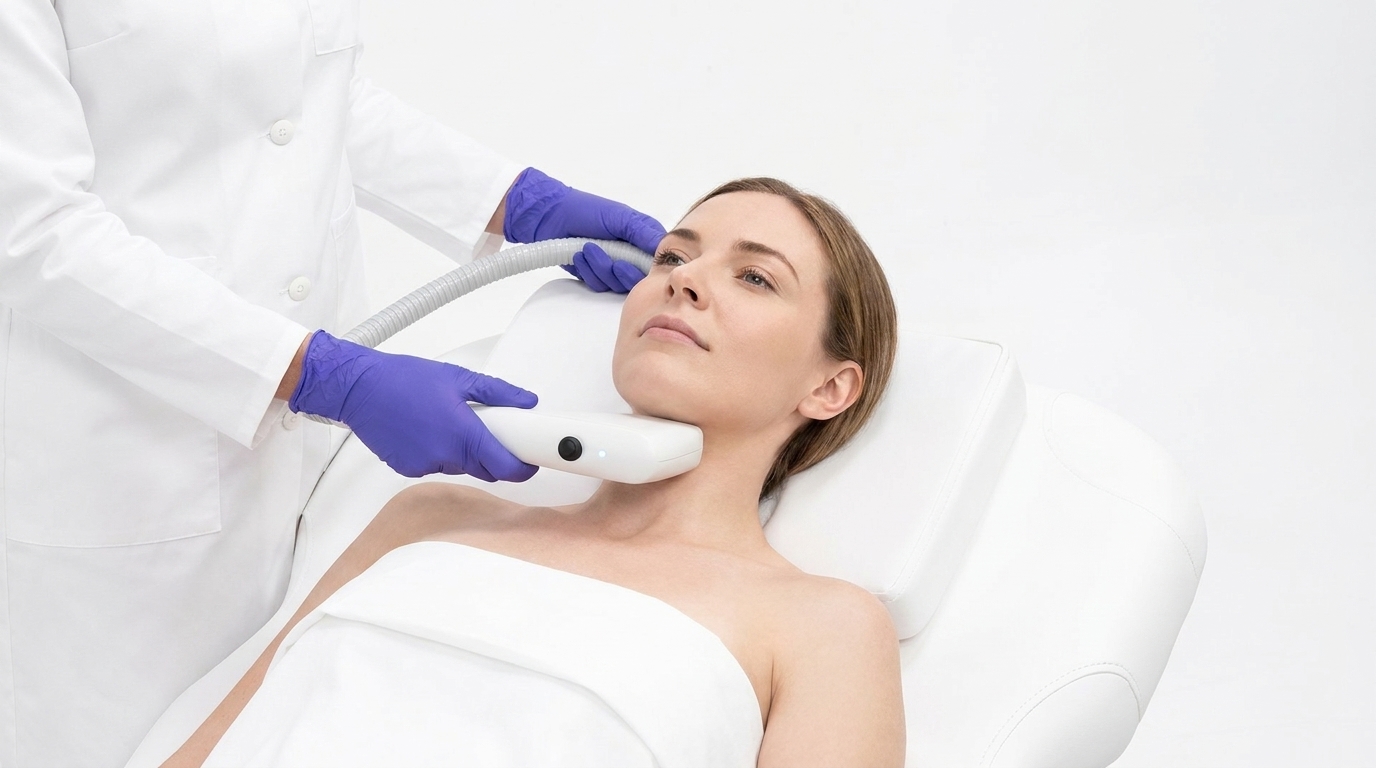
Sofwave puts ultrasound energy just under the surface. The handpiece is stamped across the area.
Sofwave heats a band in the middle of the skin with ultrasound. It is one session of about 30 to 45 minutes, and it is aimed at fine lines, crepey texture and mild slackness. Thermage heats a whole block of skin with radiofrequency instead. It is the older device, it is the one most often used around the eyes, and it is also a single session. Neither one lifts a jowl much, and no published trial has compared them.
| The difference | Sofwave | Thermage |
|---|---|---|
| What it is | Ultrasound heat at a set depth | Radiofrequency heat through the skin |
| What it feels like | Warm, with short prickles | A hot flick, over and over |
| How long until it works | Six to twelve weeks | Two to six months |
| Downtime | None | None |
| Cost | Priced per area, one session | Priced per treatment tip and area |
Sofwave puts ultrasound energy just under the surface. The handpiece is stamped across the area.

Thermage heats the deeper layers with radiofrequency. The tip is stamped across the area.
Side by side
Sofwave
Ultrasound heat at a set depth
Several transducers fire together and warm a band about 1.5 mm below the surface. Nothing enters the skin.
Thermage
Radiofrequency heat through the skin
Current passes through the tissue to a pad on your back. The skin's own resistance to that current is what makes the heat.
Sofwave
A band at one chosen depth
The energy stops in the middle layer of the skin, where collagen sits.
Thermage
A block of tissue, not a plane
Radiofrequency warms a volume rather than a layer. A cooling spray protects the surface while the depth heats.
Sofwave
Firmer, smoother skin
Finer lines, a tidier neck, a slightly cleaner jaw edge. The change is modest.
Thermage
Firmer skin and better texture
Crepey skin, mild slackness and wrinkles, including the thin skin of the eyelids.
Sofwave
It does not reach the deep support layer
Thermage
It cannot be aimed at a chosen depth
Sofwave
Warm, with short prickles
The handpiece cools the surface as it works. Numbing cream is usual and is often enough.
Thermage
A hot flick, over and over
The tip is stamped across the area. Each pulse is a burst of heat with a spray of coolant before and after. Uncomfortable rather than dreaded.
Sofwave
Six to twelve weeks
Some early smoothing in the first month, then a slow build.
Thermage
Two to six months
Collagen contracts a little on the day, then rebuilds slowly.
Sofwave
About a year
Thermage
About one to two years
Sofwave
None
Pinkness for an hour or two, sometimes mild swelling for a day.
Thermage
None
Redness and slight swelling that settle within hours. Make-up on the same day is normal.
Sofwave
Priced per area, one session
Thermage
Priced per treatment tip and area
Sofwave
There is not one
Home ultrasound wands sold for tightening put a small fraction of the energy into the surface. They never reach the layer this device heats.
Thermage
Home radiofrequency wands are far weaker
They warm the top of the skin a little. The clinic device drives current through the full thickness with a return pad, which is a different scale of heating altogether.
Sofwave
Thermage
Sofwave
Sofwave puts its heat in one layer. Ultrasound is aimed at a band in the middle of the skin, and the surface above it is cooled. That makes it predictable and keeps recovery to nothing.
Thermage
Thermage heats a volume instead. Current spreads through the tissue, so the warming is broader and less precise. That is a weakness if you want a specific depth, and a strength if the whole area needs firming.
Sofwave
Sofwave is not an eyelid treatment. It is used on the brow, face and neck, and the eyelid itself is not part of what it is offered for.
Thermage
Thermage is the one routinely used on the eyelids. It has been treating that thin skin for years, using a smaller tip made for the area.
Sofwave
Sofwave's list is a surface one. Redness, small raised welts, and rarely a burn if the settings are wrong.
Thermage
Thermage's known complications come from heat going too deep. Burns and blistering are rare. So is fat loss under the skin, which leaves a small dent. There is no good published figure for how often that happens.
Common questions
Both help a little and neither is a strong answer. Sofwave firms the skin itself and Thermage improves crepey texture, but if the skin hangs in a fold, surgery is the honest comparison.
They are close. Thermage is a repeated flick of heat with coolant between pulses, and Sofwave is a warm prickling under numbing cream. Most people manage either without medication.
Yes. Thermage has a smaller tip made for the eye area and is routinely used there. Sofwave is used on the brow, face and neck rather than on the lid itself.
Sofwave usually shows something at six to twelve weeks. Thermage builds more slowly, over roughly two to six months. Neither gives you much on the day.
Most people who like the result repeat Sofwave about once a year, and Thermage every one to two years. Ageing carries on either way.
Some clinics do, spaced apart. There is no published evidence that combining them beats doing one well, so ask what the second one is meant to add.